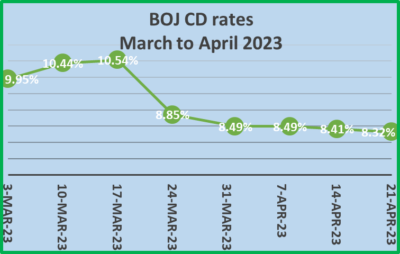
 Bank of Jamaica’s latest CD offer of $20 billion attracted 186 bids amounting to $44,629,464,000, but only 75 bids were successful and resulted in the average yield of 8.32 percent for successful bids, that is down from 8.41 percent at last week’s auction and represents the fourth decline since the rates closed at 10.54 percent for the March 17 CDs.
The lowest bid at this week’s auction was 7.50 percent, down from 8 percent last week and the highest bid was 11 percent, but the highest rate for total allocation was 8.349 percent, with the highest rate for partial allocation being 8.34999 percent resulting in success for 99.30 percent of the amount applied for.
The total nominal outstanding amount for the 30-day CDs on April 21 will be $106 billion.
More decline in interest rates
Government must shake up BOJ
Inflation has moderated substantially since the sharp spike in 2021 and the Bank of Jamaica has some role in it, with tighter monetary policy, but the price may be much greater than may be visible currently. A look at BOJ reports on inflation since 2021 is very worrying, when compared with the actual outcome, suggesting that the MPC that is guiding the BOJ has done a terrible job in its forecasts. This is a matter the Minister of Finance must carefully look at and so correct what is clearly a major area of concern in managing a very critical part of the country’s economy.
 The job of fighting high inflation may be substantially done for this round, how efficiently was it executed is another matter that the country needs to have answered. A careful look at reports emanating from the Bank of Jamaica tells a tale of what looks more like guesswork, than scholarly assessment. Don’t take our word for it, compare BOJ’s utterances since 2021 and their outturn.
Up to April 2021, BOJ fiddled around telling the country that inflation was well under control and that it would remain within the band of 4-6 percent for two years, that’s before they quickly found out that it was not going to be so. Even then rather than acting promptly, they waited until August to announce an increase in the overnight rate, although admittedly they started to pull money out of the market earlier by way of certificate of deposits.
Something must be terribly wrong that within a month of assuring the Minister of Finance that all will be well they had a change of mind. The same thing seems to be happening currently, with inflation set to be within, or very close to the 4-6 percent range in April well ahead of the forecast made by the BOJ at their March meeting when they stated that the target would not be reached until the fourth quarter this year.
The Governor of the Central Bank informed the Ministry of Finance in April 2021, that they could not increase interest rates as that would trim economic growth. But by May 2021, they were singing a different song of higher inflation and forecast for increased rates.
 In May, last year they made an erroneous statement that inflation was still moving higher and would increase over the next two months, in fact the underlying data was suggesting that it was improving. Importantly, at their last meeting at which they reviewed the state of inflation they felt so comfortable that things were in line with their forecast that the next meeting was set for May. Had they looked at the real message that had been screaming at them for 2022 and more so since November they would have taken action to reduce overnight interest rates from then.
The MPC release stated, “Annual inflation is projected to continue to fall to the Bank’s inflation target range of 4.0 to 6.0 per cent by the December 2023 quarter. One-off regulated price adjustments may, however, result in a temporary uptick in inflation.”
“Notwithstanding these positive developments, the MPC noted that the risks to the inflation outlook remain elevated. In a context where the domestic economy continues to grow, labour market shortages carry the potential for future wage adjustments that can put upward pressure on inflation. Higher inflation could also result from a worsening in supply chain conditions and higher commodity prices if there are further geo-political disruptions. Among the factors that could lead to lower-than-projected inflation, weaker-than-expected global growth could negatively affect domestic demand, and some projected adjustments to regulated prices may not materialise.”
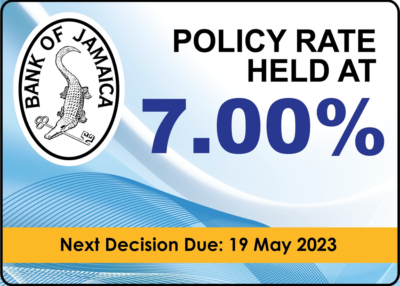
Therefore, to continue underpinning inflation returning to the target range and to underwrite continued stability in the foreign exchange market, the MPC unanimously agreed to hold the policy interest rate at 7 percent, to maintain tight Jamaican dollar liquidity in the money market and to continue fostering relative stability in the foreign exchange market. The Bank’s liquidity management strategy incorporates the impact of the one percentage point increase in the domestic and the foreign currency Cash Reserve Requirements applicable to DTIs, effective 01 April 2023.”
Monthly inflation in Jamaica 2021 to 2023
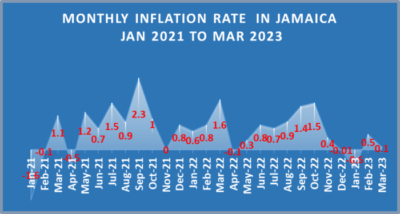
Jamaica is currently enjoying the longest stretch of low inflation from November last year for some time, with the latest reading on inflation being 0.1 percent rise in March this year with an average of 0.08 percent per month or less than one percent per annum. Over the past two years and three months, the rate peaked at 2.3 percent in September 2021.

BOJ must slash the ON rate to 5% now
Bank of Jamaica must make a bold move and cut the Overnight rate they charge banks to 5 percent from 7 percent now and prevent driving the economy into recession, with inflation now within the Bank’s target range and set to fall lower over the next few months.
The cut in rates now is also essential to help pension funds and the fall in the value of many of the interest sensitive assets with the financial market that fell had to be marked down to market, with higher interest rates and impaired capital in some of the country’s banks.
Many observers may credit BOJ with managing the inflation in Jamaica well and bringing it back to their target 4-6 percent range. The problem is that the country is now faced with severely undershooting the lower end of the target, a target this publication thinks should be revised down to 2.5 to 4 percent.
In March, ICInsdier.com published an article captioned “Time come for BOJ to cut interest rates”.
We posited that “Interest rates in Jamaica and around the world were pushed up since 2021 to curb inflation that got out of hand, in the process Bank of Jamaica hiked their overnight rate from 0.50 percent August 2021 to a high of 7 percent in November last year, since then point to point inflation peaked in April last year at 11.8 percent, but has since declined sharply by 34 percent to February this year, with the pace since November last year running at 44 percent below the 2021 period.
The average monthly inflation rate has dropped from the 2022 level of 0.6 percent per month from November 2021 to October 2022. It is now running at an average of 0.2 percent per month or 2.4 percent per annum over the last five months, well below the Bank’s target of 4-6 percent per annum. 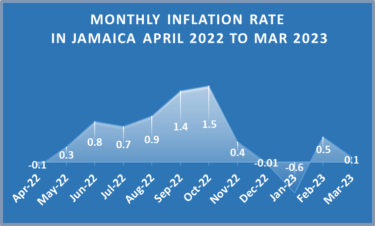 If history is anything to go by, the next three months should see relatively low inflation, suggesting that the current average of 0.2 per month could continue for a few more months. The fall has been consistent, although the rate for a few months exceeded this pace.”
Bank of Jamaica’s target of 4-6 percent is close at hand based on the point to point inflation, with the danger now that the rate could fall well below the lower end of the band if BOJ does not act soon to lower interest rates.
Since then, inflation has remained very low, as we forecasted, with the All-Jamaica Consumer Price Index (CPI) increasing by a mere 0.1 per cent for March 2023.
The big problem is that BOJ MPC members are constantly looking backwards at the point to point inflation and not correctly reading the more critical signals in the data they sent that inflation was killed from 2022.
Inflation now running at just 2% per annum
The All-Jamaica Consumer Price Index (CPI) increased by a mere 0.1 per cent for March 2023, influenced mainly by a 0.8 per cent increase in the index for the heaviest weighted division ‘Food and Non-Alcoholic Beverages the Statistical Institute of Jamaica (Statin) stated in a release today and comes after a 0.5 percent rise in February and a 0.06 percent decline in January.
 According to Statin, “the increase in the index for the ‘Food and Non-Alcoholic Beverages’ division was due to higher prices for agricultural products such as cabbage, Irish potato and sweet potato which contributed to the 2.5 per cent increase in the index for the class Vegetables, tubers, plantains, cooking bananas and pulses. “
“The rise in the CPI was also influenced by the 1.1 per cent increase in the index for the division ‘Restaurants and Accommodation Services’ resulting from higher prices for meals consumed away from home. The inflation rate was, however, tempered by a 1.8 per cent fall in the index for the ‘Housing, Water, Electricity, Gas and Other Fuels’ division and a 0.2 per cent decline in that of the ‘Transport’ division. The movement in the former division was due to lower electricity, water and sewage rates, while lower petrol prices impacted the latter division.”
The point-to-point inflation rate (March 2022 – March 2023) was 6.2 percent just outside BOJ’s upper mandate level.
 This was influenced mainly by the point-to-point inflation rate for the divisions: ‘Food and Non-Alcoholic Beverages’ (10.1%) and Restaurants and Accommodations Services’ (16.9%). These upward movements were, however, tempered by a 1.9 per cent decline in the index for the group ‘Housing, Water, Electricity, Gas and Other Fuels,“ Statin stated.
Inflation has been declining from the latter part of 2021, with the rate since March last year running at an average of 0.416 percent per month and 4.99 percent cumulative. Since November last year, the average monthly inflation has been running at 0.17 percent or just over 2 percent per annum, an urgent signal to the Bank of Jamaica that the time has passed for a serious cut in interest rates.
Interest rates are down again
Interest rates declined in the latest auction of CDs placed on the market by the Bank of Jamaica, with the average rate falling to 8.41 percent from 8.49 percent at the auctions over the past two weeks.
 The rate is slightly ahead of the 91 days Treasury bill rate of 8.136 percent, which was determined at the Treasury bill auction held on April 12 and 8.315 percent for the 182 days Treasury bill.
The central bank offered $17 billion and received offers amounting to $40.7 billion from 275 bids, with 161 being successful, down from the previous week of 351 and 253 successful bids. The lowest bid was at 8 percent, the same as the prior week, and the highest bid was at 11.5 percent, down from 13.5 percent, but the highest successful bid was 8.59 percent, a fall from 8.749 percent.
At the close of the auction, the amount pulled from the financial market was $104 billion, up from $99 billion the previous week.
Tourist arrivals jumped 32% in March for Jamaica
Tourist arrivals to Jamaica probably rose 32 percent in March this year over 2022 and are set to deliver a 4 percent increase to 283,000 visitors over 271,742 stopover arrivals in March 2019, data released for Montego Bay’s Sangster’s International Airport suggest.
 The data also indicates that arrivals for the 2023 first quarter could result in stopover arrivals to the country rising a solid 45 percent to 742 thousand versus 510 thousand for the same period in 2022 and 5 percent above 2019.
The above is deduced from 491,300 total incoming and outgoing passengers in March 2023 compared with 385,800 in March 2022, Sangster’s International Airport, according to Aeroportuario del Pacifico, airport manages the international airports in Kingston and Montego Bay.
The total number of passengers at Montego Bay Airport increased by 27.3 percent in March this year, from 385,800 in March 2022 to 491,300. By comparison, 491,800 passengers passed through the airport in March 2019.
In the first three months of 2022, the Montego Bay Airport handled 45.6 percent more passengers than the 928,100 in the first three months of 2022 to 1,351,000 in 2023.
Kingston had a greater pick up in passenger movements than Montego Bay, with Norman Manley Airport handling 136,000 passengers in March this year, 38.1 percent more than the 98,500 handled in March 2022.
In the first three months of 2023, Kingston’s Airport saw total passenger movements grow by 46.9 percent, from 268,400 in 2022 to 394,200.
BOJ sucks $11 billion from money market
Bank of Jamaica sucked more money from the financial market on Wednesday, April 5, pushing the total CDs outstanding to $99 billion, up from $89 a week ago, with the average rate holding steady under 8.5 percent for a second week but the total amount of CDs outstanding is still below the record of $109.5 billion on March 1.
 The bank offered $34 billion in CDs and attracted $59.7 billion from 351 bids, with only 253 successful bids getting allocated funds. The offer elicited bids as high as 13.5 percent and as low as 8 percent. The interest rate for the highest successful bid was 8.749 percent and received 75.23 percent of the amount applied for, with the highest fully satisfied rate being 8.74 percent.
At the auction on March 29, a total of 438 bids amounting to $70 million chased after the $35 billion on offer, with 302 being successful at an average rate of 8.49 percent and resulting in $88.85 billion being quarantined by the central bank. The rate on CDs fell to an average of 8.85 at the March 22 auction from the prior auction rate of 10.54 percent.
Jamaica’s NIR hits new record
Jamaica Net International Reserves surged to a record monthly close in March, to US$4.15 billion after increasing by $221 million in the month and by $66 million in February, surpassing the highest monthly close in December 2021 of $4 billion.
 Reserves fell by $111 million in January to $3.87 billion after a build up to $3.98 billion. The increase in March was accompanied by buoyant foreign exchange inflows in the banking system that resulted in an appreciation of the Jamaica dollar from just over $155 to the US dollar in most of February to a low of $150.9 at the end of March.
The buildup in the reserves would be due to a strong rebound in tourism traffic above the 2019 levels reopening on Jamalco Alumina plant continued strong inflows in remittances which are US$1 billion more per year than in 2019 on an annual basis.
The increase for March is in keeping with ICInsider.com’s forecast in December that the NIR could hit a record for the first quarter of 2023. “With tourist arrivals expected to jump sharply in the first four months of 2023 over 2022 which was about a third lower than in 2019, inflows could be up some fifty percent over 2022 from that sector and could boost the NIR for the first quarter.”
Steady remittance inflows for Jamaica
Remittance inflows to Jamaica dipped by US$7.4 million or 2.9 percent in February this year compared with the same period in 2022, thus reversing the 2 percent increase enjoyed in January and resulting in a small decline for the two months, data out of Bank of Jamaica shows.
 The decline in February of gross receipts represents the first monthly fall since the decline in October last year.
While gross inflows were down, outflows also fell by US$9 million and resulted in net remittance inflows of US$227 million, compared with US$225 million in February 2022 and continues from a $6 million decline in outflows in January this year and resulting in net inflows for the two months increasing 2.9 percent over last year.
Remittance inflows for January to February this year fell by 0.5 percent to US$496 million.
The United States continued to be the prime source of inflows with 71.7 percent of total flows up from 70.8 percent in February 2022.