Barita shareholders to vote on rights

Barita climbs to a new closing high of $50 on Friday.

Barita Investments (BIL) has advised that the Board of Directorshas taken the decision to withdraw its Notice of a Rights Issue to BIL’s shareholders, dated December 14, 2018 and instead hold a meeting of shareholders to consider the matter.
As a result an Extraordinary General Meeting of shareholders will be on Thursday, January 17, 2019, at the Terra Nova Hotel, at 10 am to consider the issue of increasing the issued shares by way of a rights issue.
“The purpose of the meeting is to ensure that BIL’s minority shareholders will have an opportunity to contribute to the decision for a Rights Issue,” the directors stated in their release to the Jamaica Stock Exchange.
The resolutions to be put to the extraordinary general meeting, include one for the issue of 262.28 million shares, as a rights issue. Each shareholder will be entitled to 10 shares for each 17 held, at the record date. The price for each share of the rights, is expected to remain at $15.50, as originally approved by the directors, unless varied at the upcoming meeting. The resolution is also asking that the terms of the issue are to be determined by the directors.
The rights in the original directors release were to be non-renounceable, if this condition remains after the vote at the meeting, it will mean that shareholders will not be able to sell their rights to a third party, as such if they decide not to take them up they will not be able to benefit directly from the issue.
The directors had previously voted to offer the rights to shareholders without calling a general meeting but after consultations, decided to put the matter to a general meeting of shareholders where it properly belongs.
Since announcing the rights in early December, the stock price has risen more than 56 percent to $50 and is up 567 percent for 2018 to be the stock exchange’s best performing stock.
Rita’s 14% of Barita value exceeds 62%

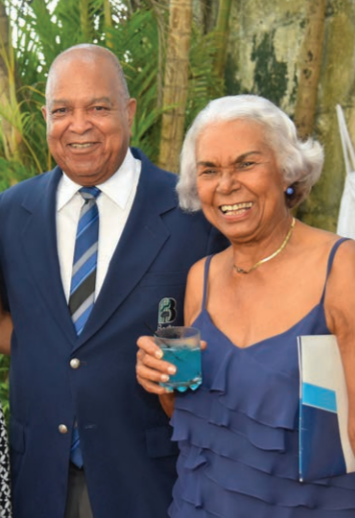
Rita Humphries-Lewin and husband Carl.

Rita Humphries-Lewin sold 81.56 percent of her shares in Barita Investments and collected $2.64 billion for it, but the amount she retained is now valued more than the amount sold in August this year, to Conerstone Investments Holdings.
Up to early part of August, Humphries-Lewin owned 339,975,664 in Barita Investments or 76.25 percent of the total issued shares. At the takeover price of $9.20 that was valued at $3.13 billion. She retained 62.7 million shares representing 14.06 percent of the issued shares, now valued by the market at $2.92 billion.
With the price of the stock reaching $46.50 on Monday, the vastly reduced ownership is worth almost what the full 76 percent holding in the company was priced at, based on the acquisition price, when Conerstone acquired 75 percent of the company.
Humphries-Lewin would have collected from the shares she sold but the amount she retained
On the other hand,Cornerstone paid $3.07 billion for 75 percent of Barita but based on the latest price for the stock the block is now valued at $15.5 billion representing a huge gain of $12.4 billion in a matter of 4 months.
The new majority owners have big plans for the company that could well push the valued much higher in the not too distant future.

Barita defies broker’s sell recommendation

Barita climbs to a new closing high of $46.50 on Monday.

Barita Investments closed at $46.50 on Monday with a gain of 450 percent for the year so far, to be the best performer of any stock listed on the Jamaica Stock Exchange. Since late 2016, the stock gained 1,400 percent.
In late 2016, a leading brokerage house concluded their assessment of Barita Investments as follows, “we expect just a marginal increase in year on year net profit. Given this expectation, we estimate BIL shares to be valued at approximately $2.35 by applying the market average P/E to estimated EPS. Therefore at a current market price of $3.10, we are recommending a SELL on BIL.” Interestingly, while they recommended a sale, IC Insdier.com placed a BUY RATING on it and it occupied the number 2 spot on the main market BUY RATED list. That is a huge contrast.
That year, while reported profit was down to $207 million from $242 million, in 2015 total comprehensive income, the better measure of profitability was $691 million or $1.55 per share, compared to $201 million, a huge increase. In 2017, traditional profit slipped to $172 million after an impairment on investments charge of $81 million, total comprehensive income ended at $492 or $1.10 per share. For 2018, reported profit jumped to $374 million and total comprehensive income moved to $736 million or $1.65 per share.
Investors who sold their stock in 2016 lost out big time. Information gleaned by IC Insider.com is that the gains experienced in 2018, may not be over. The company may have pocketed around $100 million from the placement of a US$10 million bond issue recently, both the company’s equity portfolio and the equity-linked Unit Trust would have benefitted from the rise in local stock prices and resulted in increased profits for the December quarter. Then there are other fees that should have increased that will add to the profit for the quarter and for the fiscal year. Importantly, unlike in the past, when unrealized gains on securities was treated as other comprehensive income from the current year, all

Barita Investments 2017 AGM held on March 23, 2017

gains or losses will be treated as a part of regular profit and that is likely to make a big difference in how investors value the company.
The new majority owners, in the eyes of investors have brought new life to the company. At least, that is what from the meteoric rise in the stock price is saying. The company is to raise over $4 billion by way of a rights issue at a price of $15.50 each. The directors have not yet stated publicly, what the funds from the rights issue, will be used. There is talk that some of it will be invested in an expanded portfolio of equities, to take advantage of what is being seen as an improving Jamaican economy that should lead to a rise in stock prices and a role out of services to the wider Caribbean region.
Apart from the company’s stock that seems set to be 2018 number one performer, the equity linked units trust is the best performing for 2018 and seems set to cop the number one spot for the year. Their other funds have trailed the rest of the market by a mile, with the real estate and FX Growth funds down more than 20 percent.

NCB to go for 62% of Guardian

NCB Financial Group is to go after 62% of Guardian Holdings.

NCB Financial is to make a revised offer to acquire 62 percent of the Trinidad based Guardian Holdings (GHL), at a revised price of US$2.79, the group said today, in a release.
This is in line with the original offer made in 2017 but at higher price and above the 51.85 percent at US$2.65 they agreed to, after being investigated by the Trinidad Exchange Commission. The revised offer which will be published soon, with the exact timing is yet to be determined. The acquisition is to be partially funded by US$45 million to be provided by way of vendors’ loan from selected shareholders.
The acquisition is set to make a major impact on the NCB Group and ultimately the stock price. For one GHL is being bought for just less than 10 times earnings while NCB is selling at 15 times 2018 earnings as such the impact on the price of NCB shares will be seen in 2019 as GHL profit will be

Guardian Holding

valued more to NCB shareholders. Most importantly, majority ownership will permit it to reshape the group by merging the separate insurance companies and securities operations into one and allow it to rationalize various back office operations within the group into one unit and thus cut considerable cost out of the enlarge group.
NCB already owns 29.99 percent of Guardian. The GHL shares last traded in Trinidad at TT$16.95 or approximately US$2.53. NCB closed trading on the Jamaica Stock Exchange at $148.

Barita proposes $15.50 rights issue

The directors of Barita Investments on December 13, passed a resolution for a Rights Issue of 10 shares for each 17 owned at the record date, to take effect in early January which if taken fully will results in 258 million new shares and bring the capital issued to 707 million units.
The board resolution states:- The Board approves the issue of 258,064,516 ordinary shares (in this resolution “New Ordinary Shares”) part of the authorised capital, the same to be offered to the holders of Ordinary Stock Units by way of a Non-Renounceable Rights Issue on the following terms:
(i) Offer Price of J$15.50 per New Ordinary Share. (ii) Offer to Stockholders of the Company as at a Record Date of December 31, 2018. (iii) Offer to Open on January 8, 2019
(iv) Last date for splitting to be January 15, 2019. (v) Offer to Close on January 22, 2019 for acceptance by Existing Ordinary Stockholders/Renouncees
(vi) Offer to Close on January 25, 2019 for acceptance by applicants for Excess Shares (not taken up by Allottees under the Letter of Provisional Allotment).
2. The Directors are hereby authorized to dispose of all such New Ordinary Shares not taken up by Allottees on terms and conditions as the Directors may consider expedient in their absolute discretion, in consultation with the Arranger for the Rights Issue, Sagicor Investments. BIL further advised that the share ratio allocation for the Rights Issue will be as follows: Ten (10) additional shares for every seventeen (17) shares owned by existing stockholders of Ordinary Shares in Barita Investments.
Apart from a rights issue, the above resolution speaks to the last date for splitting being January 15, which raises the question if a stock is to be considered as well.
Barita stocks that trades on the Jamaica Stock exchange at $33.45 on Friday and is up 346 percent for the year to date.

Scotia hikes dividend

David Noel new Scotia Group’s CEO.

Scotia Group delivered below par performance in that final quarter of the 2018 fiscal year, with profit falling to just $1.6 billion from $3.36 billion in 2017.
The quarterly results, however, is not an indication for what can be expected for the 2019 fiscal year as one time fall in revenues and in some cases, expenses are unlikely to be reflected for the full year to come. In keeping with expected pick up in profit the banking group hiked their dividend from the usual 48 cents per share to 51 cents in their latest announcement. Based on Scotia’s long held policy, when dividends are raised it is usually an indication that future dividend payments will continue at the elevated level for the ensuing period. Investors in the stock can therefore look forward to at least $2.04 cents for all of 2019. That will be a return on the latest stock price of $54.01 of 3.8 percent. Dividends paid in 2018 amounted to $1.92 per share. The total amount of dividends to be paid in January will be $1.59 billion which is alomost all the profit reported for teh quarter. The dividend will be paid on January 18, 2019, with the ex-dividend date set for December 24.

Strong food & insurance sales gains at Grace

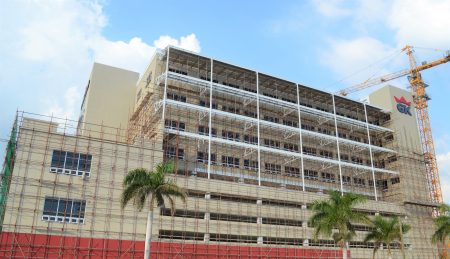
Grace new HQ close to the end of construction in downtown Kingston

Grace Kennedy reported net profit attributable to shareholders of $3.26 billion for the year to September compared with $3.3 billion in 2017 on strong gains in Food and Insurance segments. For the September quarter, the group earnings of $1.06 billion was realized, down from $1.5 billion.
The current quarter’s result is negatively impacted by one off expenses.
Segment results show declines in the Money transfer business with segment results down to $2.34 billion from $2.46 billion in 2017. Banking was flat with results of $401 million but both Insurance and Food trading recorded healthy increases. Food reported $1.35 billion in 2017 and climbed a strong 12.5 percent to $1.52 billion and Insurance jumped a robust 22.7 percent from $508 million to $734 million.
When adjusted for non-recurring gains in 2017 and one-time expenses of $236 million in the September 2018 quarter, profit for the nine months would have been greater by approximately $600 million.
For the nine-months, the Company revenues rose 7 percent to $73.8 billion but climbed a healthier 11 percent to $25.46 billion for the September quarter, over the same period in 2017. Group Chief Financial Officer, Frank James, informed IC Insider.com that the savings from the rationalisation exercise will generate savings considerable higher than the cost, due partially to some former employees being retired and not incurring separation cost.
Operating cost rose faster than revenues, with an increase of 13 percent to $24.6 billion for the

Group Chief Executive Officer, Don Wehby.

quarter and an increase of 8 percent to $71.4 billion for the nine months. Unfortunately, Grace continues the backward practice of not breaking out direct selling cost from other costs in their interim results as such investors cannot determine how movement in cost is affected by changes in revenues versus fixed and administrative cost.
Shareholders’ equity increased of $3.2 billion to $48.4 billion over 2017. Loans receivables remained flat at $26.4 billion compared to $26.58 billion in September 2017 and is down from $27.55 billion at the end of 2017. At the end of the period total assets increased $7.3 billion to $137 billion since September in 2017 and liabilities rose by a smaller $3 billion to $86.44 billion.
In speaking to the recent performance, Group Chief Executive Officer, Don Wehby, affirmed, “The Company is investing strategically for future growth and efficiency to achieve this objective. We are seeing a 12.6 percent increase in profit over prior period, with the one-off adjustments, and we expect continued growth based on our strategy.”
Since 2018, the Group embarked on a programme which aims to improve its return on investment and shareholder value. The process involves a review of its overall organizational design, cost structure, and business processes at all levels resulting in restructuring which affected a number of positions in August. In expounding further Wehby stated, “Although the restructuring costs of $236 million impacted the quarter’s performance, I am confident that the Company will realize the benefits of this in subsequent periods.”
Grace pays an interim dividend of 50 cents per stock unit on December 13, bringing dividends to date to $1.35 per stock unit of more than $1.3 billion.
Wehby and the group’s chairman Gordon Shirley in their report to shareholders stated that Grace Kennedy anticipates continued growth for the fourth quarter, subsequent to the quarterly report the group announced changes in their Florida distribution with an investment in the company that manufactures it patties that will take over Graces distribution and warehousing in that area. The new arrangement will mean less cost and more profits for Grace.
IC Insider.com projects earnings is $4.80 for the current fiscal year to December and $6 for 2019. The stock is listed on the Jamaica Stock Exchange and trades at $60 for a PE of 12.5 times current year’s estimated earnings versus an average for the market in the region of 15, with a premium of a mere 20 percent above net book value per share and seems undervalued, currently. The stock looks like a good long term investment.

One time cost hits Broilers Q2 profit

Jamaica Broilers recorded profits attributable to stockholders of $230 million or 22.42 cents per stock unit for the October 2018 quarter, down sharply by 48 percent from $446 million generated in the same period in 2017.
The major contributor to the decline was as a result of foreign exchange losses of $231 million.
For the half year to October net profit fell moderately to $644 million compared to $658 million for the similar period in 2017. Sales revenue for the quarter amounted to $13.6 billion, an 18 percent increase over the $11.5 billion generated in the corresponding quarter of the previous year and rose 12 percent to $25.7 billion in the six months to October from $23 million in 2017.
Gross profit inched up by just 3 percent for the quarter to $3 billion, compared to $2.96 billion in the previous year and climbed 10 percent from $5.63 billion to $6.22 billion for the six months to October. Gross profit margin collapsed in the quarter to 22.4 percent from 25.7 percent in 2017 while year to date, it came in slightly lower than the 24.5 percent in 2017 at 24.2 percent.
Jamaica Operations reported segment result of $1.35 billion, 28.4 percent above last year’s $1.05 billion. The directors attribute the improvement to increased poultry sales which was up 7 percent to $17.2 billion and enhanced inventory management. Revenue for increased by 24 percent over the prior year to $7.38 billion. “The increase was driven by increased sales of main products – fertile eggs and baby chicks, as well as, feed sales from the acquired feed mill”, Management stated.  US Operations reported a segment result of $666 million, down slightly from $674 million for the 2017. The “decrease

Christopher Levy – Jamaica Broilers President and Chief Executive.

was primarily attributable to one-off staff cost elements and acquisition costs related to the recent feed mill purchase; these cost elements are not expected to recur”, the directors stated. Haitian Operations increased market share of table eggs to 34 percent, compared to 31 percent of the market at the end of the second quarter last year. Revenue for the Haitian Operations increased13.4 percent over the prior year but the segment result drifted down moderately to $85 million from $86 million in 2017.
The Other Caribbean Operations reported segment results of $1.23 billion an increase of $1 billion over the corresponding quarter of 2017, mainly due to the net results of the JBGL Stockholders Nominee, driven by the unrealised fair value gains and eliminated on consolidation of the Group.
Distribution costs, increased 16 percent for the quarter to $482 million and 7 percent for the six months to $918 million. Administrative cost grew by just 5 percent in the quarter to $1.94 billion and 13 percent for the half year to $4.2 billion. The results also include the operating expenses of the new hatchery in Pennsylvania and the costs associated with the formation of the Shareholders’ Trust – these costs were not in last year’s comparative results.
IC Insider.com projects earnings is $2.30 for the current fiscal year to April and $3 for 2020.The stock is listed on the Jamaica Stock Exchange and trades at $29.50 for a PE of 15.6 times current year’s estimated earnings, with a premium of 127 percent net book value per share and seems to be fairly valued, currently.
Shareholders’ equity stands at $12.9 billion with borrowed funds at $12.8 billion and cash and investments of $3.9 billion. Current assets total $20.66 billion verusus current liabilities of $14.45 billion.

Blue Power profit jumped 55%

Sales at Blue Power for the half year of its 2019 fiscal year to October, increased 13 percent to $862 million from $761 million for the same period in 2017, while sales for the second quarter to October were up nearly 12 percent to $426 million from $381 million for the same period in 2017.
Profits for the six months grew 55 percent to $87 million, from $56 million in the same period last year. For the second quarter profit after tax jumped 52 percent to $26.6 million from $17.5 million in 2017 in spite of picking up foreign exchange losses in the current period. Earnings per stock rose from 10 cents to 15.4 cents for the half year.
Lumber Depot sales rose 9 percent from $544 million to $592 million and the Blue Power division increased 25 percent from $217 million to $270 million for the six months
The Lumber Depot contributed $38 million before tax compared to $32 million in 2017 while Soap Division jumped to $61 million from $2 million in 2017.
Net finance cost was $9.5 million compared to $2.7 million for the quarter and for the six months it was a net inflow of $13 million in 2018 and was flat for the 2017 period.
For the half year, “exports sales of soap accounted for 24 percent of overall soap sales,” Noel Dawes, Managing Director told shareholders, in a report accompanying the financials. He further stated that “sales in the Caribbean market continue to be brisk as greater interest, acceptance and satisfaction of our product range materialize. The increase in export sales over the same quarter in the previous year was 64 percent from $47 million to $77 million.”
The company should earn around 30 cents per share for the current fiscal year and close to 40 cents for the next fiscal year ending April 2020. The stock trades at $5.45 at a PE ratio of 18 times estimated current year’s earnings.
Blue Power has investments and cash funds amounting to $247 million, with current assets of $655 million versus current liabilities of just $131 million and shareholders equity of $839 million.

Scotia Group stuck in neutral

Investors could find themselves in shark infested waters if they are not careful with the prices of several stocks now at very high levels. Investors need to be careful of being sucked into attractive profit results that are not based on sustainable earnings.
A case in point is Scotia Group. In the July quarter the interim results showed a big jump in profits, but that was based on an unsustainable rise in foreign exchange earnings due to the slippage of the Jamaican dollar, resulting in nearly $2 billion raked in for the quarter. For the October quarter only $396 million is reported for that line item, but the year shows a big jump from $2.5 billion to $4 billion. Net interest income is on the slide, falling from $26.64 billion in 2017 to $25.2 billion in 2018 and in the quarter the decline continues with October falling to $6.1 billion from $6.3 billion in July and $6.7 billion in the October quarter in 2017. While loan provisioning is down, year over year to October, to $1.9 billion from $2.2 billion it rose in the final quarter to $744 million from $695 in 2017 and $620 million in July this year. Net fee income has been steady for the various quarters at just over $2 billion but fell in the fiscal 2018 year to $8.1 billion from $8.6 billion.
Operating expenses rose to $5.74 billion in the October quarter from $5.1 in July and $5.18 billion for the 2017 final quarter. For the full year operating expenses rose to $22 billion from $21.3 billion. The group had a gain on disposal of a subsidiary of $753 million which saved profit from falling for the latest year with a rise to $12.78 billion from $12.17 billion in 2017. For the quarter, profit dropped to just $1.6 billion from $3.36 billion in 2017.
Importantly, the loan portfolio that rose strongly in the July quarter to $177 billion is up at a slower pace of 3.2 percent to $183 billion, an annual pace of 13 percent, but it needs to increase further to really deliver a reasonable increase in profit going forward.
The stock closed at $54.05 on the Jamaica Stock Exchange on Thursday, but its recent profit performance does not send very encouraging signals to buy.