The Trinidad and Tobago Stock Exchange closed the week with just 2 points lost in the major market indices but with prices of 10 stocks falling and six rising following last week that ended with 7 stocks rising and 5 declining. Guardian Holdings, One Caribbean Media and Republic Financial closed on Friday at 52 weeks’ lows.
Trading left the PE ratios of the majority of stocks to be very attractive with big upside gains ahead.
The average PE ratio of the market is 10.7 compared to 5.4 based on the current year’s earnings. The huge difference between the two shows the undervalued level of the market currently is and the extent of the upside that lies ahead.
The only winning stocks of note for the week is Scotiabank up 35 cents to $56.35. Ansa McAl gave up the $2.79 gained last week to close at $60. Angostura Holdings lost 50 cents to end at $16 and West Indian Tobacco fell 35 cent to $6.15, a 52 weeks’ low.
Several stocks could gain more than 100 percent when the market comes back to life, these include, First Caribbean with a possible gain of 250 percent, Guardian Holdings at 500 percent, Republic Holdings at 120 percent, Massy Holdings at 120 percent, Trinidad Cement with 270 percent, Eric Solis 400 percent and One Caribbean Media with 300 percent.
 At the close of trading on Wednesday, the JSE Combined Market Index rallied 503.65 points to end trading at 336,013.76, while the All Jamaican Composite Index declined 3,548.11 points to 357,372.64, the JSE Main Index declined 2,758.68 points to lock up trading at 320,529.65. The Junior Market Index slipped 5.71 points to 3,741.82 points and the JSE USD Market Index rallied 1.02 points to end trading at 240.82.
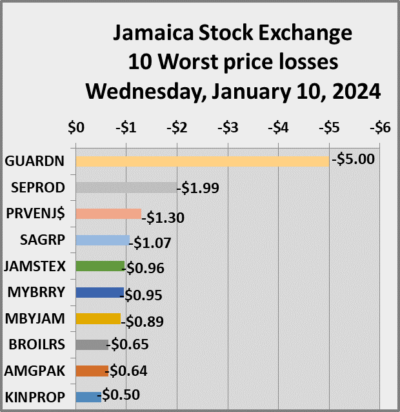 At the close of the market, Main Market stocks rising are AS Bryden that rallied $1 and ended at $40, Caribbean Cement climbing $2.24 to $57, NCB Financial gaining $1.30 in closing at $67.50.
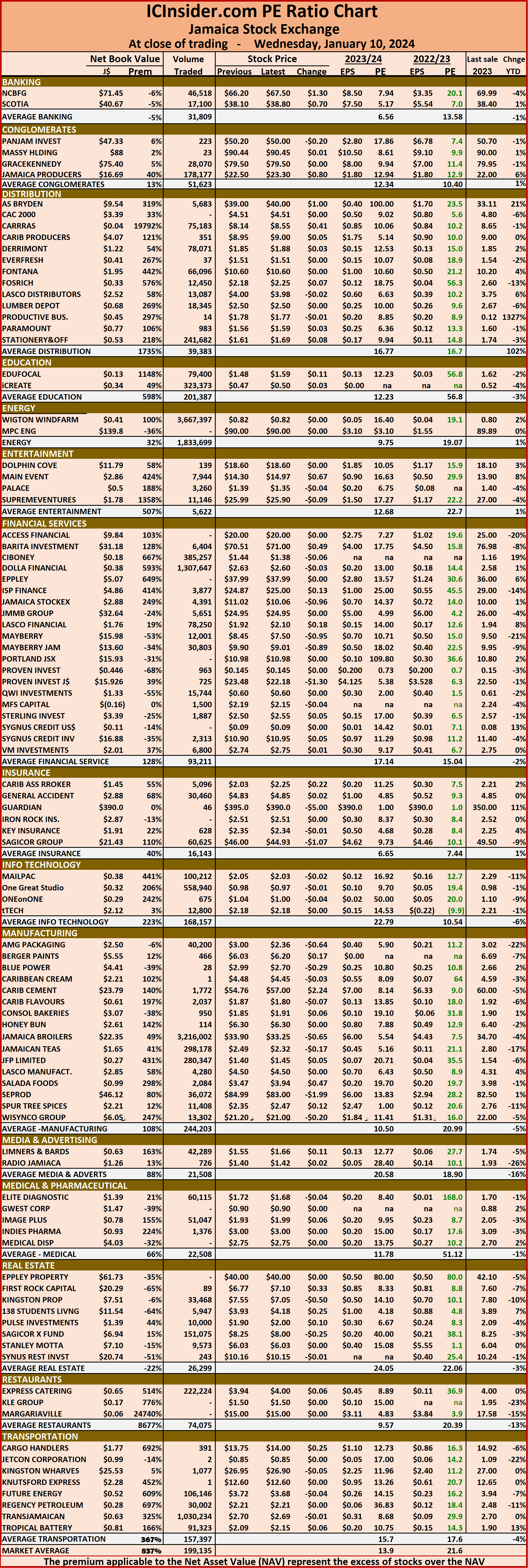 Investors should use the chart to help make rational decisions when investing in stocks close to the average for the sector and not going too far from it unless there are compelling reasons to do so. This approach helps to remove emotions from investment decisions and place them on fundamentals while at the same time not being too far from the majority of investors. Investors who buy when the price of a stock is close to the average will find that they are not inclined to overpay for a stock.