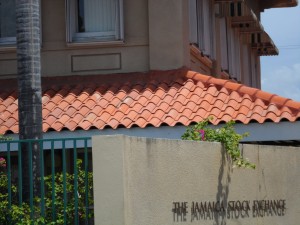
 The main market of the Jamaica Stock Exchange major indices roseat the close on Tuesday, but with sharply lower volume that dropped 95 percent from Monday’s levels.
Main market activity ended with just 1,062,072 units valued at over $33,962,415, in contrast with 22,820,352 units valued at $1,138,660,815 on Monday.
At the close, the All Jamaican Composite Index advanced by 335.04 points to end at 406,501.02 and the JSE Index gained 304.93 points to close at 370,376.09.
The main and US markets traded a total of 29 securities, with prices of 9 rising, 11 declining with 9 remaining unchanged, compared to 32 securities trading on Monday.
Scotia Group led trading with 216,870 units for 24 percent of the day’s volume, followed by Mayberry Jamaican Equities with 140,980 units and accounting for 22 percent of the total main market volume changing hands and Supreme Ventures with just 86,305 units for 8 percent of the day’s volume.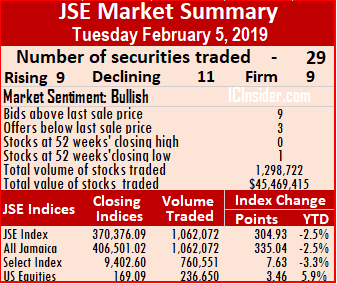
IC bid-offer Indicator|The Investor’s Choice bid-offer indicator ended with the reading showing 9 stocks ending with bids higher than their last selling prices and 3 closing with lower offers.
An average of 42,483 units valued at $1,358,497, in contrast to 786,909 shares valued at $39,264,166 on Monday. The average volume and value for the month to date amounts to 684,936 units valued at $22,375,029 and previously 952,625 units valued at $31,131,917. Trading for January resulted in an average of 101,980 units valued at $3,042,494, for each security traded.
In main market activity, Jamaica Broilers jumped $3 to finish trading of 66,896 units at $33, Jamaica Producers lost $1 to close at $22, with 12,548 shares changing hands, Jamaica Stock Exchange closed trading with 62,328 units changing hands with a rise of 35 cents to $13, JMMB Group fell 50 cents to close at $32, trading 10,248 shares. Kingston Wharves gained 80 cents and settled at $70.00, with 3,678 units 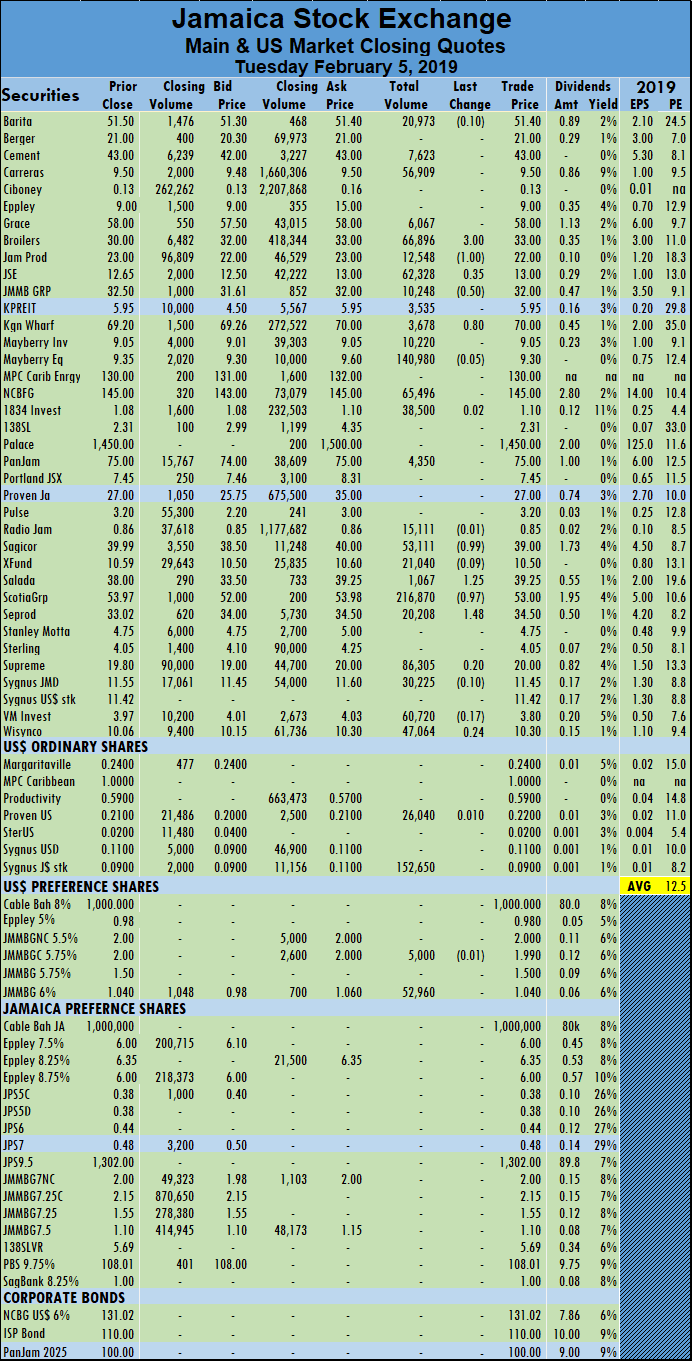 changing hands, Sagicor Group fell 99 cents trading 53,111 stock units, to close at $39, Salada Foods jumped $1.25 to $39.25 in trading 1,067 units. Scotia Group lost 97 cents and finished trading of 216,870 shares at $53 and Seprod rose $1.48 cents to end at $34.50 with an exchange of 20,208 shares.
Trading in the US dollar market resulted in 236,650 units valued at $83,993 changing hands. JMMB 5.75% preference share traded 5,000 units and lost 1 cent to end at a 52 weeks’ low of US$1.99, JMMB 6% preference share concluded trading of 52,960 units at US$1.04, Proven Investments traded 26,040 units and rose 1 cent to close at 22 US cents and Sygnus Credit Investments closed trading of 152,650 units to close at 9 US cents. The JSE USD Equities Index advanced 3.46 points to close at 169.09.
NCB hikes dividend 29%
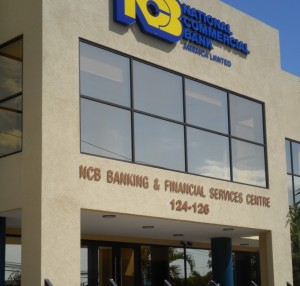
NCB hiked dividend to 90 cents from 70 cents in 2018.
Profit after taxation and one-time gains, resulted in net profit of $7.4 billion for the first quarter of the 2019 financial year, slightly lower than the prior year’s results that included a gain (negative goodwill) of $4.4 billion relating to the acquisition of Clarien Group. Profit for the latest quarter, includes a gain of $3.3 billion from the disposal of 326,277,325 JMMB Group shares at $28.25 per share.
The strong improved results climbed on the back of 24 percent in net income, to $20.7 billion from $16.7 billion in 2017, offset by a 21 percent increase in expenses. Included in expenses is loan loss provision of $1, up from just $146 million in 2017 and seems tied to the need to adjust loan provisioning in line with new Accounting Standards. Depreciation and amortization cost almost doubled to $1.3 billion, from $667 million in 2017. Other operating expenses jumped 29 percent to $6 billion from $4.7 billion in the prior year. The big improvement in revenues flowed from increases in net interest income from $7.55 billion to $9.85 billion, an increase of 30 percent, while exchange trading delivered a third more, at $4.2 billion.
Retail and Small Business Banking segment profit grew a strong 36 percent to $1.34 billion, but Payment Services fell just 2 percent to $1.2 billion. Corporate Banking jumped sharply by 76 percent to $1.25 billion, Treasury and Correspondent Banking was up by just 14 percent to $1.65 billion. Wealth, Asset Management and Investment Banking, grew attractively by 39 percent to $1.2 billion, Life Insurance & Pension Fund Management rose 29 percent to $1.3 billion while General Insurance moved from a loss of $107 million to a profit of $227 million.

NCB giving back to the community.
The Group’s loans and advances, net of provision for credit losses, rose 16 percent to $373.5 billion. NCB stated that “the growth was driven by our Jamaican that increased by 22 percent or $50.4 billion. Non-performing loans totalled $18.5 billion as at December 2018 (December 2017: $15 billion) and represented 4.9 percent of the gross loans compared to 4.6 percent as at December 2017.” Customer deposits grew just 7 percent to $461 billion. The varied growth rate between loans and deposit is a strong positive for profit as the revenues climb faster than cost.
The group re-launched a revised take-over to acquire up to 32.01 percent of the outstanding shares of Guardian Holdings which, when combined with NCB’s existing 29.99 percent holding will bring the total to 62 percent. The profit of the group will get a further boost from this acquisition. IC Insider.com has updated the earnings per share for 2019 to $14 from continuing operations and with the stock price at $145, the PE is just over 10 times earning making the stock BUY RATED with a 2019 target price of $225.
JSE – directors cannot override AGM decision

Palace Multiplex in Montego Bay.
IC insider.com was informed that the Jamaica Stock Exchange stopped the payment. In discussion with the JSE they indicated that the company did not comply with the rules of the exchange to inform them of the dividend. Accordingly, the change in dividend payment was to allow for the public to have notice of the ex-dividend date.
That of course is only partially true, while the company did not advise the exchange when the directors were to meet to approve the dividend and what was the outcome of the meeting. The exchange had adequate notice of the payment from October 31. The exchange JSE staff did nothing about the information that they got and approved for posting on their website.
The company’s directors’ report clearly states that the dividend had an xd dividend date of January 4 with the payment to be made on January 18. The annual report was posted on the JSE website from October. The directors, report along with the audited report were put to the meeting for acceptance which was done.

Andre Tulloch, head of the JSE regulatory arm.
Shareholders after approving the directors’ report, approved the resolution for the payment of the dividend, effectively agreeing to ex dividend and payment dates as set out in the directors report.
In the wisdom of the Jamaica Stock Exchange, they ignored the supremacy of the AGM and forced the company to submit information to change all the dates relating to the dividend. They failed to understand that the directors have no powers to change what the shareholders approved, and if a change is to be made, then the directors would need to call a general meeting to get shareholders to make the change. The correct remedy would have been some reprimand not a call for a non-legal action.
The requirements of the JSE is that any meeting at which a dividend is to be consider should be communicated to the JSE no later than 7 days before the date of the meeting and within 48 days of the meeting the decision taken. This was not done by Palace, but the JSE who had notice of the declaration from the end of October, did nothing about it for more than two months.
On 17 January, a posting on the JSE website showed that the record date was changed to January 31. The posting stated the “Palace Amusement (PAL) has advised that following decision made at their Annual General Meeting in December 2018, to pay a dividend of $2 per stock, the payment will be made on February 8, 2019, to the shareholders on record as at January 31, 2019, The ex-dividend date is January 30, 2019.”
The added problem is that shares were traded in January after the xd date of January 4. The seller would have expected to collect the dividend that was approved. It also means that cheques already drawn, may have to be redone, to record the new record date.
The JSE has clearly, made a huge error in this matter and should immediately correct it, to prevent a messy situation from getting worse. You cannot correct a wrong by another wrong.
Barita rights issue closes in March
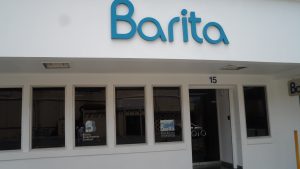
Barita Investments – 2018 best performing JSE stock.
Barita Investments held an Extraordinary General Meeting on January 17, 2019 and passed the Resolution to issue up to 262,280,484 ordinary shares as a Rights Issue to Stockholders and gave the power to the directors to set the other terms.
Subsequent to the meeting, the directors agreed the terms of the issue with offer opening on February 25 and closing on March 18 to shareholders on record at February 5 at a price of J$15.50 per share. Shareholders will be entitled to ten shares for every seventeen shares owned on the record date. Shares not taken up by existing shareholders will be available to other shareholders who apply for excess shares. The deadline for applications for any excess shares is March 25.
Barita’s stock has been trading in the $50 region for sometime, spurred partially by announcement of the rights issue plus other positive developments for the company, including new business.
Barita’s share was the best performing on the Jamaica Stock Exchange in 2018, with gains of 593 percent.
Fall again for JSE main market – Thursday
 Trading on the Jamaica Stock Exchange on Thursday, resulted in another day of moderate fall in the two main indices, but market volume and value increased over that of Wednesday.
At the close, the All Jamaican Composite Index dropped 1,118.62 points to close at 407,309.91 and the JSE Index declining by 1,018.09 points to end at 371,112.27.
Market activity ended with 5,588,296 units valued at $115,025,442 compared to 2,621,751 units valued at $79,656,335 changing hands, on Wednesday.
JMMB Group led trading with 2,084,124 units for 37 percent of the day’s volume, followed by Pulse Investments with 986,375 units accounting for 17.7 percent of the volume changing hands and JMMB Group 7.50% with 400,000 units and 7 percent of the day’s volume.
The main and US dollar markets, had 36 securities changing hands, with prices of 13 rising, 10 declining with 13 remaining unchanged, compared to the same number of securities trading on Wednesday.
IC bid-offer Indicator|The Investor’s Choice bid-offer indicator suggest that the market could enjoy strong gains on Thursday with the reading showing 8 stocks ending with bids higher than their last selling prices and 5 closing with lower offers.
An average of 169,342 units valued at $3,485,619, in contrast to 79,768 units valued at over $1,781,160 on Wednesday. The average volume and value for the month to date amounts 70,913 units valued at $1,992,151  compared to 61,632 units valued at $1,838,617, previously. Trading for December ended, with an average of 835,037 units with a value of $25,906,477, for each security traded.
In main market activity, Barita Investments lost $1 to close at $51, trading 15,748 shares, Caribbean Cement finished trading 29,100 shares to close at $40, Eppley added $1 and settled at $10, with 5,848 shares trading, Grace Kennedy fell $2.90 in trading 23,247 shares at $56.10, Jamaica Broilers traded 56,842 stock units and rose $1 to $29. JMMB Group concluded trading of 2,084,124 shares but lost $3 to close at $29, Kingston Properties shed 30 cents to finish at $6.20, with 350 stock units, NCB Financial Group lost $1.25 in trading 138,873 shares to close at $143.75, PanJam Investment gained 50 cents to close at $71,50, with 24,178  units changing hands. Pulse Investments rose 34 cents and concluded trading of 986,375 shares at $3.50, Sagicor Group fell 90 cents to settle at $39, in trading of 17,250 shares, Sagicor Real Estate Fund ended trading rose 48 cents trading 13,000 shares to close at $10.60, Scotia Group traded 99,524 shares after rising $1.01 to close at $55. Sterling Investments lost 36 cents and ended at $3.70, with an exchange of 38,070 shares and Supreme Ventures rose 50 cents and concluded trading at $20, with 119,504 stock units changing hands.
Trading in the US dollar market resulted in 32,240 units valued at $12,360 units. Preference share, JMMB Group 5.75% settled at US$2 with 4,867 shares trading. Proven Investments ended trading of 3,099 units at 21.9 US cents Sygnus Credit Investments fell 0.015 cent to end at 0.75 US cents trading 24,274 shares. The JSE USD Equities Index declined by 0.83 points to close at 165.87.
Junior Market trading cools – Wednesday
 Trading on the Junior Market of the Jamaica Stock Exchange finished on Wednesday with 22 securities changing hands, resulting in an exchange of 3,592,672 units valued at $12,085,054.
Wednesday’s trading fell sharply from the 11,135,194 units valued at $34,955,488 passing through the market on Tuesday, from trading in 29 securities.
Trading activity pushed the Junior Market Index down by 22.64 points to 3,202.80 with the prices of 9 securities rising, 11 declining and 2 remaining unchanged.
Trading ended with an average of 163,303 units for an average of $549,321 in contrast to 383,972 units for an average of $1,205,362 on Tuesday. The average volume and value for the month to date amounts to 703,409 units valued at $2,919,088 and previously 755,754 units valued at $3,148,757. In contrast, December ended with an average of 136,222 units at a value of $737,367 for each security traded.
IC bid-offer Indicator| At the end of trading, the Investor’s Choice bid-offer indicator reading shows 7 stocks ended with higher bids than their last selling prices and 5 closing with lower offers.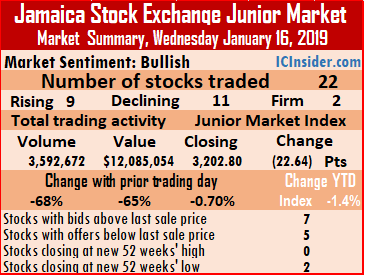
At the close of the day’s activities, Access Financial closed with a loss of $2 at $50, with 6,673 shares trading, AMG Packaging ended 26 cents higher at $2.23, with 62,645 stock units changing hands, Caribbean Cream ended trading 58,493 shares, 15 cents higher to $5.85, Caribbean Producers traded 14,744 units and rose 20 cents higher to $5. Derrimon Trading ended with a rise of 20 cents to $2.75, with 21,049 shares passing through the market, Elite Diagnostic closed at $2.95, with an exchange of 81,386 stock units, Everything Fresh lost 4 cents to end trading of 120,950 shares at $1.65, Express Catering settled at $8, with 87,049 units. Fontana traded 2,808,416 shares and gained 10 cents to close at $3.20, General Accident traded with a loss of 10 cents at $3.35, with 84,366 shares changing hands, GWest Corporation finished trading with a loss of 6 cents at $1.75, with 22,756 shares, Honey Bun closed with a loss of 25 cents at $3.75, with 2,222 stock units. Indies Pharma rose 5 cents to end at $3.15, trading 69,089 shares, Jetcon Corporation settled 25 cents higher at $3.43, with an exchange of 4,930 shares. Knutsford Express finished trading 34,800 shares 10 cents higher at $11.60, Lasco Distributors closed with a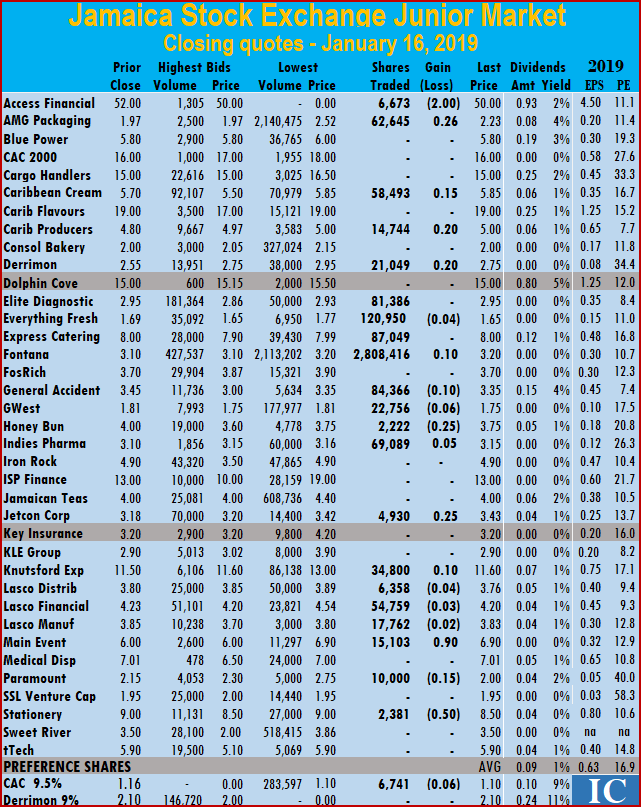 loss of 4 cents at $3.76, with 6,358 shares changing hands, Lasco Financial ended with a loss of 3 cents at $4.20, in the swapping of 54,759 shares, Lasco Manufacturing concluded trading 17,762 stock units with a loss of 2 cents at $3.83. Main Event finished 90 cents higher at $6.90, with an exchange of 15,103 units, Paramount Trading ended trading of 10,000 shares with a loss of 15 cents to close at a 52 weeks’ low of $2 and Stationery and Office traded 2,381 shares with a loss of 50 cents at $8.50. In the junior market preference segment, CAC 2000 closed with a loss of 6 cents at 52 weeks’ low of $1.10, with 6,741 shares traded.
Prices of securities trading for the day are those at which the last trade took place.
CMP flouting law – no AGM for 11 years
 For the nine months to December 2007 CMP Industries reported profit of $5.2 million representing an improvement over the results for the similar period in 2006. The company had $23 million in cash and no interest bearing debt.
From all indications, CMP was generating rental income from property owned at Marcus Garvey Drive that been rented successfully since. By now, the company should have piled up a large amount of cash with several years having passed, are those funds been well managed? That is a big question. Shareholders have no way of knowing since the company has not presented any new financial information nor held a general meeting to update them.
The 2007 results are the last that minority shareholders have received, when the company was listed on the Jamaica Stock Exchange. Apparently, Cash Plus owned entity acquired the majority shares but the Trustees in Bankruptcy has taken control over the company but has supplied no updates on the company finances nor called a general meeting of the company. That leaves the company in breach of the companies Act that require annual general meetings to be held annually.
Recent contact with the Trustees in Bankruptcy indicates that they are controlling the company to realise funds to pay off debtors of Cash Plus. If that is true and it can’t really be so unless they sell the shares of the controlling interest, as the company belongs to all shareholders and any cash inflow if distributed has to be done equally to all shareholders as CMP is not indebted to Cash Plus debtors.
CMP Holdings Limited, was incorporated under the laws of St. Lucia, and which owns and controls approximately eighty percent (80%) of the shares in CMP Industries in 2007 sold the shares to Castelo Holdings, was said to have acquired 80 percent interest in CMP.
CMP shares were suspended from trading on the JSE in 2008, pending an offer to minority shareholders that never came. Minority shareholders need to know what is happening to their investment in the company and the Trustees in Bankruptcy cannot continue to flout the law.
Indies shareholders exposed to tax risk
 Indies Pharma reported lower profit for the year to October as slower gains in second half revenues and a more meager profit margin sapped the contribution from the increased sales.
While the company needs to sort out the loss in profit margin. There is also another big issue directors need to deal with. Included in receivables is shareholders’ loan of $136 million with no movement in the year and no information in the audited statements of terms relating thereto including the date for liquidation. IC insider.com source suggest that the recent two large blocks of shares of approximately 115 million units traded in the market this week, is a move to clear off the balance and that should show in the March quarterly report.
Additionally, directors owe the company $37 million, an amount that increased during the year. The company needs to clean up the balance sheet as it could be subject to taxes on distribution for the amount owed to the company by directors and possibly the shareholders. The other factor is that it appears that these amounts are free of interest. Other related party indebtedness also needs regularising with specific terms for transparency.
Profit for the full year is down to $120 million after tax, from $137 million in 2017. At the half way mark, profit was $54 million versus $52 million in 2017, the growth in profit for the 2018 second half was less than in 2017.
Revenues from sales grew just 2.5 percent for the year, down from 9.9 percent at the half-year mark. Cost of sales rose 16.6 percent for the full year compared to the 17.5 percent at April, but with sharply differing sales growth. The net effect is a fall in gross profit for the full year to $393 million from $412 million in 2017. Gross profit improved to $187 million at the 2018 half-way mark, from $177 million in 2017.
Administrative cost was virtually flat at the end of April at $110 million versus $108 million and climbed 6.7 percent to $240 million for the year. Finance cost, inclusive of foreign exchange losses, was flat at $16 million for the year.
As the company listed on the Junior Market, the corporate tax bill is down to $18 million, from $35 million in 2017.
The statement of financial position reflects pretty strong financials, with equity capital of $668 million, strong working capital including $102 million of liquid funds.
Indies last traded at $3.35 on the Junior Market, based on these results the PE ratio would be 37 but investors are looking for a brighter 2019 results.
Sterling comments on rights issue

Sterling Investments
1. SIL shareholders have known about the upcoming rights issue for over 3 months, the longest notice given by any company in the last 2 years!
2. SIL shareholders voted at an EGM on October 8, 2018 to conduct a rights issue. All shareholders, large and small, had a chance to physically attend the meeting and vote on the resolutions proposed. The Board welcomed the decision of the shareholders to do the rights issue and take advantage of great investment opportunities available in the global marketplace!
3. On December 12, the company published the details of the rights issue on the JSE website and the allotment formula for all shareholders. The notice informed shareholders that they would be able to purchase 2 shares for every 3 shares they owned. It also stated that the rights would apply to all shareholders that owned shares as at December 27, 2018. We received many calls from excited shareholders who wanted to participate!
4. SIL placed 2 full page advertisements in the newspaper to remind shareholders: On December 27, 2018 Sterling Investments Limited placed an ad in the Gleaner advising shareholders that the information was available on the JSE website, the SIL website.

Marion Ross of Sterling Investments.
6. Sterling Investments remains committed to ensuring all shareholders are given equal and sufficient opportunity to participate in this great investment company. Existing SIL Shareholders will have until January 18th 2019 to renunciate their rights and can apply for shares in the excess pool until January 25th.
7. We are grateful to IC Insider.com for their shareholder advocacy.
Publishers’ comments: thansk for the feedback. While SIL took steps to inform shareholders it does not chnage the facts that the information that was mailed, was sent out late and had critical pages missing or pages with only partial information thereon.
Another stock exchange fiasco
Sterling Investments
The Jamaica Central Securities Depository (JCSD) finds itself in another fiasco regarding the issue of new shares, following the mess up of the recent Seprod share issue where amounts originally allocated to investors were changed.
The latest mess is the documentation and their dispatch for the rights issue of Sterling Investments shares. The notice for the issue that opened on January 4 and closes on January 11, was only posted on January 3, clearly late for some investors.
The lateness of course is a problem the company could easily fix by extending the deadline date. So far, no official position to extend the deadline date, has been taken. The latest bit of information reaching IC Insider.com, suggests that the date will have to be pushed back.
Two documents were sent to shareholders. A cover letter, describing the issue and mentioning that shareholders can apply for excess shares over their allotment. The application forms sent did not include the page for shareholders to

The Jamaica Stock Exchnage subsidiary
apply for excess shares (page 4). That of course is not the only problem with the forms. In addition, part of page 1 with instructions is missing, also cut off are sections of pages 2 and 5. In short, the application forms included reflects a level of sloppiness in its execution and does not reflect well on those responsible for the job.
It unclear how the company and the JCSD will deal with the matter, but it appears that the proper way would be the sending of the corrected forms to shareholders and extend the deadline date.
The capital market needs to clean up its act if it is not loose credibility.