This is proving to be very embarrassing; accountants unable to compute earnings per share (EPS) properly for companies issuing additional shares. A number of listed companies have been releasing quarterly and audited results with the wrong calculations for earnings per share.
 Trans Jamaica, the latest company, to be divested by the Government of Jamaica, reported a profit for the quarter to March of US$2.27 million but only the application of a tax credit of US$3.77 million saved it from a loss for the quarter. Revenues for the quarter were $12.96 million, up from $12.79 million in 2019, but after incurring $5.6 million in interest cost they ended with a pretax loss of US$1.5 million. In the 2019 March quarter, they barely eked out a profit of $1.58 million but that was only after crediting US$1.234 million in shareholders’ grant that ended at the end of 2019. The company’s reported EPS are all wrong.
Interestingly, Trans Jamaica’s top 10 shareholdings, make for interesting reading. Others are NROCC with 2.5 billion shares and JMMB Group with 763 million units, NCB Group and connected entities dominate the top 10. Interestingly, the National Investment Fund, which acquired a large portion of Wigton Windfarm shares, is nowhere on the top 100 listings for Trans Jamaica shareholders.
For the December quarter, Wigton Windfarm reported the earnings per share for the December 2018 quarter as $56,701. That, of course, is completely incorrect.

Wigton posted a loss in the December 2019 quarter.
The company stated in the quarterly, “the average number of shares was 10,000 units”, and at the same time, they stated that 10,999,990,000 shares were added, in May 2019. In reality, no shares were added as the existing stocks were split to become 11 billion units. This is what the prospectus stated, “in anticipation of this Offer for Sale PCJ as sole shareholder adopted the following resolution in writing on April 3, 2019, with respect to the Company; namely (a) sub-dividing the Company’s 10,000 ordinary shares into 11,000,000,000 ordinary shares.” That change required that 2018 and all prior years’ earnings, must use 11 billion shares to compute the company’s earnings per share. Wigton’s June to December quarterly reports published for 2019 are all incorrect and require revisions, as the incorrect information is still on the Jamaica Stock Exchange’s website.
The latest company to run foul-up this rule is Trans Jamaica Highway. The company, in its first report to the Jamaica Stock Exchange, reported EPS of 0.02 US cents for the March quarter, 5.8 US cents for the 2019 quarter and 30.7 cents for the year to December last year— all of which are incorrect. A note accompanying the share capital of the quarterly to March states. “On January 22, 2020, an extraordinary shareholders’ meeting passed a resolution to restructure the authorized share capital pursuant to section 65(1)(d) of the Companies Act, 2004, in anticipation of NROCC completing an initial public offering on the main market of the Jamaica Stock Exchange. Pursuant to this resolution, the Company’s share capital was restructured by dividing each of the 27 million existing ordinary shares to create 12.5 billion ordinary shares.”
As is the case for Wigton, the total number of shares now issued must be used to properly compute EPS for all three periods included in the quarterly report.
Limners and Bards, in releasing their audited accounts, made the same mistake that was quickly corrected after IC Insider.com brought the matter to the public.
 MailPac Group

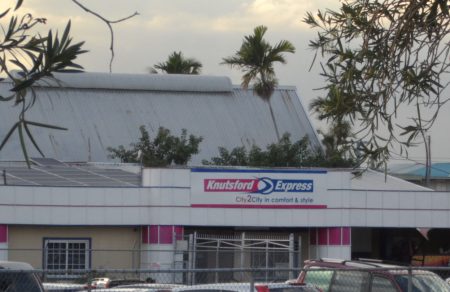
 Net profit at Knutsford Express climbed 7 percent in the February quarter to $36.4 million from just under $34 million for the corresponding period in 2019. For the nine months to February, profits fell sharply by 35 percent to $103 million from $158 million for the comparative period in 2019. Losses in the new operation in Florida negatively affected profit, with the segment bringing in revenues of $20.6 million for the three quarters, but lost $26 million. The new operation generated $8 million in revenues for the February quarter, an improvement over the $7.2 million generated in the July quarter and much more than in the November period. The loss in the latest quarter was down by $1.2 million at $8 million in February compared to July. The numbers suggest that it will take another two to three years or the Floridian operations to breakeven.

 The T&T Composite Index gained 1.38 points to 1,257.18. The All T&T Index rose 2.75 points to end at 1,692.16 while the Cross Listed Index was unchanged at 111.16.
 Trinidad & Tobago NGL climbed 99 cents to $19.50, with 39,090 shares changing hands.
 The share price tumbled over the past month with the fall in the overall market, in sympathy with the fall in the net asset value per share to a low of 80 cents on March 20 but recovered some lost ground to close on April 3, at 93 cents per share. The stock traded on the Jamaica Stock Exchange as low as 63 cents on March 10 with that price proving to be a bottom so far. The price moved upwards to close on Thursday at 83 cents for a rise of almost 32 percent since the low in March.



 Results for the media group for the nine months to December 2019, was vastly better than for the similar period in 2018, resulting in the stock price rebounding from its yearly low of 80 cents by more than doubling the December 2018 price. For the rest of the 2021 fiscal year, not all things may go well with the level of dislocation to the local economy arising from business closures currently in place.

 The directors have not yet met to determine the exact amount of the split or the total number of shares that likely to be offered for sale later, but at Tuesday’s annual general meeting, the Chairman gave shareholders some sense as to what the outturn could be.