 Derrimon Trading Company Limited (Derrimon) acquired 49% of the issued shares of Caribbean Flavours and Fragrances (CFF) from its previous majority owners, Anand and Joan James.
The share transfers of two blocks of 22,030,408 shares each, were executed through the Jamaica Stock Exchange on August 5, to effect the transfer to Derrimon for J$121,167,244, at $2.75 per share. Mayberry Investments acted as the investment banker to the deal on behalf of Derrimon.
Established in 1998, Derrimon is now a major distributor of consumer goods to supermarkets and wholesalers island-wide as well as supermarket operators.
“We are looking forward to working with Anand James, who remains as Managing Director of CFF, to expand on the synergies provided by this unique business. We believe that this investment will also assist us to reach the next level in our evolution.” CEO and majority shareholder of Derrimon Derrick Cotterell said.
 CFF is engaged in the manufacture and distribution of flavourings and water soluble colourings for the food, beverage, baking, confectionary and pharmaceutical industries. The Company also manufactures and supplies fragrances, which are used in production of household cleaning, body car, aroma therapy and air freshener products. The Company supplies its products predominantly to commercial concerns in Jamaica, and exports to Caricom countries including Trinidad, Barbados, Guyana, and St. Kitts.
Managing Director of CFF Anand James said “I am very pleased with the progress of CFF since its listing on the Junior Market last September. Less than one year later, the listing has assisted me to identify a
long term strategic partner who shares my values and overall strategic focus.”
The deal will result in some changes to the board of directors of CFF, which will now comprise two
executive directors from each of the two companies. The three non‐executive directors as well as CFF’s
mentor will remain unchanged.
Derrimon largest owners of Caribbean Flavours
Jamaica’s NIR passes US$2b
 Jamaica’s Net International Reserves (NIR) now exceeds US$2 billion as it sits at US$2.18 billion, up by US$805 million during July. The increase reflects the US$800 million bond, the government raised recently on the international market.
The gross amount of the reserves is US$2.8 billion, up by US$793 million during July, of this amount US$606 million is due to the International Monetary Fund (IMF) and represents primarily, funds obtained from the IMF for liquidity support for the financial system, when the JLP government undertook the first debt exchange, back in 2010.
Reserves of Goods Imports amount to 28.13 weeks and 20.30 weeks of Rreserves of Goods & Services Imports.
Grace & JPS paying shareholders
 Grace Kennedy approved an interim dividend of 78 cents per stock, to be paid on September 30 to stockholders on record of September 12, the EX dividend date is September 10, 2014.
An interim dividend of 70 cents per share was paid on April 30, this year. A third dividend is expected to be paid later in the year, in keeping with the company’s policy of making three payments per annum.
Jamaica Public Service approved a Class F preference share a dividend of US$1,137,653 or 0.463287757 per stock, to be paid on August 15, 2014, to stockholders registered at the close of business on August 4, out of retained earnings. The EX-dividend date is July 30, 2014.
strong>
Jamaican Government revenues short $3.5b
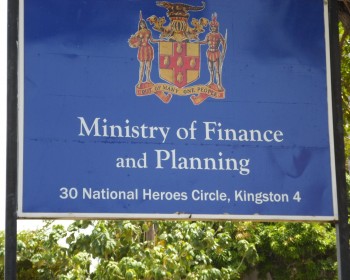 A $2.5 billion shortfall in the collection of company tax and a $2 billion shortfall in the collection of grants, offset by some areas that over performed, resulted in the overall tax take for the first 3 months of the 2014/15 fiscal year to June, falling short of budget by $3.5 billion revenues.
On the expenditure side, reduced payments of $2.3 billion for non-wages and interest and a billion less in the wage bill, coupled with a $3 billion reduced capital spend, helped to cut expenditure by $6.3 billion, leaving the fiscal deficit better off by $2.8 billion.
Revenues came in at $93 billion for the three months and expenditure at $110 billion, for an overall fiscal deficit of $17 billion.
Areas of revenues that were major out performers are, PAYE with $578 million or 3.6 percent, tax on dividends, $100 million or 24 percent, tax on interest, $726 million or 255 percent, special consumption tax on local goods $737 million or 27 percent, education tax, $231 million an increase of 5 percent.
Local GCT fell sort by 5.5 percent amounting to $792 million, GCT on imports fell short by 5 percent or $723 million.
Finance cost shocks JPS
Jamaica Public Service Company profit got a shock for the June quarter when a 21 percent increase in finance cost drove total cost for the quarter in this area to US$18 million from US$15 million in 2013.
 For the six months to June, finance cost was flat with the prior year at nearly US$33 million for each period. The company, the sole distributor of power to end users in the country, reported only US$1.7 million in after tax profit for the quarter and US$8.9 for the six months to June. In 2013 the second quarter profit was US$1.6 million and the six months US$2.4 million.
Revenues generated in the periods to produce those results are US$270 million versus $268 million in 2013 for the quarter and US$533 million in the six months and for 2013, US$539 million. Although the revenues varied, a more important measure is gross profit which are net of the impact of fuel and the charge for the purchase of power from private power plants. The sales net of fuel and the purchases of power came out at US$67.2 million in the June quarter compared with US$62.9 million in 2013 and US$137 million for the six months and US$133.5 in 2013. The return on equity is only around 5.4 percent for the year well below the allowed rate of 16 percent by the regulators, but the impact of devaluation charge due to the accounting in US dollar rather than Jamaican dollars negatively affected the returns.
Ironically, while JPS records its financials in United Sates dollars, the company suffered a devaluation loss of US$7.4 million in the quarter and US$12.5 million for the six months. Without the foreign exchange losses return on equity would have been much greater than the above stated figure.
“JPS currently has approximately 606,654 customers who are served by a workforce of approximately 1,690 employees. The Company owns and operates: 4 power stations, 9 hydroelectric plants, 43 substations and approximately 14,000 kilometres of distribution and transmission lines,” the company stated in its annual report for 2013.
JPS That has equity of US$337 million also has debt of US$418 million as of March.
Little change in employed in March
Jamaica’s unemployment rate drops to 13.6 percent in March compared to March last year, according to data released by the Statistical institute of Jamaica (STATIN), but the rate is worse than it was in December last year. 
The unemployment rate in December was 13.4 percent according to Statin data for that period. There were 1,133,000 employed persons in March this year, which was 25,700 more than the 1,107,300 recorded in April 2013, the Statin labour report said, the March 2014 numbers are only a marginally better than the 1,130,500 persons employed in December last yea.
According to the Statin data, the country’s labour force in March was 1.311 billion persons down from 1.322 billion in Match 2013 as 11,300 persons exited the work force over the one year period, the report stated. At the same time 25,700 persons found work across a wide cross section of the work force. The number of persons classified as outside the Labour Force was 769,900 In March 2014 and an increase of 16,200 over 2013.
Who got jobs?|The Occupation group ‘Elementary Occupations’ increased by 18,200 persons or 12.8 percent, moving from 141,700 in April 2013 to 159,900 in March and the group, ‘Professionals, Senior Officials and Technicians’, increased from 241,900 persons in March 2013 to 251,700 persons (4.1 percent). The group ‘Craft and Related Trades Workers’ had the largest decline for the period, moving from 139,300 in March 2013 to 134,700 in 2014, resulting in a decline of 4,600 (3.3 percent) persons.
The number of persons employed in the ‘Hotels & Restaurants Services’ increased by 9,100 (13.4 percent) persons while the group ‘Transport, Storage and Communication’ increased by 7,300 (10.5 percent) persons.
Jamaica’s trade deficit falls, March’s better
 Jamaica enjoyed a reduction in its trade for the first four months of this year, compared with the same period in 2013. The trade deficit amounted to US$1.34 billion, down from US$1.46 billion in 2013.
The country imported goods valued at US$1.86 billion for the January to April 2014 period, a decrease of US$199 million or 9.7 percent and exported US$77 million or 12.9 percent less for the January to April 2014 period, representing a big improvement over the change to March. Total exports for the 4 months came in at S$521 million, down from US$598 million in the similar period in 2013.
For the three months to March this year, imports fell by US$281 million and exports were down US$111 million to US$358 million, down from US$469 million in the 2013.
Carreras pays out $9.09 in last 12 months
 Carreras declared an interim dividend of $1.20 per stock unit, to be paid out of accumulated profits on September 4, to stockholders on the Register of Members as at August 18, 2014.The Ex-dividend date is August 14, 2014.
Carreras last declared a special capital cash distribution of $1.34 per stock unit to be paid on July 31. The latest approved dividend will bring the total payments the company made to shareholders since August last year, to $9.09 per share. Carreras traded today at $34.20.
Access Financial Services declared an interim dividend of 36.5 cents payable on September 1, to stockholders on record at August 18, 2014. The Ex-dividend date is August 14. Access last paid 31 cents per share on August 15, last year as dividend. Access last traded at $8.97.
J$ gains versus all 3 majors
The Jamaican dollar made moderate gains against all three main currencies it trades against in Wednesday trading with US$26.6 million being sold at an average an J$112.79 to US$1 as the rate declined by 2 cents, the Canadian lost 4 cents Jamaica to end at J$104.45 and the Pound sterling closed 22 cents lower at J$190.92.
Pan-Jamaican Investment Trust refinances
 The first tranche payment of J$600 million due on a $2.5 billion secured notes obtained by Pan-Jamaican Investment Trust in 2012, became payable on maturity on July 22, 2014.
Pan Jamaican indicates in a release to the Jamaica Stock Exchange, that arrangements have been made to refinance the amount with effect from July 23, 2014 for a further two years.
The proceed from the notes was obtained when the company acquired additional shares in Sagicor Life Jamaica (now Sagicor Group) in 2012 for a consideration of $3,055,100,542. The original funds were obtained from a private placement with maturities ranging from 2 years to 5 years.