 The Trinidad and Tobago Stock Exchange suffered four years of decline, resulting in the T&T Composite index losing 37 percent and the ALL T&T Index declining by a more significant 48.52 percent since the start of 2022 to the end of 2025. For the first five months this year, the market has clawed back a small bit of the loss, with Composite index rising 5.72 percent since the end of last year and the ALL T&T Index rising 4.92 percent.
ICInsider.com returns with an updated PE Chart, with historical and projected earnings to assist investors in navigating stock selection.
Since the start of 2026, Republic Holdings rose $4.02 to $107.25, First Citizens gained $3.02 to $37, National Enterprises more than doubled, jumping $3.50 to $5.50, Trinidad and Tobago NGL surged $7.41 to $10.05, Medcorp dropped $7 to $41, Scotiabank lost $2.49 to end at $45.50 and Endeavor Holdings slipped $2.44 to close at $16.
 The market suffered, with several companies posting reduced profits during 2025 and the first quarter this year. Those with increased profits showed mostly mild changes. The same is not the case with Uniiever that reported a major turnaround in profit in the March quarter, suggesting big gains are ahead for the stock price, with the PE ratio at just 10 based on this year’s earnings.
 The only winning stocks of note for the week are Scotiabank up $2.15 to $58.50, Unilever Caribbean with a gain of 75 cents and Guardian Holdings with a gain of 26 cents. Calypso Investment Fund lost 40 cents to close at $23.60 and LJ Williams lost 22 cents in closing at $1.27.

 While operating revenues, net of interest cost jumped 15 percent to $1.43 billion, operating expenses rose a mere 2 percent from $820 million to $837 million, resulting in operating profit popped 39 percent to $595 million, after $1.4 million in contribution from associated companies. Amounts set aside for credit losses rose from $74 million to $107 million in the quarter, pushing pretax profit up 37 percent to $487 million from $355 million. Taxation for the quarter was relatively flat with that of 2020, at $110 million.
 The group earned $6.37 per share for the nine months period. Management did not think it important to provide investors with the earnings per share for the quarter and did not report it. Based on the issued shares of 162.53 million units, earnings per share for the June quarter amounts to $2.15. The group should end up earning around $9 per share for the year and now trades around 15 times the current year’s earnings at the last traded price of $138 on the Trinidad and Tobago Stock Exchange.
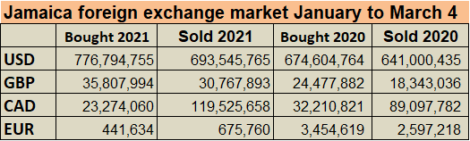
 Data out of Bank of Jamaica shows purchasing by Authorized dealers and Cambios for the year to March 4 amounts to $777 million US$103 million more than in 2020, while selling was just $33 million more in 2021 than in 2020. This development is a huge revelation with the tourism sector, a large foreign exchange sector operating around a third of capacity compared to a full capacity for the similar period last year.
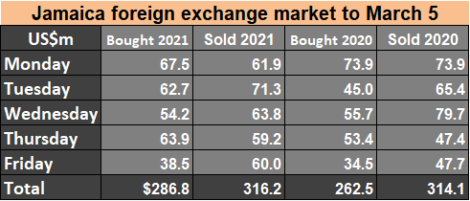
 Last year, trading on the first Monday in March brought in US$73,900,712 while selling amounted to US$73,904,949. Tuesday’s purchases amounted to US$44,971,292 and selling US$65,382,991, while on Wednesday purchases were US$55,679,393 and sales US$79,738,789 and on Thursday, March 5 last year, dealers purchased US$53,369,689 from the system and sold US$47,373,166.
 Others are confirming increased flows from the BPO sector that has grown over 2020, increased remittances and exports. Additional flows may be coming from entities or individuals who bought last year in anticipation of the local dollar running away but may have decided to cash in with the price peaking around the $150 million mark.
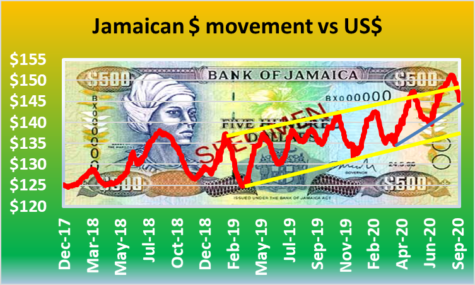 The Jamaican dollar hit a low of $151.27 against the US dollar in August and has rebounded since to trade at $145.3 on Wednesday with one technical indicator showing that it could appreciate further.
 In Wednesday’s trading, dealers sold $64.8 million at $145.306 having bought US$55.8 million at an average rate of $144.43. In trading, Scotia Bank bought US$8.5 million more than they sold. First Global, JMMB Bank, National Commercial Bank and Victoria Mutual Building Society sold far more US dollars than the bought.