More recovery for JSE – Tuesday

Seprod shares jumped $3.75 on Tuesday.

Trading picked up on the main market stocks of the Jamaica Stock Exchange on Tuesday over Monday’s low level and the market indices made strong gains, continuing the recovery from last week’s steep fall and adding to Monday’s gains.
At the close the All Jamaica Composite Index advanced 4,308.59 points to close at 288,621.38, the JSE Market Index gained 3,925.61 points to 262,966.73 while the JSE US dollar market index inched higher by just 0.47 points to 191.75.
At the close of trading, 25 securities changed hands in the main market with 3 trading in the US dollar market, leading to 9 stocks advancing and 11 declining. The main market ended with 5,755,768 units valued at $88,334,159 changing hands compared to 4,567,079 units valued at $32,966,262 at the close on Monday. Trading in the US dollar market accounted for 84,612 units valued at US$47,715 bringing the total of all trades to J$94,584,782.
IC bid-offer Indicator| At the end of trading in the main and US dollar markets, the Investor’s Choice bid-offer indicator reading shows a fairly strong at 8 stocks with bids higher than their last selling prices and none with a lower offer.
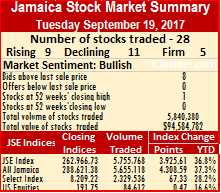
The main market ended trading with an average of 230,231 units for an average of $3,533,366 for each security traded compared to an average of 182,683 units valued at $1,318,651. The average volume and value for the month to date ended at $340,965 units with an average value of $3,892,714 compared with an average of 352,182 units with an average value of $3,275,641 on the previous trading day. The average volume and value for August ended at 184,094 units with an average value of $4,336,090.
At the close Carreras rose to a new 52 weeks’ high of $11.50 after the 10 to 1 stock took effect on the market on Monday and Seprod jumped $3.75 to $33 while Scotia Group closed at $51.
Jamaican$ gains ground – Monday

The rate the public paid for the US dollar at, eased on Monday to JS$131.09 down from J$131.31 on Friday, as dealers sold US$38.44 million compared to US$52.68 million on Friday.
Dealers bought US$43.67 million in US currency, at an average of J$129.82 versus J$130.46 on Friday when they purchased US$63.42 million.
On Monday, dealers purchased the equivalent of US$46.95 million up from US$68.16 million and selling US$40.62 million versus US$58.12 million on Friday.
The selling rate for the Canadian dollar rose to J$106.17 from J$105.95, at the close on Friday while the British Pound was less costly, with J$173.48 buying the British currency versus J$174.10 previously and the euro, fell slightly in value against the Jamaican dollar, with it taking J$159.32 to buy the European common currency, versus J$159.58 previously.

Inflows up J$ falls to $131.22 – Thursday

Bank of Jamaica auctioned off US$20 million on Wednesday and the amount seems to have swollen foreign exchange trading volumes on Thursday, with dealers buying the equivalent of US$70.98 million and selling US$70.8 million. 
On Wednesday dealers bought US$50.45 million versus US$31.03 million on Wednesday and in US currency they bought US$58.56 million, at an average of J$130.30 versus J$129.68 on Wednesday, when they purchased US$45.41 million. The rate to buy the US dollar by the public, rose to an average of J$131.22, in trading US$59.51 million from J$130.51 for US$27.84 million on Wednesday.
The selling rate for the Canadian dollar rose to J$107.94 from J$107.43, at the close on Wednesday while the British Pound was more costly, with J$172.97 buying the British currency versus J$172.62 previously and the euro, fell in value against the Jamaican dollar, with it taking J$156.51 to buy the European common currency, versus J$157.01 previously.

Net US$ Inflows rise J$ falls again – Wednesday

Dealers in the Jamaican foreign exchange market bought the equivalent of US$19.4 million more foreign exchange on Wednesday than they sold but the rate to buy the US dollar by the public, rose to an average of J$130.51 trading US$27.84 million from J$130.14 for US$21.70 million on Tuesday.
Dealers bought US$45.41 million in US currency at an average of 99 cents more than on Tuesday, at J$129.68 versus J$128.69 when they purchased US$29.18 million.
Trading of all currencies ended with the equivalent of US$50.45 million purchases by dealers on Wednesday versus Tuesday’s levels of US$33.50 million while they sold US$31.03 million compared with US$24.32 million on Tuesday.
The selling rate for the Canadian dollar slipped to J$107.43 from J$107.52 at the close on Tuesday while the British Pound was more costly, with J$172.62 buying the British currency versus J$170.09 previously and the euro, rose in value against the Jamaican dollar, with it taking J$157.01 to buy the European common currency, versus J$156.29 previously.

Jamaican $ slips to $130 to US$ – Tuesday

At the end of trading on Tuesday, the rate to buy the US dollar by the public, rose to an average of J$130.14 from J$129.93 previously while dealers bought the US currency at an average of J$128.69 versus J$128.88 on Monday.
Trading in the Jamaican foreign exchange market ended with more normal levels on Tuesday versus Monday’s levels, resulting in US$ 33.50 of purchases by dealers of all currencies and outflows of US$24.32 million.
In contrast, purchases by dealers on Monday amounted to the equivalent of US$57.88 million while dealers sold US$34.37 million.
In USA dollar trading, inflows ended at US$29.18 million versus US$50.25 million on Monday with outflows of US$21.70 million compared to US$29.08 million.
The selling rate for the Canadian dollar rose to J$107.52 from J$107.10 at the close on Monday while the British Pound was more costly, with J$170.09 buying the British currency versus J$169.58 and the euro, lost value against the Jamaican dollar, with it taking J$156.29 to buy the European common currency, versus J$159.25 previously.

Forex trading climbs on Monday

Trading in the Jamaican foreign exchange market rose on Monday over Friday’s levels, resulting in US$57.88 of purchases by dealers of all currencies and outflows of US$34.37 million.

In contrast, purchases by dealers on Friday amounted to the equivalent of US$32.08 million while dealers sold US$33.58 million.
In USA dollar trading, inflows ended at US$50.25 million versus US$28.73 million on Friday with outflows of US$29.08 million compared to US$31.87 million.
At the end of trading, the US dollar was sold at an average rate of J$129.93 from J$130.11 previously while dealers bought the US currency at an average of J$128.88 versus J$128.35 on Friday.
The selling rate for the Canadian dollar climbed to J$107.10 from J$106.95 at the close on Friday while the British Pound was more costly, with J$169.58 buying the British currency versus J$168.87 and the euro, gained value against the Jamaican dollar, with it taking J$159.25 to buy the European common currency, versus J$157.26 previously.

Minority deserves better

SOS directors released June’s quarterly results even though the JSE rules require the first report to be relased for the September quarter.

The investing public seems not to be treated with the respect it deserves. It appears that many companies thing of investors last, not recognizing that they are shareholders just like the majority owners.
The last persons seen are the first to be remembered and is equivalent to out of sight out of mind. That seems to be the case with shareholders in the Caribbean. Newly listed Stationery & Office Supplies release of the June quarterly report although not required by the Jamaica Stock Exchange is an example of good corporate governance and is to be applauded.
In Trinidad for example, there is little liquidity in that market and the directors refuse to do anything about it. In Jamaica many companies tend to stick with the minimum regulations of the stock exchange, even when the recent examples in Jamaica say how important it is to ensure that there is adequate liquidity in the market.
The current regulation for listings in Jamaica, is for new listed companies to file their first quarterly report in the quarter ending after listing. The rule is inadequate to protect investors. Information is critical for the capital market to function properly, as such investors should not have to wait more than two quarters to get a quarterly report. In 2016, there was the very poor decision by Wentworth Graham the then head of the regulatory arm of the Jamaica Stock Exchange to permit 1834 Investments to wrongly withhold the December quarterly report from the public. This was based on improper interpretation of the rules relating to the release of financial information.

Main Event release their first report in June after their January IPO.

Earlier this year Main Event issued their IPO and included interim results to September 2016, with the year end of October. The IPO was in January but it was not until June that shareholders had information on the out turn of the operations for 2016 as well as for the first quarter this year. As it turned out, profit of $60 million at the 11 month period melted down to $56.5 million for the full year. The audited report was only signed on the June 5, more than 7 months after the year end while the first quarter results were never released but the second quarter to April was released within the deadline of June 15.
The management of Stationery & Office Supplies may have had a lot to shout about with pretax profit jumping 146 percent to $20.3 million for the June quarter this year and hence the release of the results to Jamaica Stock Exchange in less than a month of listing on the Junior Market.
Under the stock exchange rules it need not have put out the six months report having been listed in August. Some persons may see it as self interest in the release, but there is no evidence of that. The release provides the investing public with pertinent information in a timely manner, on which they can make their investment decisions. The hope is that the Jamaica Stock Exchange rules will be strengthened quickly to ensure that pertinent information is release on a timely basis to the public.

TOP 10 – main market to shine

Sagiocr Group returns to TOP 10 list

IC Insider.com said last week, the main market sits just below the critical 290,000 point mark and seems headed to break through that level, based on the shortage of supply for Scotia Group shares.
During the past week the All Jamaica Composite Index (AJI) surged to 296,779.53 during trading on Thursday.
The AJI high of the past week is just shy of the 298,000 points the report stated the cut in BOJ’s bench mark rate would translate to. Having broken through the critical 290,000 points resistance level it looks like the main market is free to move to the next resistance level around 370,000 points. The junior market on the other hand raced ahead of the main market earlier this year and is struggling currently as a number of the stocks were pushed to values well ahead of the rest of the market and have been undergoing downward adjustment. The other factor is that many investors are not looking ahead as to what earnings could be. The recent trading of Stationery and Office Supplies is a case in point. Demand fell away ahead of the release of half year results, only to climb after the company released strong growth in profit, suggesting it could be just slightly ahead of IC Insider.com’s original forecast of 40 cents per share. This is not the only case of investors currently miss pricing stocks, but time usually takes care of it.
Buying came in for Barita Investments that returned to the top list last week pushing it out of the list once more, as some buying came in for the stock even with increased selling and Sagicor Group returned to the listing having been pushed out in the prior week.
The average PE ratio for the Junior Market Top stocks is at 7.3 and the PE for the main market TOP 10, ends the week at 6.9. The average PE for the overall main market trades at 13.2 and 13.2 for Junior Market, based on 2017 estimated earnings.
At the close of the week, IC Insider.com’s TOP 10 stocks now trade at an average discount of 45 percent to the average of the market for Junior Market Top stocks and it remains at 48 percent for the main market.

Forex inflows down in September vs August – Friday

Inflows of finds into the system for the first week of September fell to just US$171 million from US$270 million in the first week of August while outflows stood at US$145 million versus US$213 million for the same period.

Trading in the Jamaican foreign exchange market slowed on Friday, resulting in US$32.08 of purchases by dealers of all currencies and outflows of US$33.58 million.
In contrast, purchases by dealers on Thursday amounted to the equivalent of US$34.55 million while dealers sold US$25.84 million.
In USA dollar trading, inflows ended at US$28.73 million versus US$32.45 million on Thursday with outflows of US$31.87 million compared to US$24.24 million.
At the end of trading, the US dollar was sold at an average rate of J$130.11 from J$129.96 previously while dealers bought the US currency at an average of J$128.35 versus J$128.69 on Thursday.
The selling rate for the Canadian dollar climbed to J$106.95 from J$105.61 at the close on Thursday while the British Pound was less costly, with J$168.87 buying the British currency versus J$169.24 and the euro, lost value against the Jamaican dollar, with it taking J$157.26 to buy the European common currency, versus J$157.79 previously.

Jamaica’s forex trading remains elevated – Wednesday

Trading in the Jamaican foreign exchange market remained elevated on Wednesday, resulted in US$50.57 of purchases by dealers of all currencies and outflows of US$42.83 million.
In contrast, purchases by dealers on Tuesday amounted to the equivalent of US$53.88 million while dealers sold US$42.39 million.
In USA dollar trading, inflows ended at US$40.92 million versus US$46.71 million on Tuesday with outflows of US$34.27 million compared to US$36.62 million.
At the end of trading, the US dollar was sold at an average rate of J$129.91 from J$129.42 previously while dealers bought the US currency at an average of J$128.63 versus J$128.29 on Tuesday.
The selling rate for the Canadian dollar climbed to J$105.61 from J$105.17 at the close on Tuesday while the British Pound was more costly, with J$168.72 buying the British currency versus J$165.79 and the euro, gained in value against the Jamaican dollar, with it taking J$155.69 to buy the European common currency, versus J$155.95 previously.