The Jamaican economy may not be growing at lightning pace but it should end 2019 with growth around 1.5 percent having grown an average of 1.2 percent for the year to September and reports from players in the private sector that volume sales in the December quarter bettered that of 2018.
 Growth in the September quarter was pulled down to 0.6 percent as a result of a decline in the mining sector with the closure of the Alpart Alumina plant and weather-related impact that negatively affected growth in the agricultural sector.
As the end of 2019 approached, concerns about the state of the Global Economy surfaced with forecast for slower growth worldwide. According to BOJ, “a slowdown of 0.3 percentage point in the quarter ending September, relative to the growth in the June 2019 quarter” was seen. The main cause was the “weaker growth in China, Japan and selected emerging market economies”. The Canadian and US economies, however, outperformed growth projections for the penultimate quarter of 2019.
As 2020 starts, a number of the negatives globally seems to be receding with signs that trade issues between the USA and China are thawing as well as the cut in interest rates during 2019 in the USA is helping to keep US growth on track.
For Jamaica, there are three bright spots that augur well for 2020. The closure of the Alpart plant will be a drag on growth in the first half of 2020 but gains in other areas should overcome the negative impact of mining and lead to positive growth for the full year. On the flip side, a major game-changer is the switch over of Jamaica Public Service to new power generating plant that will cut import cost for fuel and result in a fall in electricity cost locally.
Data released by the Statistical Institute of Jamaica shows that inflation was 6.2 percent in 2019, the worse in four years, but the exchange movement played a major role in the spike. Statin also reported a continued decline in the unemployment rate at 7.2 percent to October and an increase in the number of persons employed.
Alpart closure a drag on 2019 GDP
Big inflation spike in 2019
The Statistical Institute of Jamaica (STATIN) reported that the annual inflation rate in Jamaica to December 2019, was 6.2 percent, a sharp increase from inflation over the last four years.
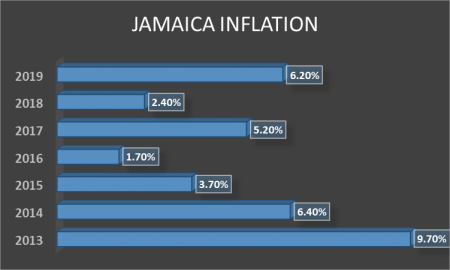 According to data from the Statin, inflation in 2018 was 2.4 percent, down from 5.2 percent in 2017. In 2016 the inflation rate ended at 1.7 percent and 3.7 percent in 2015, 6.4 in 2014 and 9.7 percent in 2013.
Jamaica’s Central Bank, in response to the sharp rise in the inflation for the year, stated, the outturn “represents a sharp jump when compared with the 3.4 percent recorded in September 2019. This inflation outturn was not anticipated and was higher than the Bank of Jamaica’s target of 4.0 to 6.0 percent.”
The release from Bank of Jamaica, stated, “the higher inflation rate was primarily influenced by faster increases in food and energy-related prices in the consumer price index (CPI). The heavily weighted Food & Non-Alcoholic Beverages division of the CPI increased over the year to December by 10.7 percent, when compared with 6.7 percent in September 2019. This was primarily related to higher prices for vegetables and starchy foods, the consequence of adverse weather conditions (drought followed by heavy rains) that affected the Island between June and October 2019.
BOJ interest cuts overnight rate.
There was also news of crop-related diseases affecting some items. Housing, Water, Electricity, Gas & Other Fuels reflected higher rates for electricity and water, which was partly related to increases in international oil prices in the December 2019 quarter. This division increased over the year to December to 1.5 percent, compared with a decline of 3.2 percent in September 2019.”
The release continues, “despite the higher headline inflation, underlying inflation, which excludes the immediate influence of agriculture and energy prices, remained stable and below 3.0 percent. At the end of December 2019, the annual rate for this measure was 2.9 percent, which was unchanged compared with the rate in September 2019. This underscores that the Jamaican economy continues to reflect some slack with economic growth below its potential. It also highlights that the jump in inflation is likely to be temporary as expected tempered movements in agricultural prices dampen inflation over the next three to six months.”
Unemployment drops below 100K
 The number of unemployed persons in October 2019 fell under 100,000 to 96,700, with a fall of 19,000 persons after 29,200 persons were employed over October 2018 and moving the number of employed to 1.248 million persons.
The development in Jamaica’s labour market saw the country’s unemployment rate hitting the lowest level in record history at 7.2 percent down from 8.7 percent for October 2018 and 7.8 percent in July last year.
The occupation group ‘Clerks’ had the most significant increase in employment of 17,700 persons for the twelve months to October. The second-highest increase was for the occupation group ‘Service Workers and Shop and Market Sales Workers’, which increased by 13,900.
The largest change in employment by industry group was in ‘Public Administration and Defence; Compulsory Social Security’ which increased by 10,800 persons, moving from 60,300 in October 2018 to 71,100 in October 2019. Employment in Agriculture, Hunting, Forestry & Fishing declined by 6,500 workers.
Guyana to grow 86% in 2020
 The International Monetary Fund (IMF) is projecting a stunning 85.6 percent growth in Gross Domestic Product for Guyana in 2020 with oil production scheduled to begin in early 2020.
The huge increase in economic growth projected for 2020, will be up from a projected 4.4 percent increase in 2019 and 4.1 percent actual growth in 2018.
According to the IMF, economic growth for the current year continues as the domestic economy extends the broad-based expansion across all major sectors. Growth is driven by continued strength in the construction and services sector ahead of oil production in 2020 and strong recovery in mining. The oil sector is projected to grow rapidly, accounting for around 40 percent of GDP by 2024 and supporting additional fiscal spending annually of 6.5 percent of non-oil GDP on average. This would boost non-oil GDP growth by 3.5 percentage points on average.
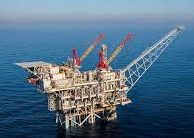
Oil drilling offshore Guyana
The external outlook is expected to gradually improve after the start of oil production in 2020, the IMF stated. “The current account deficit is projected to narrow from negative 22.7 in 2019 to negative 18.4 percent of GDP in 2020, with the commencement of oil exports. The deficit will be financed largely by FDI inflows and donor-supported investment. In the medium term, the current account balance will improve further as oil-related imports subside with the completion of oil fields and as oil exports from Liza II commence in 2022.”
“Public debt is projected to peak at 56.6 percent of GDP in 2019 before declining sharply from 2020, reaching 15.8 percent of GDP by 2024, as the incoming oil revenue significantly reduces borrowing needs and increases GDP”, the IMF reported.
TBill rates drop to 1.55%
Rates on Government of Jamaica Treasury bill dropped to 1.55 percent on the 30 days instrument in the latest issue auctioned on Wednesday, October 16.
 The fall in rates follows applications for $2.2 billion of the Government of Jamaica Treasury Bills on offer and resulted in a notable fall in the average rates compared to the results at the September auction.
The October auction attracted $5.9 billion in bids, resulting in the 91 days instrument due January 2020, yielding an average rate of 1.54966 percent. The 182 days instrument due April 2020, produced an average rate of 1.64864 percent and the 273 days due July 2020, averaged 1.80915 percent.
In September auction resulted in an average yield of 1.74141 percent for the 91 days Instrument and 1.75085 percent for the 182 days with $4.6 billion chasing the $1.4 billion on offer. The previous 273 Treasury bill average yield was 2.00534 percent in August.
In October 2018, yields on the 182 days Treasury bill averaged 1.88 percent, then rose to 2.32 percent at the February 2019 auction and started to decline at the next auction in March.
Rates have fallen from 9.12 percent in December 2012 and 9.11 percent in March 2014 and are well below the lowest rates on record. The trend suggests that rates seem poised to fall further.
J$ gains moderate Jamaica’s inflation
 Jamaica’s inflation rate eased 0.4 percent in September 2019 according to the All Jamaica Consumer Price Index recently released by the Statistical Institute of Jamaica (STATIN) as the Jamaican dollar appreciated from a low of J$138.1 to the US dollar well into late August.
The rise in the value of the Jamaica dollar in the above period would reduce prices downwards for imported items but mainly fuel that would lead to reduced gasoline prices airfares and electricity that have a major impact on inflation.
The rate is down from 0.8 percent in August and 1 percent in July but higher than the negative 0.1 percent in June. For the twelve months to September, inflation came out at 3.4 percent.
According to Statin, the movement for September “was mainly as a result of a 0.5 percent increase in the index for the heavily weighted division Food and Non-Alcoholic Beverages. Fluctuating prices in agricultural produce had a strong influence on the movement in the index for the class ‘Vegetables and Starchy Foods’ moving up by 1.3 percent.

Chart showing the effect of movement of the J$ & local inflation.
Jamaica’s all season tourism

Jamaica enjoying strong growth in stopover arrivals in 2019
Much has changed since with the summer months last year pulling in more long-stay quests than the winter months.
Last year, the winter months of January to March saw 625,002 stopover visitors coming to Jamaica while 629,486 came in the April to June period. July 2018 had the most stopover arrivals to that point with 257,050 visitors with March, having 236,818 being the next highest. February 2018 with the least number of days had 193,575 visitors and was the lowest of the seven-month period.
Stopover visitor arrivals in 2019 March with 271,642 had the most just beating out July’s 270,462.
For 2019, the January to March period saw the industry recording a 13.3 percent increase over the same period in 2018 to reach 708,297 visitors and almost 26,000 more than the April to June 2019 period with total stopover arrivals of 682,386.
The less important cruise arrivals declined in 2019 to July with 979,648 passengers compared to 1,134,006 in 2018. While the first three months fell by 6.7 percent to 728,265 the second quarter declined by 23 percent to just 273,823 passengers, pushed by a 41 percent fall in May and 28 percent decline in June. In July the fall off was 25.5 percent with 77,560 arrivals versus 104,127 in 2018.
Jamaica’s inflation slows in August
 Jamaica’s Inflation rate slipped to 0.8 percent in August from 0.9 percent in August 2018 and lower than the 1.1 percent recorded in July this year according to data released by the Statistical Institute of Jamaica.
The major contributors to the latest inflation data were food and non-alcoholic beverages, increasing 0.9 percent and Housing, Water, Electricity, Gas and other Fuels that climbed 1.7 percent due to higher electricity rates. The Transport sector rose 0.3 percent mainly due to higher prices for petrol and air travel.
For the year to date, inflation is up 3.3 percent and 2.6 percent for the fiscal year to date. The 2019 inflation rate is slightly ahead of the 2018 rates with the 2018 year to date inflation at 1.6 percent to August and the fiscal year to date 1.9 percent. Inflation for the last 12 months to August this year is 4.1 percent versus 3.9 percent for the same period in 2018.
The consumer price index measures the price level of consumer goods and purchases, and services from private individuals or households.
July business confidence rises
 Bank of Jamaica’s (BOJ) Perception of Present and Future Business Conditions in the July 2019 survey shows rises for both indices but with businesses being more positive about the future of the economy than for the present.
The Present Business Conditions Index increased slightly to 125.5 relative to 124.9 recorded in the previous survey, the BOJ reports show. While the survey shows a slight increase, the results are below the 2019 peak of 128.9 recorded in March, just after the Jamaica Government announced a series of tax cuts in the budget presentation. The 2019 readings are well ahead of 97.5 recorded in June 2016. The Perception of Present Business Conditions index is not the best indicator of business conditions, as respondents’ answers are based on their interpretation of current events, rather than reflecting the real implications for future developments.
The Future Business Conditions Index, the better measure of business conditions, increased relatively sharply to 149.3 from 141.7 in the previous survey. The BOJ report stated, “the advance in the  Present Business Conditions Index reflected an increase in the number of respondents of the view that conditions are about the same. The outturn for the Future Business Conditions Index mainly reflected an increase in the proportion of respondents who believe that conditions will be better.”
Future Business Conditions Index is still below the March 2019 peak of 153.5 and the all-time peak of 155.1 attained in December 2017. Since June 2016, the Future Business Conditions Index hit a low of 120.2 in July 2018.
While business condition surveys when released, are months behind, IC Insider.com reviews of business sentiments in the past show that movements in the local stock market are the best indicators of the sentiments of the businesses and consumers.
Minimum wage hike will hurt Growth
Dr. Peter Phillips – former Minister of Finance
Dr. Peter Phillips, leader of Jamaica’s opposition party, was on to a good thing when he proposed lowering the GCT rate to help those less privileged in the Jamaican society. But he has completely missed the mark with the proposal that sharp hike in minimum wages will spur economic growth.
 Corporate taxes need to be reformed. Businesses and their owners should pay one rate based on profits. The tax rate on businesses should be around 20-25 percent with no taxes on dividends. As such, shareholders would pay taxes on profit once not twice, with the latter being the case. All asset taxes that drive up borrowing costs must be removed and thereby reduce the distortion in the system. Payroll tax credits must be eliminated; they are a wasteful use of the country’s taxes. The excessive tax on financial institutions must also be eliminated as they are taxes on the end users, not the financial institutions, and they drive up the cost of production.
 The above are some of the tax proposals that Phillips and his team should be addressing as reforming them could push economic growth. Hiking the minimum wage sharply will not only hurt economic growth, but it will also surely lead to reduced employment.
Phillips should revisit the tax matter and back off from what would be an ill-advised huge hike in the minimum wage that would lead to many minimum income earners losing their jobs. The evidence is there to prove it. Study the details on Jamaica’s employment numbers and the proof will be very clear.
Between 2008 and 2017, the Jamaican government increased taxes sharply to close the fiscal deficit and thus reduced disposable income significantly, which led to lower consumption. The cuts also led to a decline in productivity as businesses had to absorb higher unit costs per output as sales contracted. With the economy growing for the past five years, tax intake has been much higher in each year from the 2017 fiscal year. It is time we return some of the taxes imposed during the years of austerity back to the people.
What is needed is not just an arbitrary cut in one tax or the other, but a proper assessment of those that are inhibiting production. Yes, GCT should probably be reduced to 15 percent, which could well result in increased inflows as the lower tax rate would lead to increased consumption and less leakage.
On close examination, there are several other categories of taxes that should be removed as they bring in relatively a small portion of the country tax revenues, leaving around ten in all. This would reduce government’s operating cost for tax collection. Small businesses are burdened with all sorts of tax compliance issues and need relief from them so that they can focus on running their businesses and earning a decent income for their owners.
Contrary to Danny Roberts’ comments a few years ago that raising the minimum wage does not cut jobs, the data clearly shows the opposite. The category of workers most vulnerable to job losses, based on increased minimum wages, are those in private households, who suffered major declines in employment as the minimum wage rose above the country’s overall earnings. In fact, between 2003 and 2009, the minimum wage was increased 35 percent faster than the country’s average earnings and had a telling effect on employment in the sector. Employment in private households peaked at 74,200 in April 2004 and went downhill, hitting 56,000 in 2010 ―a loss of 16,000 jobs or a 22 percent decline. The proposed increase in minimum wages by Phillips is likely to lead to a 30 percent or more cut in jobs at that level.
Unlike many sectors that began to shed jobs with the advent of the global crisis, household employment started to fall off from 2004, making some recovery in 2006 and 2007 and continued to decline, reaching a low of 51,400 in the summer of 2009.