An 86 percent surge in profit after taxation at Scotia Group pushed the July 2021 quarter profit to $2.8 billion over $1.55 billion reported in 2020, a period heavily impacted by a massive provision for credit losses amounting to $2.57 billion. Profit after tax for the nine months to July climbed 31 percent to $7.29 billion compared to $5.56 billion last year, helped by the drop in credit loss provisioning in the current year.
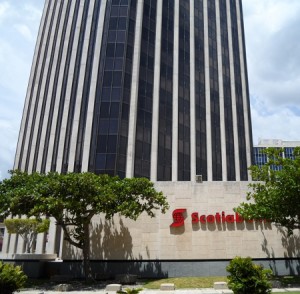
Scotia Group headquarters in Kingston.
Net interest income fell 8.4 percent for the third quarter to $5.7 billion from $6.2 billion in 2020 and slipped 9 percent to $17 billion for the nine months to July from $18.7 billion in 2020. Expected credit losses for the latest quarter of $584 million was a fraction of the 2020 provision. For the nine months expected credit losses dropped sharply to $1.99 billion from $5.25 billion in 2020. Falling interest rates on investments, reduction in lending and growth in funds deposited by the public would have negatively impacted the results. The recent increase in interest rates by the Bank of Jamaica could benefit the group with investments and loans that could generate higher income and widen the net interest income margin.
Net fees and commission income rose to $1.95 billion from $1.65 in 2020 in the third quarter but fell slightly from $5.08 billion in 2020 to $4.99 billion in 2021 for the nine months. Gains on foreign currency activities slipped from $1.75 billion in July 2020 quarter to $1.65 billion and rose 17 percent to $6.2 billion from $5.3 billion for the nine months. Insurance revenues grew to 35 percent in the latest quarter to $696 million from $516 million and fell in the nine months to $2 billion from $2.4 billion. Other revenues brought in $1 billion for the nine months compared to just $39 million for the prior period and are attributable primarily to gains realized on the extinguishment of debt facilities.
Loans advanced to customers that stood at $222 billion at the end of July last year declined modestly to $216 billion at the end of July this year but is up slightly from $214.7 billion at the end of April this year. The report to shareholders stated that mortgage loans recorded growth of 11 percent year over year and is similar to increase up to the April quarter. Growth in loans is essential for the group is it is an area that contributes most to the rise in profits and creates stability in earnings.

Audrey Tugwell Henry Scotia group’s CEO
Segment results show the problem local banks have with retail banking. That segment generates the most income for Scotia but contributes the least in profits. For the nine months to July, Retail Banking contributed $1.3 billion to profit on revenues of $14 billion and in 2020, the segment contributed a loss of $975 million from revenues of $14.5 billion. Treasury generated $1.3 billion in segment profits from $2.9 million in revenues to third parties against $1.46 billion from revenues of $3.1 billion in 2020. Corporate Banking resulted in a profit of $3.5 billion on revenues of $8.44 billion and profit of $3.23 billion on revenues of $8 billion in 2020. Investment Banking delivered a profit of $1.85 billion on revenues of $2.6 billion and profit of $1.3 billion on revenues of $2.29 billion in 2020 and Insurance produced profit of $2.12 billion on revenues of $3.1 billion and profit of $2.5 billion with revenues of $3.48 billion in 2020.
Customer deposits grew 10.7 percent to $371 billion to July, from $335 billion for the comparable quarter of 2020. Investment securities rose from $141 billion at the end of July 2020 to $146 billion after dipping to $116 billion at the end of the 2020 fiscal year and cash resources stood at $147 billion, up from $116 billion at the end of July 2020.
Shareholders’ equity ended at $116 billion at the end of July this year, up from $110 billion as of July 2020.
Earnings per share stood at 90 cents for the July quarter and $2.34 for the nine months this year and should end up around $3.50 for the entire year; for 2022, and earnings should exceed $4 per share. At the close of trading on the Jamaica Stock Exchange Main Market to stock at $39 at the start of the final week of September.
While the stocks trade at 11 times the current year’s earnings, 2022 should see growth in profits, thus reducing the valuation most likely below ten times 2022 earnings.
 Blue Power suffered a reversal in fortunes, with a suspension of exports of soaps to Caricom, following a decision of the Jamaica Government to stop issuing Certificates of Origin for soaps manufactured in Jamaica, using imported soap noodles.

 With just 15 service stations within its network and the planned opening of the Beechwood Avenue station, there is much scope for the company to expand and grow profits in the future, but it seems a bit overdone for Fesco to be priced at a 38 percent premium to the next highest priced stock on the Junior Market.

 At the close of trading on the Jamaica Stock Exchange on Wednesday, the market value for Barita is $99 billion and JMMB $75 billion, nearly 25 percent less than Barita. Why is the market pricing Barita at a steep premium to JMMB? Barita has only a small percentage of its stock in the public’s hands and therefore is enjoying a scarcity premium, while JMMB is far more liquid with more shares in the public’s hands.




 Gross profit for the quarter came in at $279 million, 61 percent over 2020, whilst the gross profit ratio closed at 48.3 percent, similar to the outturn in the prior year. Gross profit for the nine months came in at $751 million, 25 percent more than in the prior year, with $600 million with the gross profit ratio remaining consistent at 48.3 percent, as was the case in the prior year.
 Gross cash flow brought in $230 million and ended with $259 million after working capital financing but ended with $78 million after addition to fixed assets of $84 million, $32 million for the acquisition of investments, loan payment of $4 and the payment of $59 million in dividends. The $84 million in capital expenditure was mainly used to upgrade the vehicle fleet to service new routes and acquire additional manufacturing equipment.
 We projected revenues of $1.465 billion and they delivered $1.449 billion in the quarter. Our forecast for TV revenues was $626.344 million, they reported $639.377. Radio revenues came in at $199.605, somewhat higher than ICInsider.com’s projection of $184.05 and the print division delivered $610,217 million versus ICI’s forecast of $635,697. Other income amounts to $29 million versus IC forecast of $19 million.

Shocking 4 years of Cargo Handlers errors
The number of shares issued by publicly listed companies is very important information for investors to know, but investors would not think so when examining interim financial statements in Jamaica and Trinidad and Tobago of some of the companies.
 There have been so many occasions one has to search high and low to find it if at all it is reported in the interim numbers. This is such a simple matter and the stock exchanges in the region could cure it easily, by making it one of the items that must be included in quarterly reports. It should be included as a part of the statement of movement in Shareholders’ equity.
 Take the matter of segment reporting. Some companies report it quarterly and some only annually. Most correctly report the current period and the comparative previous year’s period. Why can’t the JSE insist on some minimum standards for the benefit of investors so they get information consistently? Limners and Bards is the latest company to provide a quarterly report with no segment results yet they report it in the audited report albeit just one year forcing investors to have to go back to the previous year’s report for the comparison. Seems if that is the approach they should just report the current year’s figures and let investors go back to the previous year’s reports for profit and balance sheet information.
 Communication with investors is a subjective matter but there are some simple matters that it just takes some thinking or consulting to get right.
The latest shocking reporting is that of Cargo Handlers that shows the number of shares issued as a part of the statement of shareholders’ equity. The oddity is the company reporting only 37.466 million issued shares since 2018 when it increased to more than 374 million units. The Jamaica Stock Exchange website shows them as having 416.25 million shares issued and the audited accounts show that the change took place in 2018 the numbers moving from 37.485 to 374.653 million shares. One wonders why no one discovered this glaring error when the list of top 10 shareholders show four of them having more shares than what they list as issued. The error goes back to 2018 for all of the quarterly reports.
This is such a glaring error and neither the Stock Exchange, the Financial Services Commission the directors of the company or its accounting staff have found out.
Our reporting standards are not up to scratch and some persons in the financial system love to talk about best practices globally.
The vast majority of listed companies report profit results with direct and indirect costs and gross profit. But others do not. The group shockingly includes GraceKennedy, 138 Student Living, Knutsford Express. It is full time that companies lift the standard of reporting so that investors can get pertinent information to use in their investment decision making. In response to a question put to Don Wehby about the bulking of all cost on the profit statement suggest that they are in compliance with accounting standards, but that is such a lame and shocking excuse from a company of such standing in the country. Seprod produces it, Jamaica Broilers does it and several other listed companies so why not Grace. Are grace directors suggesting that their shareholders are lesser persons than those of other companies? The case of 138 Student Living is shocking when one considers that the Chairman, Ian Parsard is also Group Senior Vice President – Finance & Corporate Planning at Jamaica Broilers.
AMG Packaging is in a class by itself when it comes to poor communication. The company has embarked on a major capital project, but the directors appear to be of the view that minority shareholders are best kept in as much darkness as possible about it. The audited accounts for 2020 are silent on any commitment to the project.
The latest quarterly the only capital spend, is shown as work in progress on the balance sheet in the amount of $57 million, with no comments on the progress, the total commitment and when it is expected to be complete and be in use. Worse there are no comments on its use. It is noted that the purpose has moved from a warehouse to a factory between 2018 and now.
In the 2018 annual report, the Chairman stated that “the Company recently took an option to purchase an adjoining property. If the transaction is completed, the additional space will be used to alleviate some of the space constraints in the existing facility, making operations more efficient.”
In the 2019 annual report “The Company completed the acquisition on the property at 12 Retirement Crescent which will allow us to expand our operations and to better serve our customers.” The company also stated that they “obtained funding from Proven Wealth Limited to assist with the development of 12 Retirement Crescent. The KSAC is in the process of reviewing the architectural drawings for 12 Retirement.”
The 2020 annual report states, “the company plans on utilizing the strong cash and cash equivalents position into developing 12 Retirement Crescent. The pandemic had caused the development of 12 Retirement Crescent to delay from 2020 to 2021. A contractor has been chosen and the building of an additional 11,370 square feet is set to begin in February 2021.”
In the results to February this year, the only comment made about the development is “that the new steel frame warehouse purchased from China arrived and construction commenced. The financial statement shows WIP at $49 million, with a zero balance in the November quarter.”