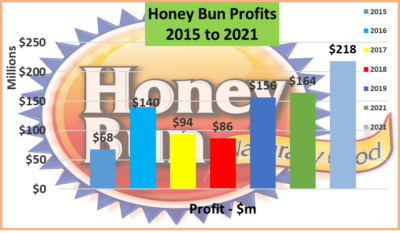
Profit before tax jumped 47 percent at Honey Bun, for the year to September, this year to $289 million from $196 million in 2020 and rose 27 percent to $218 from $172 in 2020 after providing 194 percent more for taxation in the year amounting to $71 million.
 For the three months to September, profit before tax rose 30 percent to $81 million from $62 million in 2020 and after an increased charge of 488 percent in profit tax, profit ended 23 percent lower than in 2020, at $43 million.
Sale revenues rose 37 percent for the final quarter, to $590 million from $431 million in 2020 and a healthy 28 percent for the year, to $2.145 billion from $1.675 billion in 2020, bettering the increase of just 8 percent in 2020 over 2019.
The company suffered a decline in the 2017 profit to $95 million after a solid rise to $140 million from $68 million in 2016, but profit dropped again in 2018 by 8 percent to $86 million. Profit bounced in 2019 by 81 percent to $156 million but only grew 10 percent in 2020, but 2022 could turn out to be a bumper year for the company that has been adding to its product line for the local and export markets if the current growth in revenues continues.
Gross profit margin has been pretty steady in recent years and remained constant at 49 percent in the year, compared to 2020 and was up to 51 percent in the September quarter from 50 percent 2020. The effect, gross operating profit rose 28 percent for the year to $1 billion and 34 percent in the quarter to $ million.
Excluding depreciation, administrative expenses rose 23 percent to $352 million, with wage-related costs increasing by 20 percent, which is a major part of the increase. The administrative wage bill jumped to $207 million from $172 million in 2020. The overall wages bill moved from $428 million to $499 million for the year. Contributing to the wage increase is an increase in the number of persons employed to 219 from 207 in 2020. In the quarter, administrative expenses, net of depreciation, increased 14 percent to $52 million. Selling and distribution costs increased by 19 percent to $348 million for the year and 39 percent for the final quarter to $140 million. Finance costs for the year and last quarter were negligible, but the company generated investment and other income of $19 million for the year, down from $25 million in 2020. Depreciation charge for the year was $71 million, up from $68 million in 2020.
 Gross cash flow brought in $356 million, but growth in working capital, purchase of fixed assets of $101 million, increased investments of $34 million and paying $59.4 million dividends reduced to gross intake to $104 million. At the end of September, shareholders’ equity stood at $1 billion, with long term borrowings at a mere $16 million and short term at $6 million. Current assets ended the period at $637 million, including trade and other receivables of $108 million, up from $723 million in 2020, with cash and bank balances of $404 million. Investments in stocks amount to $96 million, up from $61 million in 2020. Current liabilities ended the period at S230 million. Net current assets ended the period at $407 billion, but the company could draw down on the investment in shares that would swell net current assets.
Earnings per share came out at 46 cents for the year and 13 cents for the final quarter. ICInsider.com forecasts $1 per share for the fiscal year ending September 2022 and $1.40 for 2023, with a PE of 10 times 2022 earnings based on the price of $9.98 the stock last traded at on the Jamaica Stock Exchange Junior Market that is trading with an average PE of 14. The stock should double in price over the next twelve months based on the above forecast and gets the coveted ICIsider.com Buy Rated seal of approval.
Profit bolts 27% at Honey Bun but watch 2022
VM Investments buying Mutual funds
VM Investments (VMIL) has entered into an agreement with Republic Bank (Barbados) to acquire all the ordinary shares in Republic Funds (Barbados) Incorporated, the owner and operator of the Republic Bank Barbados family of Mutual Funds.

VM Investment to acquire Mutual funds.
The funds comprise Republic Property, Income and Capital Growth Funds. The transaction completion is subject to the approval of regulators in Barbados and Jamaica. “VMIL is in an unprecedented growth mode, and we continue to be keen on strategically expanding our footprint throughout the region,” said Rezworth Burchenson, CEO of VMIL.
“VMIL was selected as the preferred bidder following rigorous pre-defined criteria,” VMIL stated. The required regulatory approval process is expected to be completed within six to nine months but could be extended depending on various factors.
ICInsider.com gathers that the total assets under management by the fund could be in the region of J$1.55 billion.
VMIL, a publicly listed company on the Jamaica Stock Exchange since 2017, reported a 69 percent increase in nine months profit to $612 million over the same period in 2020. Profit after tax for the September quarter jumped 82 percent to $348 million, over 2020 out turn of $191 million.
Growth in profits flowed from a 33 percent surge in revenue for the nine months to $1.77 billion, from $1.3 billion in 2020 and a 33 percent increase in the September quarter from $615 million to $818 million. The “performance was primarily driven by the improved investment climate which contributed to significant growth in gains from investment activities which increased by $520 million (270.71 percent) compared with the same period in 2020. These activities generated revenues of $712.17 million for the period,” VMIL informed investors in the release of the results.
Shareholders’ equity increased by $668 million from $3.9 billion at the end of September 2020 to $4.56 billion at the end of September and net book value per share ended at $3.04, up from $2.60 in 2020.
The company reported earnings per share of 41 cents for the nine months and 23 cents for the quarter and could hit 70 cents for the full year with a low PE of 8.6, well below the average for the Main Market of 15.4 at the last traded price of $6.10. the stock is one of ICInsider.com TOP10 stocks.
Profit climbs 35% for Fontana
Fontana reported topline growth of 17.3 percent pushed revenues to $1.3 billion in the September quarter from $1.11 billion in 2020 and drove profit higher by 35 percent for the September quarter, to $61 million from $45 billion in 2020, even as the company suffered a fall in gross profit margin.
 Gross profit margin in the quarter declined to 34 percent from 35 percent in 2020 and 38 percent for the fiscal year 2021 and resulted in gross profit rising 11.7 percent as the cost of sales jumped 20.4 percent to $865 million from $719 million in the 2020 quarter. The Christmas quarter is the best for the company, providing increased margins and much higher sales than the other quarters.
Other income rose 7.4 percent to $15 million from $14 million in 2020. The company’s new Kingston store has not reaped the benefits of patronage from Jamaicans and visitors during the Easter period, with Carnival activities, while its Montego Bay and Ocho Rios stores would suffer fall out from patronage for tourists since March last year.
Administrative other expenses rose 14.4 percent to $331 million from $289 million in 2020, while sales expenses declined by 4 percent to $12.6 million from $13 million. Finance cost declined 15.6 percent to $52 million from $61 million in 2020.The company generated gross cash inflows of $121 million, but movements in working capital, addition to fixed assets and loan repayment resulted in a reduction in cash funds of $26 million from the amount at the end of June of $859 million. At the end of September, shareholders’ equity stood at $1.87 billion, with long term borrowings at $1.24 billion and short term at $152 million. Current assets ended the period at $1.99 billion, including inventories amounting to $995 billion, trade and other receivables of $148 million, cash and bank balances of $83 million. Current liabilities ended the period at $810 million, with net current assets at $1.2 billion.

Profit figures are actual before tax, with 2022 projected based on IC forecast.
Earnings per share came out at five cents for the quarter. IC Insider.com forecasts 75 cents per share for the fiscal year ending June 2022, with a PE of 9.7 times the current years’ earnings based on the price of $7.28 the stock traded at on the Jamaica Stock Exchange Junior Market on Friday, that a vast discount to an average of 14.4 for the market.
The company paid a dividend of 8 cents in June this year. Net asset value is $1, with the stock selling at 7.3 times book value.
The company underwent a significant expansion in setting up the Waterloo Square branch that was opened in 2019 and contributed much to its image, revenues and profit. The growth is unlikely to stop there. When the company went public in 2018, it had five locations that grew to 6 in 2019. The next branch is slated for the highly populated area of Portmore that should come on stream in the latter part of 2022. At the time of the public offer, the company stated in its prospectus that “It is also seeking further opportunities to expand its branch network to better serve the customer base, particularly in growing communities such as Montego Bay and Portmore. Accordingly, the company has good management, and investment in the stocks will deliver good gains in the short and long term, the latter as further expansion drives sales and profit. Based on the positive attributes, the stock gets ICInsider.com, the coveted ICBUYRATED seal.
Profit revs up at overpriced Future Energy

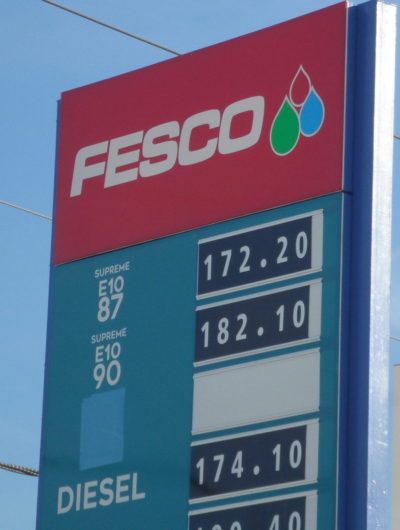
Beechwood Avenue service station.
Profit jumped 45.5 percent before tax for FESCO to $57 million from $39 million in 2020, and for six months to September, pretax profit surged 49.5 percent to $97.2 million above the $64.97 million in 2020. Profit after taxation jumped 121 percent to $57 million from $26 million, in the 2020 September quarter, with taxation eating out $13.4 million in 2020 and for the half year, it moved 95 percent higher to $97 million from $50 million following profit tax of $15 million in 2020.
The company is now on a tax holiday, initially for five years for listing on the Jamaica Stock Exchange Junior Market.
Sales spiked 51 percent to $2.4 billion from $1.6 million in the September quarter and jumped 54 percent to $4.3 billion for the six months to September from $2.8 billion in 2020.
Cost of sales rose 52.2 percent to $2.35 billion from $1.54 billion in the 2020 September quarter and jumped 54.7 percent to $4.2 billion from $2.7 billion in the half year to September 2020. Gross profit popped 22.1 percent to $73.5 million from $60 million in 2020 for the quarter and 37 percent to $128 million for the six months from $93 million in 2020.
 Operating and administrative expenses dropped 15 percent to $17.8 million, from $21 million for the quarter, but rose 29.6 percent to $38 million from $29.55 million in the six months to September 2020.
Gross cash flow brought in $98 million, but growth in working capital reduced the cash provided by operating activities to $72, after receiving $322 million from loans and proceeds from the issue of new shares offset by addition to fixed assets amounting to $136 million, the company improved its cash position at the end of the period substantially. At the end of September, shareholders’ equity stood at $639 billion, up from $255 million at the end of September 2020, with long term borrowings standing at $117 million and short term loans at $7 million. Current assets ended the period at $883 million, up from $312 million in September 2020. The 2021 figure includes trade and other receivables of $551 million, cash and bank balances of $307 million. Current liabilities ended the period at $517 million and $217 million in 2020. Net current assets ended the period at $366 million. The company owned and operated service station on Beechwood Avenue in Kingston was opened recently and will add to sales in the present quarter onwards.
Earnings per share came out at 2.3 cents for the quarter and 3.9 cents for the year to date. IC Insider.com forecast is for 10 cents per share for the fiscal year ending March 2021. Accordingly, the stocks that closed at $3.25 on the Jamaica Stock Exchange Junior Market on Friday boast a high PE of 34 times the current year’s earnings compared to the market average of around 14. Net asset value is 26, with the stock selling at 12.5 book value.
Brighter future in AMG’s vision
AMG Packaging recently released full year results, with profits of $62.6 million, up 11.6 percent above the $56 million earned in 2020, and profit rose 12.7 percent to $20 after tax in the August quarter from $18.4 million after a tax credit in 2020.

AMG Packaging warehouse
Revenues rose a mere 5.3 percent, from $187 million in the August 2020 quarter to $197 million and slipped 2 percent from $720 to $706 million for the entire year. Other income contributed $4 million in the 2021 final quarter versus $1.9 million in 2020 and $6.6 million for the year, from $4 million in 2020.
The company realized an improvement in its gross profit margin that increased in the August quarter to 28 percent from 25.7 percent in 2020 and rose to 29 percent for the year versus 25.3 percent in 2020. Input cost rose 2 percent for the 2021 fourth quarter to $141 million and declined 7 percent for the year to $501 million from $538 million. Operating profit rose 14.5 percent in the quarter to $55 million from $48 million and popped 12.6 percent for the year, to $205 million from $182 million in 2020.

Michael Chin
Administrative expenses rose 28 percent to $27.8 million in the quarter and increased 6 percent to $92 million for the year. Depreciation charge slipped from $6.2 million to $5.9 million for the quarter and rose marginally from $23.4 million to $24.3 for the year and will increase in the new year with the addition of new equipment. Finance cost slipped 7 percent in the February quarter, to $2 million from $2.2 million in 2020 and declined 9 percent from $9 million to $8 million for the year.
The business generated gross cash flows of $94 million but growth in working capital, acquisition of fixed assets. It ended with a cash deficit of $129 million that resulted in a reduction in the $259 million on hand at the end of August 2020. The fiscal year ended with shareholders’ equity of $610 million long, term borrowings at $99 million and short term at $18 million.

AMG paper binding machine
Current assets ended the period at $480 million, including $221 million in inventories, receivables of $96 million, equipment in transit of $33 million and cash and bank balances of $131 million. Current liabilities ended the period at $167 million. Net current assets ended the period at $313 million. Questioned why the amounts in inventories more than doubled, from $107 million in 2020, Michael Chin, General Manager, indicated that three orders placed months ago all came recently, as disruptions obtaining raw material makes continues. Additionally, paper shortage on the world market has seen prices jumping 17 percent for November orders, with the cost, he says, “climbing 46 percent since March.”
Earnings per share came out at 4 cents for the quarter and 12 cents for the year to date. IC Insider.com forecasts 35 cents per share for the fiscal year ending August 2021, with a PE of 5 times the current year’s earnings based on the price of $1.70, the stock traded on the Jamaica Stock Exchange Junior Market Friday. Net asset value is $1.19, with the stock selling at 1.4 times book value.
Chin sees a significant benefit to flow from the $150 million factory expansion and upgrading project. Construction of the new facility is complete and now stores raw and some finished goods. Chin states that machinery and equipment in transit are expected on the island this month and will be installed by February next year.
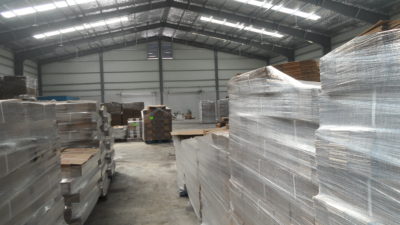
Addition to the factory to house new machine, now used for storage.
“The new machine will lead to a reduction in operating costs and provide capacity to increase production, using either virgin or recycled paper,” Chin informed this publication. One existing machine will be retired with the new one in place. Accordingly, “the new machine will do the work of two machines currently, that will involve, cutting, folding boxes and printing in multi-colour, in one seamless operation,” Chin advised. Another benefit of the new operations is the ability to store finished goods, which will allow for more continuous operation processing. It will also provide adequate space to store recycled paper in large quantities that were not possible, before the completion of the expansion, as it requires in house storage, unlike the virgin paper that can and is stored outside.
Looking forward, Chin indicates that production is back to pre Covid19 levels in the past two months; he explained that the company now employs a sales representative who will seek new business after the installation of new machinery and operational. Directors will be meeting on November 16 to consider the payment of a dividend; the last dividend was 2 cents paid in December 2019 when the profit was $59 million with earnings per share of 12 cents.
A rebounding Access is IC buy rated
Profit surged 216 percent after tax, to $90 million for the micro lender, Access Financial Services in the second quarter to September this year, from $29 million in 2020, with pretax profit spiking 287 percent from $33 million to $129 million, as the company’s turnaround continues to gather pace from the depressed 2020 pandemic effects.
 For the six months to September, profit after tax jumped 192 percent to $180 million from just $62 million for the similar period in 2020, while profit before tax jumped 192 percent to $241 million from $82 million.
Net operating income rose 9.4 percent from $887.5 million to $971 million for the six months and $457 million to $507 million for the September quarter.
The most important contributor to income, loan interest, rose 13.5 percent for the quarter to $419 million from $369 million in 2020 and rose 8.7 percent from $743 million to $807 million for the 2021 half year.
Operating expenses for the period fell 9 percent to $730 million, from $805 million in the prior year and from $424 million in the September quarter this year to $$378 million. The reduction partially helped from loan loss provision declining from $111 million in September 2020 quarter to $60 million this year and decreased 32 percent for the six months to $121 million from $178 million. In addition, loans written off fell to $58 million for the half year from $69 million in 2020 and at the end of June, loans written off was just $10 million compared to $39 million in 2020 for the similar period.
Earnings per share for the six months was 65 cents compared to 22 cents for the prior year and 33 cents for the quarter.

Access Financial Services head office.
ICInsider.com projects earnings per share of $2.40 for the current year and $4.80 for 2023, assuming that lending continues to grow in double digits per annum. The projection in earnings is one reason for the IC Buy RatedICTOP10 Dolphin Cove jumps 25% label others are good management, the provision of service in demand and good medium term growth prospects.
Loans rose from $3.89 billion to $4.38 billion year over year and are up 6 percent in the September quarter over June this year, representing a nearly 25 percent annual increase. Cash funds slipped from $683 million at the end of September 2020 to $397 million. Loans payable amounts to $2.54 billion from $2.7 billion at the end of September 2020. Stockholders’ Equity stands at $2.56 billion. Access will be paying a dividend of 10 cents per share on November 26, 2021, adding to a similar amount paid in August, 20 cents in July and 10 cents in February.
JSE 9 months profit surge demands caution
Profit after Tax surged 156 percent for Jamaica Stock Exchange in the 2021 third quarter to $187 million over the $73 million generated in 2020, as revenues jumped 66.5 percent to $621 million, from $373 million earned in the September 2020 quarter.
Revenues and profit for the above period got a healthy injection from a significant $14 billion trade in National Financial Group in July and a sizable exchange of Barita Investments shares of 38,808,202 million units on September 28, valued at $3.99 billion that made up 47 percent of overall trading in the month.
 The NCB trade pushed trading in the Main Market in July to $16 billion, well up on the over $8.5 billion regular tradings that occurred in August and up September $8.37 that benefited from the one-time Barita trade. Regardless of the one-off trades, the third quarter trading is well up on the first half of the year with an average of $2.8 billion per month. Junior Market trading for the quarter is well up on that for 2020 and is up 53 percent in dollar terms for the nine months to September, with the September quarter up a robust 114 percent over last year. Junior Market trading is $5.2 billion for the year to September and represents less than the trading in the Main Market in September alone.
Performance for the nine months was less spectacular, with total revenues rising 17 percent to $1.47 billion from $1.26 billion and profit climbing a respectable 32 percent to $378 million from $286 million.
Income from cess grew sharply to $232 million from just $57 million in the September 2020 quarter and $366 million from $232 million in the 2020 nine months. Fee Income rose from $298 million to $369 for the September quarter and from $933 million to $1.02 billion this year to September.
Total Expenses increased by 33.7 percent to $352 million from $263 million to the September 2020 quarter but increased by 11 percent in the nine months to $942 million from $839 million in 2020.in 2020. Staff Cost increased by $53 million due to salary adjustments and additional staffing, Property Expenses increased by $22 million attributed to increases in maintenance costs and licenses expense and Securities Commission Fees climbed by $23 million over the prior year.
Total current assets amount to $980,975, with cash and investments standing at $642 million and receivables of $335 million. Total current liabilities stood at $336 million. The group has long term investments of $221 million.
Shareholders’ Equity rose to $1.72 billion from $1.39 billion at the end of September 2020 and $1.53 at the end of December last year.
The company paid a dividend of $191 million during the year compared to $365 million in 2020.
Operating cash flow before movements in working capital brought in $601 million, but the group ended up with $430 million from operating activities after paying corporate taxes of $195 million.
Looking forward earnings per share that are up to 54 cents for the nine months from 41 cents in 2020 could end the year at 70 cents, but the signs are not very good with main market trading less than half of trading in August and September, but trading could pick up in the two remaining months of the year, helping to improve the company’s fortunes.
For 2021, there are positives and negatives with the expected rebound in the economy with tourism number rapidly growing BPO expansion and hopefully more new listing on the exchange. On the negative side, increased interest rates that are now in place could crimp trading activity they move much high in 2022. If confidence returns that could boost trading and generate more revenues and profits for the exchange currently at $17.50, the stock trades at a rich PE of 25, not excessively rich, but there is no room for growth presently, with the market average at 15.5.
Mayberry Jamaica shed 50m Lumber shares

Lumber Depot dominated trading with
Lumber Depot, the 2019 spinoff of the Junior Market listed Blue Power, reported record first quarter results to July, with profit of $72 million, up from $30 million in 2020, with earnings per share of 10 cents and attracted increased buying in the stock as the results hit the exchange on September 8.
Mayberry Jamaican Equities (MJE) pounced on the renewed buying interest and sold just under 50 million units in the market up to October 20.MJE slashed their holdings of 181,538,726 shares, with 25.7 percent of total issued capital at the end of July to 132,468,464, but they remained the largest shareholder at 18.76 percent.
Over the same period, Blue Power Group, the second largest shareholder, reduced their 101,989,250 holdings to 14.4412 percent to 98,989,250 or 14.02 percent. Blue power in January held 113,989,250 shares, with a 16.14 percent holding. Kenneth Benjamin, a director of Blue Power, holdings in January of 49.95 million rose to 59,954,650 units or 8.4893 percent but slipped to 58.4 million in October.
Since October 20, the average daily trade in the stock has been 773,546 units, with the lowest trade, 522,227, on the 21 of the month.
SVL Q3 revenues loss exceeds $800M
Revenues popped 22 percent to $19.3 billion for the nine months, up from $15.94 billion for the gaming company Supreme Ventures, but revenues were virtually flat third quarter with sales of $6.3 billion versus $6.266 billion in 2020. ICinsider.com computation suggests the revenue loss could be around $800 million, but there are suggestions the loss could be twice that amount.

Profit after tax for the nine months slipped marginally from $1.55 billion to $1.54 billion, but third quarter profit plunged 48 percent from $596 million in 2020 down to $311 million. Earnings per share ended at 57.7 cents and 11.8 cents for the quarter.
Lockdown during the quarter due to the spread of Covid19 resulted in reduced revenues and lower profit, Executive Chairman Gary Peart advised ICInsider.com. Taxation ate up $673 million for the year to date versus $725 million in 2020 and for the 2021 third quarter, $186 million, down from $246 million in 2020.
Direct cost rose 15 percent year over year to September to $25.2 billion, from $21.94 billion in 2020 and down just two percent for the latest quarter to $7.99 billion as gross profit was constant at 79 percent in all periods, leaving profit margins at 21 percent and translating to an increase of 9 percent to $6.54 billion in the September 2021 period, from $6 billion in 2020 and a decline of 3 percent for the quarter to $2.17 billion.
The Lotteries segment reported Gaming income of $14.4 billion and delivered segment results of $2.3 billion, for an increase of $388 million or 2.8 percent, over that of 2020, but the results for the third quarter show a revenue loss of $800 million compared to the June quarter and seems directly related to the no movement days instituted during the period. Segment results declined $626 million or 21.5 percent year over year and were down 17 percent in the quarter from $907 million to $743 million.
The Sports Betting reported segment profit of $509 million from gaming income of $8.5 billion, an increase of 62 percent over 2020. “The growth is due significantly to the attractiveness of the offers and flexibility to game, enhanced with the use of the mobile platforms and support of the eCommerce platform”, Peart advised investors. Revenues were flat in the third quarter over the June 2021 quarter. PIN codes sales declined marginally, from $8.6 billion to $8.53 billion, while reporting segment results of $139 million and was virtually flat in the third quarter over the second quarter.
Selling, general and administrative expenses rose 23 percent for the nine months to $4.48 billion and 24 percent for the quarter to $1.6 billion. The stock last traded on the Jamaica Stock Exchange at $18 at a PE of 20 times earnings.
Revenues at The Lab to hit the billion mark
Revenues at Limners and Bards are set to hit the billion mark this year, with the nine months to July hitting $942 million, up 37 percent from $686 million in 2020 and the full year to October 2020 coming in at $912 million.
 The topline performance led to profit rising 32 percent from $108 million to $142 million, with earnings per share of 15 cents. Quarterly profits climbed 35 percent from $21 million to $29 million from a 50 percent rise in revenues from $215 million to $323 million.
The revenue growth was driven by media placement (up $142.4 million or 39.4 percent) and production (up $115.9 million or 62.2 percent). There was a reduction in agency (down $2.4 million or 1.8 percent) during the period, Steven Gooden, Chairman and Kimala Bennett, Chief Executive Officer, stated in the Key Performance Highlights report.
The company enjoyed a big jump in finance income in the quarter and year to date periods with an income of $5.5 million for the quarter, up from $1.4 million in 2020 and $20.5 million for the nine months from $3.6 million last year.
Gross profit rose 25 percent to $285 million for the nine months to July, from $227 million and $82 million up 35 percent from $61 million. Gross profit mrgin slipped to 30 percent for the nine months to July, up from 33 percent in 2020 and for the latest quarter 25 percent from 28 percent in 2020.
Administration expenses increased $38.6 million, or 32.4 percent in comparison to the previous nine months period. These increases are primarily attributable to staff costs (increased work volume), repairs and maintenance of production equipment, depreciation and amortization charges and lease interest. Even with this increase, administrative expenses as a percentage of revenue remains relatively flat at 16.7 percent compared to 17.3 percent in the previous period.
 Administrative expenses rose a robust 44 percent to $57 million in the quarter and increased 32.4 percent in the nine months to $157 million but the year to date amount remains steady at 15.3 percent of sales revenue and, while the third quarter represents 17.7 percent of sales down from 18.5 percent in 2020, well below the growth in revenues. . Sales and distribution expenses increased from zero percent to $8,000 in the quarter and were flat at $537,000 for the nine months. Finance cost rose in the quarter to $32,000 from $21,500 in 2020 and from $4 million to $5.6 million for the nine months.
Gross cash flow brought in $155 million, the paying $70 million dividends the operations added $68 million to $380 on hands the beginning of the year to end at $449 million at the end of July. Shareholders’ equity stood at $536 million, with long term borrowings at $106 million and short term at $3 million. Current assets ended the period at $657 billion, including trade and other receivables of $184 million, cash and bank balances of $449 million. Current liabilities ended the period at $185 million. Net current assets ended the period at $472 million.
The stock traded at $3.50 on the Junior Market of the Jamaica Stock Exchange on Friday. IC Insider.com forecast is for earnings per share of 20 cents for the current year to October and 33 cents per share for the fiscal year ending 2022 with a PE of 17.5 times current year’s earnings, but 10.6 based on 2020 earnings. The average for the market based on the current year’s earnings is 12.7.
The company paid two dividends of 7.4 cents in January and 3.6 cents in August this year, amounting to $94 million. Net asset value is $0.57, with the stock selling at 6 times book value.