 National Commercial Bank net profit for 2014 hit $11.6 billion, a big jump from the NDX affected $8.58 billion in 2013. Earnings per share for the year ended at $4.73 just below IC Insider forecast of $4.80.
The 2013 profit was negatively affected by a huge $1.5 billion charge, from losses picked up when they exchanged high yielding government bonds for lower yielding ones and $680 million written off relating to the attempt to list on the New York Stock Exchange. The group is reporting net profit of $2.87 billion, for the September quarter compared to $1.8 billion in 2013, the latter was affected by a number of one off charges.
The 2013 full year was also negatively impacted by a $281 million hit from receivership expenses, an increase over the amount spent in 2012 of $172 million and a healthy rise in Technical, consultancy and professional fees of $1.09 billion compared with $846 million in 2012.
This year results benefited from a few one off items as well. Gain on acquisition of subsidiary contributed $301 million and gain on sales of shares in Kingston Wharves added $349 million but this is in lieu booking their share of profits for the quarter had they not sold. The group suffered a loss of $200 million on securities impairment and critically, although loan loss provision is up $200 million, the large increase in the final quarter is $700 million more than at the same time in 2013. For the full year, loan losses amount to $2.2 billion versus $2.1 billion for the previous year.
Salaries allowances and benefits cost was down in the quarter to $2.6 billion from $2.9 in the similar quarter, and for the year to $11.5 billion versus $11.2 billion in 2013. Other operating cost was up to $10.4 billion for the full year, from $9.4 billion in 2013 and for the quarter $3.1 billion from $2.8 billion.
Growth| For 2014, loans grew pretty strongly by 12 percent, moving from $143.6 billion to $157 billion and customer deposits of $202 billion, increased by $23.8 billion, or 13 percent, resulting in net interest income being steady, in the September quarter, for both years, as well as in the June quarter at roughly $6 billion each. Net interest income was up $1 billion for the year over 2013 to reach $24.66 billion from $23.56 billion. Fees and commission income moved up to $10.6 billion net, compared to $9.7 billion in 2013. Premium income grew to $7 billion from $5 billion in 2013. Gains on sale of debt securities and foreign exchange trading gains jumped to $2.6 billion versus $1 billion in 2013.
Segment| Segment results were mixed with strong increases in some, while other areas fell below the 2013 performance. Retail & SME, reported improved profits for 2014 of $1.56 billion versus $793 million in 2013. Payment Services climbed down from $2.1 billion to $1.57 billion in 2014, Corporate Banking ended 2014 with $500 million versus $850 million previously, Treasury & Correspondent Banking jumped from $1.87 billion in 2013 to $3.7 billion in the latest year. Wealth, Asset Management and Investment Banking moved down from $3.88 billion to $3.6 billion, Life Insurance and Pension Fund Management climbed from $2.17 billion to $2.9 billion and General Insurance income of $557 million in 2013 jumped to $1.28 billion.
NCB hiked their final dividend for the year to 96 cents per shares. IC Insider’s forecast for the 2015 earnings is $5.75 per share and with the current price at just over $18 per share the stock is severely undervalued with significant upside potential.
NCB 2014 profit trumps 2013 by a KM
More insider buying at Sagicor
 Sagicor Group have been enjoying trades by insider on several occasions this year. The group recently advised that a director purchased 249,648 shares between November 27 & December 1, this year.
The last time before this that an insider traded in the company’s stock was in October, when the company advised that an executive Purchased 417,016 shares under the SGJ Executive Long Term Inventive Scheme on October 24, 2014.
The financial group saw a sharp fall in profit in the quarter, from $1.56 billion to $1.1 billion and net profit of $3.84 billion, with $3.79 billion available to stockholders, for the nine months to September, which was 2.5 percent better than in 2013. the decline in profit in the September quarter is due primarily to cost associated with the acquisition of RBC Royal Bank local operation at the end of June this year. With staff reduction, branch closures and amalgamations, the losses in the acquired banking operation should be sharply reduced from that in the September quarter.
$1.2B gaming losses force SVL to act
 $1.2 billion is the number for losses at the Gaming and Hospitality segment at Supreme Ventures Limited Revenues in three years. Losses worsened from $252 million in 2012 when it jumped to $553 million last year but was down to $376 million up to September this year from $440 million in 2013.
There were no noticeable improvements in the losses in the September quarter. The substantial losses amounting to 47 percent of profit in the lottery segment in 2013 and 31 percent in 2014, with no noticeable reduction in the losses, forced management hands to take action. The losses in this segment coupled with losses in sport betting, contributed significantly in negating the profits from the lottery segment.
On December 1, (SVL) advised that they will close operations at the Odyssey Gaming Lounge at Market Place in Kingston and Castle Gaming Lounge VLT operations, in Portmore on December 1. SVL advised that the Lottery and Sports Betting Unit at the facility in Portmore will remain open for normal business operations and that it will focus all its energies on the flagship gaming lounge – Acropolis Barbican, with enhancements to its offerings in these locations.
The company further advised, that it will focus its energies on the continued development, of what it says is its profitable Acropolis Gaming Lounge. Over the next two to three months SVL will be expand the gaming floor, along with greater focus on improving the customer experience through wider game options, increased payouts and improved food & beverage offerings. The consolidation will result in a re-allocation of staff and other resources to meet the expanded needs at Acropolis Barbican. However, approximately 20 positions will be made redundant, after a reallocation of staff resources to meet the new needs at Acropolis Barbican. Will those changes be enough to eliminate the more than $500 million loss in the segment is left to be seen? The move should reduce the losses going into 2015 with less rent and staff cost.
The company also has to deal with the Sports betting losses which worsened even as revenues climbed from $177 million in 2013 to $418 million in 2014. The sharp growth in sports betting is attributable to betting on world cup football games. The segment lost $87 million in 2013 and $148 million in 2014 so far.
Big profit recovery at Salada
 Salada Foods lost money in the final quarter of their 2013 fiscal year to September, but enjoyed a major turn around this year in the same quarter, with profit rising to $60 million after tax, from a loss of $5 million.
On the pretax basis, the change was even more impressive, with a loss of $20 million last year to a profit of $62 million in the September 2014 quarter. The final quarterly results, helped to change the fortunes of the company from declining profit for the nine months ending June this year, versus 2013 to a 19 percent increase to $105 million for the year to September this year from $88 million in 2013. The operations for the Roberts brands, Mountain Peak Processors and Primora Company reduced the pretax profits with losses of $33 million for the year, from revenues of just $8.3 million and $4.4 in 2013. Salada ended with earnings per share of $1.01.
The impressive last quarter earnings, flowed from a doubling in sales moving it from $143 million in 2013 quarter to $297 million, this year. Sales revenues grew 16 percent for the year to $736 million up from $634 million in 2013. While sales rose, interest income fell in both the quarter and the full year. Administrative expenses climbed 92 percent in the quarter and 17 percent for the year to September, but sales and marketing cost fell in both periods.
Salada changed distributorship at the start of the year. Prior to the change, the company was concerned that the former distributor was holding high levels of inventories of their product. The falloff in sales earlier in the year, the sharp uptick in the September quarter could be attributable to excess supplies in the market for coffee, being removed. The sharp increase in sales in the September quarter, should lead to higher income in the December quarter and the rest of the 2015 financial year and should raise earnings to the $1.60 per share level.
 Receivables climbed from $67 million in 2013 to $240 million of which $201 million is owed for 30 days or less. Inventories fell from $251 million in 2013, to $227 million in 2014 but the composition is vastly different. While raw materials in 2013 amounted to $162 million, is now down to $93 million at the same time finished goods and work in progress at $44 million and $67 million respectively compared to $28 million and $36 million at the end of the year. The increase in finished goods and work in progress, along with the healthy receivables position, suggest that the sales in the September quarter are sustainable.
At the year-end cash is at $75 million accounts payable at $99 million with no interest bearing debt.
Investors can expect to see some recovery in the stock price that is now at $6.50 having fallen from $10 earlier in the year with the lower profits up to June.
the company announced that the directors would be meeting on December 5, to consider the payment of a dividend.
138 Student Living gets money
 138 Student Living Jamaica received the full amount they sough from the capital market, when the initial public offer, was fully taken up at the close of the offer, on Thursday 4 December, JMMB Securities Ltd reported to the Jamaica Stock Exchange.
According to a release from the brokers “all of the Ordinary Shares and Preference Shares offered for subscription by the Company, valued at $500m in the aggregate were fully taken up. All Applicants will receive a full allotment of the amounts that they applied for.”
The Company offered 82,900,000 Ordinary Shares at $4 each and initially, 33,680,000 subject to an option to increase the amount up to 60,000,000 Cumulative Redeemable Preference Shares at $5. In addition shareholders of the company offered for sale 15,716,667 ordinary shares at $4 each to raise $62.8 million and received $31.3m.
The Company will now apply to the Jamaica Stock Exchange for the listing of the Ordinary Shares and the Preference Shares on the Main Market of the JSE.
Scotiabank T&T full profit recovery
 Scotiabank reported an 11.75 percent increase in their loan portfolio for the year to October as loans reached $11.8 billion. Most of the growth took place after April and helped to push up revenues and profit in the second half of the year.
At mid-year to April loans, climbed from $10.575 billion at the end of October last year to $10.85 billion, growing by only 2.6 percent, well below the yearly growth to October. At the fiscal mid-point, profits were down in both the April quarter and the half-year, versus the prior year periods. Net income after tax for the July quarter, amounted to $140 million, an increase on the $134 million earned for the same period last year.
For the nine months to June, profits fell to $390 million from $404 million, but it represented an improvement over the decline in the six months results, with profits of $250 million versus $270 million in 2013. The second quarter results of $105 million compared with $128 million, in 2013, was one of the factors pulling down the results, as net revenues fell compared with the prior year.
With things starting to look up from the June quarter, the bank rolled out a respectable 11 percent increase in their October quarter profit after tax to hit $170 million versus $153 million in the same quarter in 2013 and a slight increase in the full year results which moved from $557 million to $560 million.
Loan loss provision rose from $4 million in 2013 to hit $28 million in 2014 and $9 million for the October 2014 quarter. Non-interest expenses were held tightly with virtually no increase in the October quarter with $173 million versus $172 million in 2013 and for the full year $639 million versus $612 million.
Banks make the bulk of their income from lending. If good loans are growing profits will usually grow if not, profits will tend to be much harder to grow. Loans grew 10 percent between July and October or 20 percent annualised but the growth in the October quarter was a more tepid 3 percent or at the rate of 12 percent per annum. This lower rate could well be a more sustainable level going forward, which will be enough to result in increasing profit at a reasonable pace.
Based on the last quarter results, investors should be looking at earnings per share climbing from $3.17 this year to be in the $4 region next year, as the bank overcomes the poor first half of the 2014 fiscal year.
The major concern, has to be the impact that the sharp fall in world oil prices will have on the Trinidad’s economy and the effect on the bank. That is something worth watching. Additionally, interest rates have been moved up, by the country’s Central Bank and could go higher, in the 2015. Rising interest rates can be negative for stocks.
Minimal branch closures at BNSJa

Jacqueline Sharp CEO of Scotia Group
Sharp was addressing the press, in providing an update on the group’s operation for the year to October. The local group closed their Westgate and Barnett street branches, with the opening of the new branch at Fairview, just outside of the old Montego Bay city centre. “The main branch in Sam Sharp’s square remains open. Due to the limited branch closures no provision was made in the 2014 accounts and the staff at the closed branches were absorbed within the group,” Sharp said.
 The Canadian parent had announced closure of branches and staff cut of 1,500, to trim cost and better align branches with customer demand. But Sharp stated that the local operation was always looking at ways of making the operation more efficient and will focusing on this aspect going forward.
Business as usual locally, comes against the back ground of Scotia Group making profit of $10 billion versus nearly $11 billion in 2013, but more importantly, the banking operations made profit of $3.935 billion vs $3.99 billion in 2013 after absorbing additional asset tax cost of $260 million.
Lower Q4 profit squeezes Scotia Group
Scotia Group Jamaica (Scotia Group) reported profit after tax of $10.1 billion for the year ended October, 2014, a decrease of $774 million or 7 percent compared with the net income of $10.9 billion in 2013.
The results for the fourth quarter of $2.5 billion represents an increase of $129 million or 5 percent over the same period last year, and a decrease of $188 million or 7 percent compared to the previous quarter ended July, 2014.
Earnings per share were $3.14 compared to $3.37 in 2013, and the Return on Average Equity was 13.41 percent, down from 15.67 percent last year. During the October quarter, income from foreign currency trading fell sharply from the July quarter, from $636 million to only $234 million and insurance revenues dropped from $661 million to $495 million, a fall of $166 million or 25 percent. While insurance income was higher than in the 2013 quarter at $476 million, the foreign exchange trading gains was still well below the $677 million generated in the 2013 quarter. Loan loss impairment fell to $227 million in the October 2014 quarter slightly higher than the $191 million in 2013 but much lower than the $497 million in the July 2014 quarter.
Jackie Sharp, President and CEO said, “Scotia Group experienced another year of solid performance across all business lines. We saw 9 percent growth year over year in our Commercial & SME portfolios; 6 percent growth in our retail loan portfolio; 12 percent growth in mortgages; and our Premium Money Market Fund which is offered by our subsidiary, Scotia Investments surpassed the $10 Billion mark. During the last half of the year, we have seen strong growth and we are poised for another successful year in 2015.”
Net interest income after impairment losses for the year was $22.9 billion, an increase of $57 million compared to 2013. Other revenue for this financial year amounted to $10.9 billion, a reduction of $465 million or 4 percent compared to 2013. Net fee and commission income remained stable year over year, despite the growth in loan and transaction volumes. Net gains on foreign currency activities decreased by $767 million, while net gains on financial assets increased by $520 million compared to the prior year.
 Operating Expenses for the year amounted to $20.2 billion, an increase of $527 million or 2.7 percent compared 2013. The Group experienced an increase in the asset, premium and minimum business taxes of $861 million as a result of the increased rates implemented earlier in the year.
Loans, after allowance for impairment losses amount to $145.7 billion as at the year-end is only up by just over $1 billion from the $144.6 billion at the end of the July quarter but increased 8 percent from $134.8 billion in October 2013.
Non-performing loans (NPLs) at October 31, 2014 totaled $4.9 billion, reflecting an increase of $411 million from prior year. Total NPLs now represent 3.32 percent of total gross loans compared to 3.29 percent last year and 3.31 percent as at July 31, 2014.Interest rates are falling on the deposit side that shows up in lower interest cost in the October quarter over that of the July quarter.
Looking ahead|Scotia should be able to manage the net interest income to their benefit going forward as Treasury bill rate continue to fall. The lower foreign exchange earnings in the last quarter is tied up in the revaluation of the Jamaican dollar during the quarter and should show improvement in the January 2015 quarter with some moderate slippage in the value of the Jamaican dollar. The slow growth in lending is likely to continue for a while longer and will act as a drag of accelerated income and profit growth. Investors should be looking for a gradual growth in profit rather than a big spurt, at any rate earnings should be climbing towards the $3.50 level in 2015.
The Board of Directors approved a final dividend of 40 cents per stock unit payable on January 13, 2015. The stock closed at $20, at the end of trading on the Jamaica Stock Exchange on Friday.
More stocks added to buy rated list
Mayberry Investments is one of the latest stocks to be added to the buy rated list based on stability in earnings, but mostly based on what seem likely to be improvement in the Jamaican stock market going forward and the gains that could accrue to the company if trading levels and stock values pick up.
 Scotia Trinidad and West Indian Tobacco were restored to the list with expected higher earnings in 2015 than in 2014 as well as Scotiabank’s fall in price below $60 per share.
Jamaica’s junior market stocks get expanded, partially based on where prices are now and reasonable profits generated for 2014 so far, with increased earnings likely in 2015. Paramount and Medical Disposables were elevated to BUY RATED and Access was restored to the list.
The Jamaica Stock Exchange is being watched for a possible upgrade form Market Watch to Buy Rated.
Interest cost jump burdens C&W

Cable & Wireless HQ Kingston
At the same time, profit before finance cost moved from a loss of $179 million in the six months to September, to a profit of $645 million. Higher finance cost, jumped from $730 million to $1.98 billion for the six months, from the year before, resulting in a similar loss as in 2103 of $600 million for the quarter and $250 million lower than in 2013 for the six months, to end at $1.32 billion.
Mobile subscribers grew by 125,000 during the April to September period and Mobile traffic increased by 34 percent and mobile service revenue is up 38 percent, the company reported.At the end of March Cable & Wireless stated that they had 705,000 mobile customers. The increase since March, puts active mobile customers at roughly 830,000, by the end of September. At the end of June this year, Mobile subscriber base increased by 37 percent with revenue increasing by 34 percent, broadband base increased by 12 percent with revenue up 39 percent. The continued strong growth in mobile customers is resulting in increased revenues for the local company, moving them closer to a break-even point.
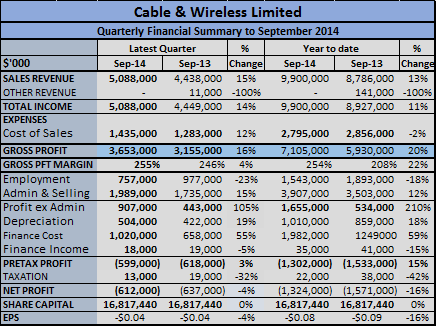 The company cut employment cost sharply for both the quarter and six months but increased marketing spend to push various mobile and internet plans and boost the customer base, which should redound to benefit increased revenues, going forward.
The second half of the year is more profitable for the company, with the revenue to be booked for the telephone directories and lower marketing cost in the final quarter of the year. Lower Treasury bill rates should see the interest rate that is used to book interest, being lowered by almost 25 percent compared with the first half of the year. IC Insider is projecting a profit in 2015/16 as revenues should continue the strong growth with the push to capture a larger portion of the cellular market and the double benefit of lower out payment cost per customer as the base grows and increase revenue from voice and data.