 There has been much made about the OUR cutting the rate for Jamaica Public Service (JPS) and the likely effect on investment in the sector. Unfortunately, many who are critical of the reduction failed to make the point that when JPS was guaranteed a 16 percent rate of return, interest rates locally were well above present levels.
Secondly, just over 12 percent after tax is a good rate of return when one considers that international interest rate are so low and treasury bills rate locally, have been declining and is now under 7 per annum. One of the most telling factors is that JPS is by no means the most efficient company especially with its plants, and newer ones will reduce cost to operate, thus helping to improve their bottom line. Most telling now, is that the lower price of electricity occasioned by lower oil prices will drive up consumption thus helping to improve JPS profits. With the latest announcement of a cut in billing rates JPS must be quietly cheering and hoping that oil remains low for a very long time.
In its latest release the power company states that “the Fuel & IPP charge on bills will be reduced by 18%, moving from $19.350 per kWh in January to $15.760 per kWh on bills this month. This will contribute to an overall reduction of 11% on customers’ bills should their usage remain consistent.”
It is also important to note that the Fuel and IPP Rate in US terms for February is 13.608 cents, the lowest the rate has been in US denomination in almost six years. The Fuel and IPP charge makes up more than 60% of customers’ electricity bills, and changes from one month to the next, depending on how much JPS pays Petrojam for the oil used to produce electricity. The fuel rate that appears on bills each month is based on the cost of the fuel used to generate electricity in the previous month.”
“JPS encourages customers to continue their conservation efforts, despite the drop in the Fuel Charge on bills, as the total amount on bills is determined by how much electricity is used.”
Lower rates to drive JPS profits
59% jump in Medical Disposables’ profit

Kurk Boothe – Medical Disposables Managing Director. the company stock fell a new low on Monday, in spite of healthy profit gains.
For quarter revenues jumped to $308 million compared to $236 million for the quarter to December 2013 and in gross profit climbing 42 percent to $81 million for the December 2014 quarter. Gross profit for the nine months to December amounted to $216 million, an increase of 32 percent. Sales revenue for the nine months ended at $848 million, an increase of $183 million or 27 percent.
Expenses rose sharply for the quarter and the year to date. Sales and distribution rose 45 percent in the quarter and 20 percent for the nine months. Administrative expenses increase by a lower 29 percent for the quarter and a robust 49 percent for the nine months. Finance and o0ther cost moved up strongly for both the quarter and year to date to hit $14 million and $27 million respectively.
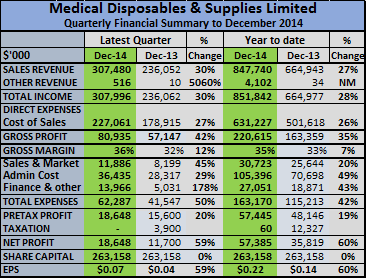 “The increase in expenses was driven mainly by staff related expenses, utilities, professional fees and information technology services. Staff related expenses, in particular, increased because of the strategic decision to realign the staff complement and compensation to sustain the current growth, development and expansion of the business” Kurt Boothe, General Manager stated in his report to shareholders.
Profit for the quarter came in at $18.6 million as it surged by 59.4 percent compared to $11.7 million generated in 2013. Profit after tax for the nine months hits $57 million, an increase of 60 percent. Earnings per share came in at 7 cents for the quarter and 22 cents for the nine months and should end up around 30 cents for the full year.
Medical Disposables is listed on the junior market of the Jamaica Stock Exchange and last traded at $1.80.
Carreras’ owners enjoying dividends
 Carreras declared an interim dividend of $1.60 per share payable on March 12, 2015 to shareholders on record as at February 20. The stock will traded ex-dividend on February 17.
The company last paid dividend of $1 per stock on December 18, and an interim dividend of $1.20 per stock unit on December 11, 2014. The payment will bring to total for 2014 to $8.09 for a return of 22 percent for the year based on the stock price of $36.75 at the end of 2013.
In September, last year Carreras paid an interim dividend of $1.20 per stock unit, $1.75 per stock unit was paid on June 26. On March 13, 2014 they paid $1.62 per share.
A special capital cash distribution of $1.34 per stock unit was paid on July 31 and a special capital cash distribution of $1.18 was last paid on January 30, last year. The company still has more capital distributions to make when they receive the proceeds from the sale of the property in Twickenham Park which is sold at $395 million before transfer cost and the balance of funds due from the tax authorities for over payment of company taxes which amounted to $940 million at the end of September, last year.
The stock traded as high as $45 on Wednesday February 11, on the Jamaica Stock Exchange.
Barita Faces challenges but..
 Barita Investments profit after tax dropped 21 percent to $46 million for the quarter ending December 2014 compared to the similar period in 2013, from total revenues of $345 million and net operating revenues of $177 million. In 2013, the company that is involved in stockbroker and fund management reported net operating profit of $165 million but increase expenses helped to pull down profit for the quarter.
Interest Income contributed $230 million to revenues, 15 percent below the prior year, while related interest expense remained flat at $168 million.
Barita is suffering from a mixture of assets priced for shorter periods than the funds clients’ invest with them. According to Chairman Rita Humphreys, “in an environment where interest rates have decreased, our liability costs have been similarly reduced resulting in our interest expense decreasing to prior year levels. However, with our investment portfolio comprising of approximately fifty percent variable instruments, our interest income has decreased at a faster rate. This has resulted in a significant contraction in our margins resulting in a recorded net interest income of $62 million, approximately 36 percent down from prior year.”
Fees and Commission income rose 65 percent above prior year to $38 million, with improvement coming from the subsidiary Barita Unit Trusts. Additionally, trading gains were 600 percent above prior year at $48 million compared to only $8 million in 2013. Depreciation of the Jamaican resulted in translation gains of $21 million down from $29 million prior year.
“Staff and administrative expenses contributed to a 16 percent increase in operational costs when compared to the same period last year. Staff costs increased by 10 percent which was triggered primarily by additional human resources and remuneration adjustments. Administrative costs were 25 percent higher than last year, with the main contributors being financial support for our charity arm the Barita Education Foundation and client support expenses,” the report to shareholders stated.
Interest rate developments, with Treasury bill rates continuing to fall and the change in the method relating to the repo business could put further pressure on income for a while. At the end of the quarter fair value reserve amounted to $107 million which could be realised in subsequent quarters and thus boost earnings. Falling T-Bill rates should result in gains in longer term Jamaican fixed interest rates securities and pickup in interest now seen in the Jamaica stock exchange is likely to hand Barita increased fee income during the balance of 2014.
Carreras fetches $395m for property
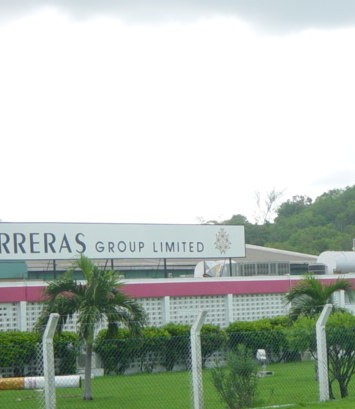
Property that Carreras previously occupied, now sold for $395m
Shareholders who have been enjoying a bumper period of high returns on their shares since 2014, should see another pay out from the net proceeds of this sale.
C&WJ revenues up 27% in Q3
 “In the Third Quarter we have continued to build momentum through our investment-led Project Marlin and we are continuing to deliver top line growth” Phil Bentley, Chief Executive of CW Communications, commented in a release of the group’s third quarter results today.
“Investments in our mobile networks have improved coverage and reliability and we saw mobile data grow a further 23 percent with traffic carried on our networks increasing by over 35 percent. Fibre investments have focussed on our Caribbean markets and are key to generating growth in the Broadband & TV segments. We continue to work with Governments and Regulators to gain the required approvals for completion of the Columbus acquisition and are on track to close before our fiscal year end” Bentley stated.
The groups CEO went on to say “Mobile revenue (53 percent of Group revenue) was up 4 percent in the Third Quarter driven by growth in LIME and Panama, up 10 percent and 4 percent respectively. LIME growth was driven by continued subscriber additions in Jamaica, 18 percent where investment in our 4G mobile network led to constant currency revenue growth of 27 percent and an NPS gain of 11 points, whilst in Barbados our “Upgrade Barbados” marketing campaign led to 6 percent revenue growth and our market-leading LTE service in Cayman drove revenue growth of 3 percent. Panama mobile growth followed a strong increase in subscribers, primarily within prepaid, as a result of increased promotions leading up to and through the holiday season.”
C&W to take one off hit
 Cable & Wireless Jamaica (C&W) lost the case against Digicel for funds withheld for calls terminated on Digicel network over several years. C&W in losing the case and will have to fork out more than $1.5 billion to settle the matter.
“It was fully provided for in the books of CWC Plc our parent. Now that we have settled and intend to payout, exceptional charge will hit our numbers and amount due to the parent will be credited to the nearly, $42 billion in loans already due them.” Gary Sinclair the company’s Chief Executive stated in a response to IC Insider’s query about the amount already booked in the 2014 audited accounts.
A note in C&W 2014 financial statements states, “a suit was filed by Digicel against Cable and Wireless for $349.3 million plus $1.3067 billion claiming bad debt retained by the company under the interconnection and in respect of the company’s “homefone” service. This matter was consolidated with another claim filed by Digicel seeking an account of amounts charged and withheld under the interconnection agreement. The company counter claimed for $525.5 million being retention billed from 2003 to 2007. There are provisions with respect to the portions of this consolidated matter.”
The 2013 audited accounts note indicates that there is provision for the devaluation/retention portion of the consolidated claim, but this amounted to just $13 million.
JPS new plant set for 2017 completion

JPS Rockfort power Plant
The Project is to be located at the existing Old Harbour site and is nominally rated at 190 MW under site conditions (197 MW – new and clean). JPS will also seek to convert the existing Bogue combined cycle project in Western Jamaica to gas fuel. The main receiving terminal will be located at the Old Harbour project. “JPS has initially determined that an onshore terminal is cost effective, compared to the larger capacity and productivity of larger FSRU-type terminals. Construction should begin on the Old Harbour Terminal and Power Plant before the end of the year, and commercial operation is expected by the end of 2017” JPS said.
“An Independent Engineer has been retained for the Bogue conversion. JPS will present its recommendation to proceed with the project to the Jamaican Regulator, the Office of Utilities Regulation (OUR), at the end of February 2015. Pending regulatory approval for the costs of the gas conversion, the Bogue project is expected to enter construction in second quarter of 2015 and would begin use of gas fuel by first quarter of 2016,” the company stated.
JPS said it “has employed various market intelligence services, which suggest that LNG is expected to provide the most stable cost to the Jamaican economy. However, Natural Gas Liquids present a short term opportunity, particularly Ethane or LPG. JPS is considering floating storage, fixed tank or mobile tank systems as well as a combination of each storage option which could accept these different fuels or switch fuels cost effectively.”
Jamaica Public Service Company Limited (JPS) is an integrated electric utility company and the sole distributor of electricity in Jamaica. The Company is engaged in the generation, transmission and distribution of electricity, and also purchases power from a number of Independent Power Producers. JPS currently serves over 603,000 customers through a workforce of 1,700 employees. The Company owns and operates 4 power stations, 9 renewable plants, 43 substations and approximately 14,000 kilometres of transmission and distribution lines.
Insider sold 2.77m Student Living shares
 Newly listed 138 Student Living advises that a related party sold 2,775,000 of the company’s shares on January 30, 2015. T
he shares traded at $4.40 and realised $12,210,000. When the company went public in December last year, some of the initial investors offered shares they owned to the public which was packaged with the public offer. Shares offered by the company were taken up in full, but those by shareholders were only partially bought by the public.
A related party to a directors sold 250,000 Jamaica Broilers Group’s shares on February 2, 2015, the Company advised the Jamaica Stock Exchange.
C&W booked Digicel’s claim before
 News broke on Tuesday that Cable & Wireless Jamaica is to pay Digicel $1.5 billion from wrongly withheld funds for interconnection calls made by cable & wireless fixed line customers. The stock plummeted 20 percent to close at 40 cents on the news. This is a classic case of sell first and ask questions after.
Information in the company’s last audited accounts indicate that the amount was already accounted for in full or in part, the March 2014 financial statements. According to a note in the financial statements, a suit was filed by Digicel against Cable and Wireless for $349.3 million plus $1.3067 billion claiming bad debt retained by the company under the interconnection and in respect of the company’s “homefone” service. This matter was consolidated with another claim filed by Digicel seeking an account of amounts charged and withheld under the interconnection agreement. The company counter claimed for $525.5 million being retention billed from 2003 to 2007. There are provisions with respect to the portions of this consolidated matter.
Even if the company had to pick up the full cost in 2014/15 accounts, it would effectively be of a one off nature and should not affect 2015/16 results which is what investors should be focusing on. At any rate, investors ought to be looking at results based on normal operating income and expenses to determine investment decisions.