 The Main Market of the Jamaica Stock Exchange suffered a significant fall at the close on Tuesday with declining stocks outnumbering advancers two to one.
The market closed with 40 securities changing hands in the main and US dollar markets with 11 advancing, 22 declining, with prices of 7 unchanged. Main market activity ended with 38 securities accounting for 9,259,581 units valued at $69,761,481, in contrast to 5,684,180 units valued at $90,557,890 on Monday from 34 securities.
The JSE All Jamaican Composite Index dived 8,562.68 points to close at 545,819.64, the JSE Market Index plunged 7,743.45 points to 497,105.10 while the JSE Financial Index lost 2.58 points to close at 134.93.
Wigton Windfarm dominated trading with 4.8 million shares for 51.6 percent of the day’s trade, followed by Sagicor Select Funds with 2.3 million shares and 25 percent of volume and QWI Investments with 1.1 million shares and 11.5 percent.
The market closed with an average of 255,401 units valued at an average of $1,835,828 for each security traded, in contrast to 243,673 units for an average of $3,283,732 on Monday. The average volume and value for the month to date amounts to 383,292 units valued at $5,297,192 and previously, an average of 402,202 units valued at $5,897,793 for each security changing hands. 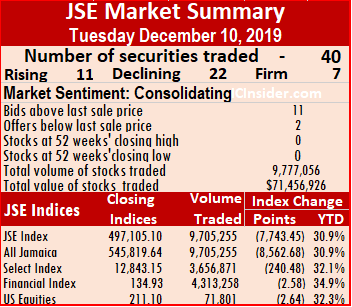 The market closed out November with an average of 653,621 units valued at $8,699,916 for each security traded.
IC bid-offer Indicator| At the end of trading, the Investor’s Choice bid-offer indicator reading shows 11 stocks ending with bids higher than their last selling prices and two with lower offers. The PE ratio of the market ended at 19.6, with the prime market stocks ending at 19.4 times 2019 current year’s earnings.
In the JSE Main Market, Barita Investments lost $1.50 to settle at $70.50, with 8,573 shares changing hands, Berger Paints fell 50 cents to $16.50 while trading 3,799 stock units, Caribbean Cement declined by 50 cents to end at $76.50, in swapping 1,066 units. Eppley Caribbean Property Fund added $1.50 to close at $39.50, with an exchange of 1,565 shares, Grace Kennedy declined by $1 to $65, in transferring 10,263 shares, Jamaica Broilers closed $1.63 lower to $36.37, with 22,923 shares crossing the exchange. Jamaica Producers lost 40 cents to settle at $24, after swapping 17,273 shares, JMMB Group closed at $46.75, after losing 35 cents in transferring 99,844 shares, Kingston Wharves ended at $59.50, with a loss of $1 trading 5,774 units. Mayberry Jamaican Equities closed $1.09 lower to $12 while exchanging 4,056 units, NCB Financial Group declined to $197, after losing $3 and trading 159,487 shares, 1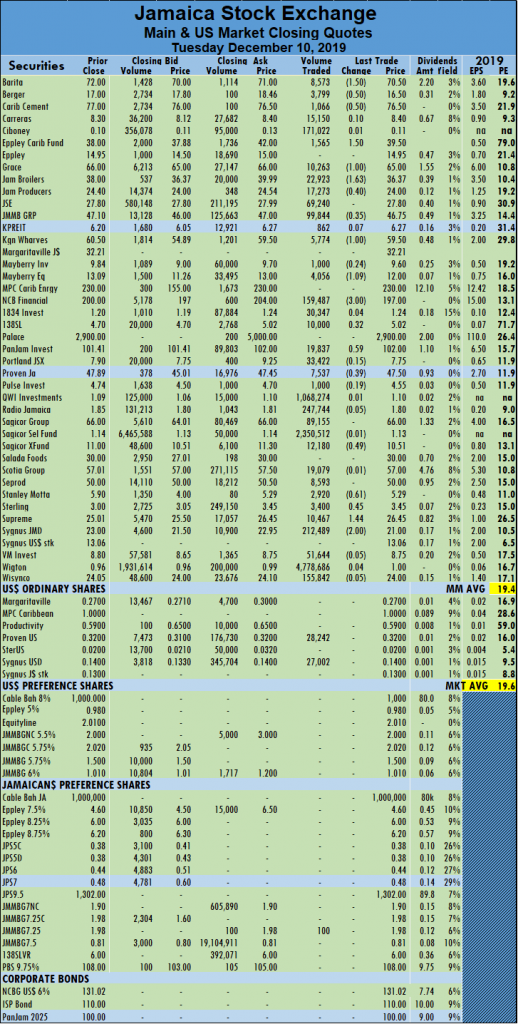 38 Student Living added 32 cents to close at $5.02, with 10,000 shares crossing the exchange. PanJam Investment gained 59 cents to settle at $102 in exchanging 19,837 units. Proven Investments lost 39 cents to close at $47.50, with 7,537 units changing hands, Sagicor Real Estate Fund fell to $10.51, after losing 49 cents and transferring 12,180 shares, Stanley Motta lost 61 cents to close at $5.29, in exchanging 2,920 shares. Sterling Investments gained 45 cents to end at $3.45, in swapping 3,400 shares, Supreme Ventures rose to $26.45, after climbing $1.44 with 10,467 units changing hands and Sygnus Investments closed $2 lower to $21, with an exchange of 212,489 shares.
Trading in the US dollar market closed with 71,801 units valued at US$12,559, with the market index falling 2.64 points to 211.25. Proven Investments traded 28,242 to close at 32 US cents, and Sygnus Credit Investments exchanged 27,002 shares at 14 US cents.
MailPac drops out of IC TOP 10
 Newly listed MailPac Group more than doubled in price, trading as high as $2.60 but closed the week at $2.22 and dropped out of the TOP Junior Market listing.
IC Insider.com has upgraded the average targeted PE to March 2020 based on the valuation of more than 22 times earnings, that the market has placed on several stocks currently.
Honey Bun also jumped ship after posting strong growth with full-year results showing profit rising 67 percent to hit $157 million from a 17 percent rise in revenues to $1.54 billion. The stock closed at $8, up from $7 last week, but traded at a record high of $9.20 on Friday. Honey Bun entered the TOP 10 in the first week in October at $6.15 and left with a gain of 30 percent, but it still has more gains ahead of it. tTech price fell to $5.35 and re-entered the TOP 10 along with Caribbean Flavours, with its price dropping from $17.90 last week to close at $15.64 to return to the TOP 10. PanJam Investment moved into the JSE Main Market Top 10 at the expense of Stanley Motta.
The past week was generally good for stocks as the JSE Main Market rose 4,691 points and the Junior Market climbed 89 points. The Junior Market movement was partially helped by the steep rise in the price of MailPac, from the IPO price of $1. Importantly,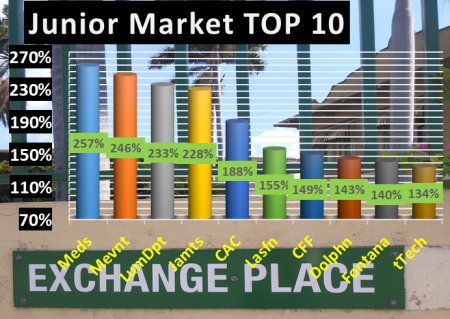 the Junior Market has made a sharp break out of a downward sloping channel that started after the market peaked in Mid-August. It now seems to be heading higher, with a healthy break out of the channel.
IC Insider.com has upgraded the target PE ratios to 25 with several stocks trading at that around 22 currently. The average projected gains for the IC TOP 10 stocks are 187 percent for Junior Market stocks and 145 percent for JSE Main market Top 10 shares.
Medical Disposables lead the top three Junior Market stocks with projected gains of 257 percent, followed by Main Event with potential profits of 246 percent and Lumber Depot with 233 percent.
Radio Jamaica is the lead stock with projected gains of 247 percent, followed by Pulse Investments in the number two spot with a projected growth of 164 percent and Carreras with a likely increase of 111percent is next.
The JSE Main Market closed the week, with an overall PE of 21.5 and the Junior Market at 14.6, an improvement over the previous week’s 14.2, based on current year’s earnings. The PE ratio for Junior Market Top 10 stocks averages 8.9 from 8.7 last week with the Main Market PE at 10.5.
The TOP 10 stocks now trade at a discount of 39 percent to the average for Junior Market stocks and JSE Main Market stocks trade at a discount of 51 percent to the overall market.
IC TOP 10 stocks are likely to deliver the best returns to March next year. Projected earnings, along with the PE ratio for each company’s current fiscal year, are used in determining potential gains with the likely gains ranked in descending order with highest-ranked being the most attractive. Possible values will change as stock prices fluctuate and will result in movements of the selection in and out of the lists for most weeks. Earnings per share are revised on an ongoing basis as new information is received that can result in changes in and out of the list.
This report is compiled by persons who may have an interest in the securities commented on.
JSE declines at start of week
The Main Market of Jamaica Stock Exchange started the week on a negative note with declines in the major indices, even as advancing stocks edged out decliners.
At the close, JSE All Jamaican Composite Index declined 925.08 points to close at 554,382.32, the JSE Market Index dipped 825.96 points to 504,848.55 and the JSE Financial Index lost 1.22 points to close at 137.51.
The market closed with 42 securities changing hands in the main and US dollar markets with 12 advancing, 10 declining and 16 changing hands with prices unchanged. Main market activity ended with 38 securities accounting for 9,259,581 units valued at $124,781,798, in contrast to 20,866,388 units valued at $599,807,083 on Friday from 35 securities.
Jamaica Stock Exchange stock dominated trading with 2.9 million units for 31 percent of the day’s trade, Wigton Windfarm followed with 2.7 million shares for 29 percent of the day’s volume and Sagicor Select Funds was next with 1.8 million shares for 20 percent of traded volume.
The market closed with an average of 243,673 units valued at an average of $3,283,732 for each security traded, in contrast to 162,405 units at $2,587,368 on Friday. 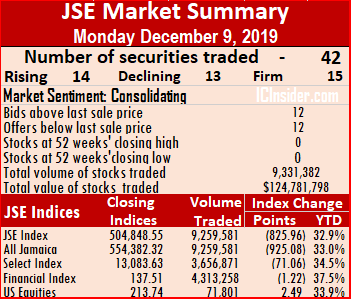 The average volume and value for the month to date amounts to 402,202 units valued at $5,897,793 and previously, an average of 429,709 units valued at $6,446,602 for each security changing hands. The market closed out November with an average of 653,621 units valued at $8,699,916 for each security traded.
IC bid-offer Indicator| At the end of trading, the Investor’s Choice bid-offer indicator reading shows 11 stocks ending with bids higher than their last selling prices and 9 with lower offers. The PE ratio of the market ended at 19.5, with the Main Market ending at 19.3 times 2019 current year’s earnings.
In the premier market segment, Eppley Caribbean Property Fund gained 50 cents to close at $38, with an exchange of 2,491 shares, Eppley closed 77 cents higher to end at $14.95 trading 695 units, Grace Kennedy climbed $1 to $66, in transferring 12,980 shares, Jamaica Producers lost 60 cents to settle at $24.40, after swapping 5,463 shares. Kingston Wharves gained $1.41 to close at $60.50, in swapping 2,929 units, Mayberry Investments rose to $9.84, after gaining 84 cents trading 200 units, Mayberry Jamaican Equities closed 94 cents higher at $13.09, with 350 shares changing hands, 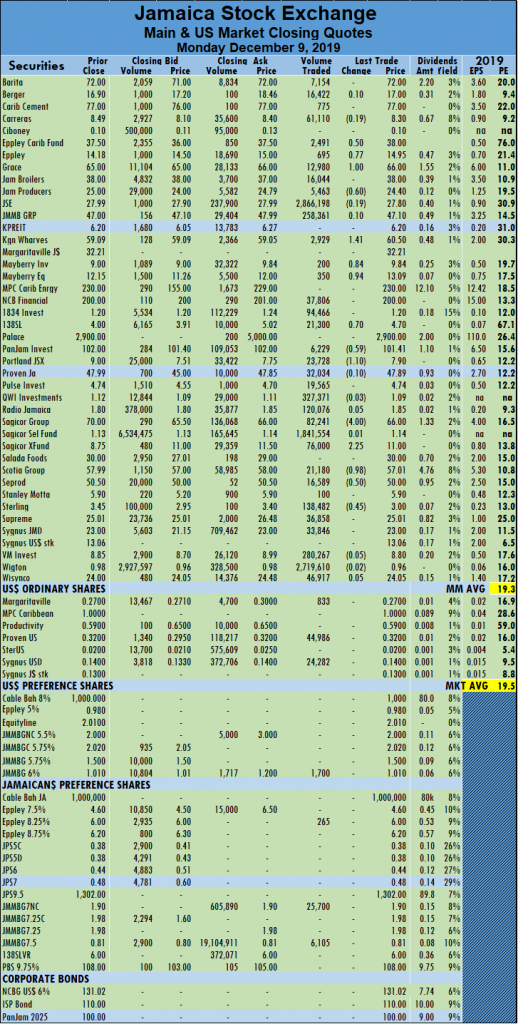 138 Student Living closed 70 cents higher to $4.70, in swapping 21,300 shares. PanJam Investment lost 59 cents to settle at $101.41 after exchanging 6,229 units, Portland JSX closed a $7.90, after dropping $1.10 trading 23,728 stock units, Sagicor Group slumped of $4 to $66 in transferring 82,241 shares, Sagicor Real Estate Fund climbed $2.25 to end at $11 with 76,000 shares crossing the exchange. Scotia Group lost 98 cents to close at $57.01, in exchanging 21,180 shares, Seprod lost 50 cents in swapping 16,589 units, to end at $50 and Sterling Investments closed 45 cents lower to $3, with an exchange of 138,482 shares.
Trading in the US dollar market closed with 71,801 units valued at US$19,617, with the market index falling 2.84 points to 211.25. Proven Investments traded 44,986 to close at 32 US cents, Sygnus Credit Investments exchanged 12,020 shares at 14 US cents, Margaritaville Turks ended at 27 US cents, with 833 units changing hands and JMMB Group 6% preference shares closed at US$1.01, with 1,700 units crossing the exchange.
JSE Main Market slips
The Jamaica Stock Exchange on closed trading on Friday slightly down, after rallying more than four thousand points rally on Thursday even as advancing stocks edged out decliners.
At the close, JSE All Jamaican Composite Index declined 949.99 points to close at 555,307.40, the JSE Market Index dipped 860.37 points to 505,674.51 and the JSE Financial Index added 0.43 points to close at 138.73.
The market closed with 38 securities changing hands in the main and US dollar markets with the prices of 12 rising, 10 declining and 16 trading unchanged. Main market activity ended with 34 securities accounting for 5,684,180 units at $90,557,890, in contrast to 20,866,388 units valued at $599,874,907 on Friday from 38 securities.
Sagicor Select Funds dominated trading with 2.1 million shares for 38 percent of the day’s trade and Wigton Windfarm with 1.6 million shares and 28 percent and Scotia Group with 492,803 shares and 8.7 percent of the day’s volume.
The market closed with an average of 162,405 units at $2,587,368 for each security traded, in contrast to 563,956 units valued at an average of $16,212,835 on Thursday.  The average volume and value for the month to date amounts to 429,709 units valued at $6,446,602 and previously, an average of 605,631 units valued at $7,371,761for each security changing hands. The market closed out November with an average of 653,621 units valued at $8,699,916 for each security traded.
IC bid-offer Indicator| At the end of trading, the Investor’s Choice bid-offer indicator reading shows 13 stocks ending with bids higher than their last selling prices and 4 with lower offers. The PE ratio of the market ended at 19.3, with the primary market ending at 19.1 times, current year’s earnings.
In the premier market, Barita Investments added $1 to close at $72, with 131,692 shares changing hands, Eppley lost 82 cents to end at $14.18 trading 1,000 units, Grace Kennedy dropped 99 cents to $65, in exchanging 54,098 shares, Jamaica Producers gained 75 cents to settle at $25 after 1,767 shares changed hands. JMMB Group rose $1.99 to $47, in transferring 44,915 shares, Kingston Wharves climbed $4.09 to $59.09, with 3,550 units traded, Mayberry Jamaican Equities closed 95 cents lower to $12.15, with 250 shares changing hands. NCB Financial slid $5.45 to $200, in swapping 92,695 stock units,  Proven Investments added 61 cents to settle at $47.99, with an exchange of 84,032 units, Sagicor Group added 50 cents to end at $70, while transferring 189,674 shares. Sagicor Real Estate Fund dropped $1.25 to $8.75 after trading 53,416 units, Scotia Group added $1.99 to close at $57.99, in exchanging 492,803 shares. Seprod gained $1.50 with 5,550 units crossing the exchange, to end at $50.50, Supreme Ventures lost 99 cents to end at $25.01, in trading 66,307 shares and Sygnus Credit Investments lost 98 cents to close at $23, with 13,692 shares changing hands.
Trading in the US dollar market closed with 125,314 units valued at US$37,013, with the market index falling 2.84 points to 211.25. Proven Investments traded 113,491 to close at 32 US cents, Sygnus Credit Investments exchanged 11,512 shares at 14 US cents and Margaritaville Turks gained 2 cents and ended at 27 US cents with an exchange of 311 shares.
Scotia Group aiming to up profits
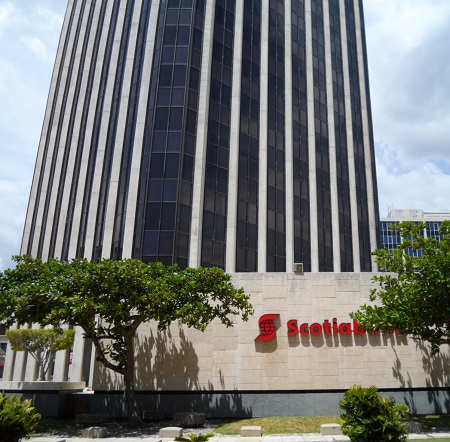
Scotia Group headquarters in Kingston.
The 2019 fiscal year is turning out to be one of the best in recent times for the number 2 banking group in Jamaica – Scotia Group. The current year was not the best performing, but it delivered on many counts for the majority Canadian owned banking group.
Critically, the primary engine driving profits – loans, grew 12.6 percent, or $23 billion to $206 billion. According to the Managing Director, David Noel, “total loan growth remained strong throughout the period with a year over year increase of 13 percent. Highlights from our Retail Banking portfolio include a 17 percent year over year growth in our Scotia Plan loan portfolio. Our mortgage portfolio continued to perform well and grew 13 percent year over year as we continue to boast one of the most competitive mortgage rates in the market. Our total commercial loan book increased by 14 percent over the prior year. Of note, commercial loans to the private sector increased by 27 percent when compared to the same period last year.”
The group reports a net profit of $13.19 billion for the year to October, an increase of $419 million or 3.28 percent over the prior year. In 2018, the group booked gains on the sale of a subsidiary of $753 million, when this gain is excluded, net profit from ongoing operations increased by stronger 9.75 percent amounting to $1.17 billion.
Performance for the year was affected by lower net interest income due to declining interest rates and higher loan loss provision, following the adoption of a new accounting standard. Net interest income after expected credit losses for the year totaled $22.5 billion, down $767 million or 3.3 percent, compared to the prior year. Importantly, the group’s final quarter numbers show marked improvement in net interest income compared to the 2018 quarter. Net interest income delivered $6.4 million to the quarterly results compared to just $6 billion in 2018, while Net interest income after expected credit losses rose from $5.35 billion in the October 2018 quarter to $5.75 billion in 2019.
Scotia reports that “our credit quality remains strong and actual delinquency is down year over year, with loans on which there is no interest being booked for representing 1.77 percent of gross loans compared to 2 percent in the prior year.”
The Group reports, “operating expenses were also higher than the prior-year due partially to increased fraud-related expenses, as well as increased investments in technology and business optimization which we believe are necessary investments for the future.”
“We will continue to make investments in our infrastructure, including a $500 million investment to create a state of the art branch. Renovations have also begun at our head office building, where we are investing $1 billion to upgrade and modernize our facilities to create a more efficient and collaborative environment.”
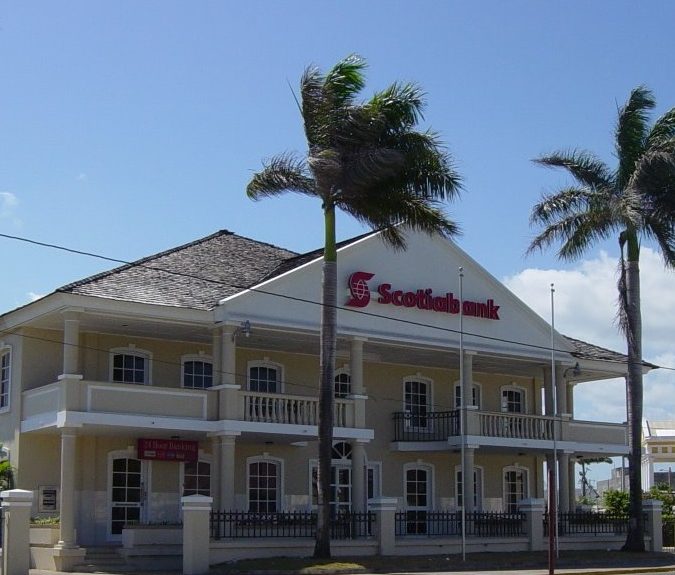
Scotia Group’s Falmouth branch
Operating expenses for the year amounted to $24 billion for the period, an increase of $2 billion, or 9.54 percent compared to the prior year. Salaries and staff benefit costs increased by $697 million or 6.76 percent primarily due to increased incentives to the sales team resulting in the growth of in the loan portfolio, while other operating expenses grew by $1.37 billion. The growth in other operating expenses was attributable to increased technology investments such as ATM software, online banking enhancements, security chips for credit cards and network upgrade to support our digital strategy. Tax on assets increased by $45 million to $1.13 billion.
Segment results saw Treasury generating revenues of $8.2 billion up from $7 billion in 2018 with a profit of compared to $4.1 billion in 2018. Retail revenues grew to $18.9 billion up from $18.3 billion in 2018, with a profit of $3.6 billion compared to $4.9 billion in 2018. Corporate and Commercial banking saw revenues rise from $7.8 billion to $8 billion and profit hitting $1.4 billion in 2019 versus $2.75 billion in 2018. Insurance services grew revenues from $5 billion to $5.1 billion and generated a slightly higher profit of $3.97 billion from $3.8 billion in 2018. Investment Management generated revenues of $3.5 million and a profit of $2.3 billion in 2019 compared to $3 billion in revenues and profit of $1.8 billion in 2018. Other operations raked in revenues of $1.54 in 2019 with a profit of $1.5 billion, in 2018, revenues were just $1 billion with a profit of $965 million.
Other income for the year, other than interest income, increased by $3 billion or 17.97 percent over 2018. Net fee and commission income amounted to $8 billion, marginal declining of $22 million. Insurance revenues increased by $371 million or 12.64 percent to $3.30 billion due mainly to higher premium income year over year, partially offset by lower actuarial reserve releases, the group reported.
Net gains on foreign currency activities and financial assets amounted to $8.43 billion, up by $3.3 billion or 63 percent above last year due to increased market and trading activities. Deposits by the public grew to $313 billion, up from $288 billion in the previous year.
The Group’s shareholders’ equity stands at $118 billion from which the Board of Directors approved a final dividend of 55 cents per stock unit, or $1.7 billion, up from 51 cents per share in 2018. The current dividend is payable on January 15, 2020, to stockholders of record on December 24. The January 2020 dividend brings the total payment for the year to $4.76 after the group made two special dividend payments during the year.
The group reported earnings per share of $1.09 for the final quarter and $4.24 for the full year, earnings per share for 2020 should hit the $5 mark.
Scotia Group is a good stock for income and long-term growth.
JSE Main Market jumps
 Trading ended on the Jamaica Stock Exchange on Thursday, with the major market indices jumping sharply as advancing stocks had the upper hand over declining ones.
At the close, the JSE All Jamaican Composite Index advanced 4,438.41 points to close at 556,256.89, the JSE Market Index climbed 4,050.98 points to 506,534.88 and the JSE Financial Index gained 0.68 points to close at 138.30.
The market closed with 38 securities changing hands in the main and US dollar markets with the prices of 21 advancing, 8 declining and 11 trading firm. Main market activity ended with 37 securities accounting for 20,866,388 units valued at $599,874,907 in contrast to 17,575,871 units valued at $314,642,943 on Wednesday from 40 securities.
JMMB Group dominated trading with 11.1 million shares valued at $500 million for 53 percent of the day’s trade, followed by Sagicor Select Funds with 5.5 million shares and 26 percent and QWI Investments with 945,356 shares and 4.5 percent of the day’s volume.
he market closed with an average of 563,956 units valued at an average of $16,212,835 for each security changing hands, in contrast to 462,523 units valued at an average of $8,280,077 on Wednesday. The average volume and value for the month to date amounts to 605,631 units valued at $7,371,761 and previously, an average of 619,777 units valued at $4,370,662 for each security changing hands. The market closed out November with an average of 653,621 units valued at $8,699,916 for each security traded.
IC bid-offer Indicator| At the end of trading, the Investor’s Choice bid-offer indicator reading shows 13 stocks ending with bids higher than their last selling prices and 4 with lower offers. The PE ratio of the market ended at 19.3, with the primary market ending at 19.1 times 2019 current year’s earnings.
In the premier market, Barita Investments gained 45 cents to close at $71 while trading 438,561 shares, Berger Paints closed 40 cents higher at $17, with 6,000 units changing hands, Caribbean Cement fell by 50 cents to $77, in swapping 25,468 units. Eppley Caribbean Property Fund gained 90 cents to end at $37.50, with 100 shares crossing the exchange, Grace Kennedy gained 99 cents to end at $65.99, in transferring 33,872 shares. Jamaica Broilers climbed $2 to $38, after swapping 7,377 stock units, Jamaica Stock Exchange added 89 cents to settle at $27.99 after trading 255,064 units, JMMB Group slumped to $45.01, after losing $2.99 while exchanging 11,092,457 shares, Kingston Wharves climbed to $55, with a gain of $1.95 in transferring 771 units. Mayberry Investments closed 30 cents higher to $9, with 10,996 shares changing hands, NCB Financial Group climbed $1.45 to end at $205.45, in swapping 23,453 shares, Proven Investments closed $1.38 higher to $47.38, with an exchange of 22,116 units, Pulse Investments gained 44 cents to settle at $4.74, with 24,000 units changing hands.  Sagicor Group climbed $2.50 to $69.50, in transferring 30,005 shares, Scotia Group closed $1.80 higher at $56, in exchanging 30,005 shares, Stanley Motta rose 90 cents to end at $5.90 after exchanging just 200 shares. Supreme Ventures closed at $26 after gaining 99 cents and trading of 11,752 shares and Victoria Mutual Investments lost 31 cents to close at $8.59 in exchanging 210,710 shares.
In the preference segment, JMMB Group 7.25% share added 38 cents to end at $1.98 in trading just 100 shares.
Trading in the US dollar market closed with 8,385 units valued at US$2,683, with the market index advancing 6.87 points to close at 214.09. Proven Investments, the sole trade and closed unchanged at 32 US cents.
JSE Main Market drops
The primary market of the Jamaica Stock Exchange enjoyed almost three times the value trading as on Tuesday but the indices slipped at the close.
At the close, JSE All Jamaican Composite Index dropped 1,461.90 points to close at 551,818.48, the JSE Market Index lost 1,305.26 points to 502,483.90 and the JSE Financial Index slipped 0.70 points to close at 137.62.
The market closed with 40 securities changing hands in the main and US dollar markets with 15 advancing, 15 declining and 10 trading firm. Main market activity ended with 38 securities accounting for 17,575,871 units valued at $314,642,943, in contrast to 35,992,474 units valued at $119,732,182 on Tuesday from 35 securities.
Sagicor Select Funds dominated trading with 6.1 million shares for 34.5 percent of the day’s trade, followed Carreras with 3.5 million units and 19.7 percent of traded volume and JMMB Group with 2.1 million shares and 11.7 percent of the total volume.
The market closed with an average of 462,523 units valued at an average of $8,280,077 for each security traded, in contrast to 1,028,356 units valued at an average of $3,420,919 on Tuesday.  The average volume and value for the month to date amounts to 619,777 units valued at $4,370,662 and previously, an average of 703,941 units valued at $2,278,299 for each security changing hands. The market closed out November with an average of 653,621 units valued at $8,699,916 for each security changing hands.
IC bid-offer Indicator| At the end of trading, the Investor’s Choice bid-offer indicator reading shows 9 stocks ending with bids higher than their last selling prices and 3 with lower offers. The PE ratio of the market ended at 19.2 with the main market ending at 18.9 times 2019 current year’s earnings.
In the premier market, Barita Investments lost 45 cents to settle at $70.55, with 791,907 shares changing hands, Caribbean Cement dipped $1.50 to $77.50 while trading 2,230 units, Eppley Caribbean Property Fund gained 60 cents to end at $36.60, in exchanging 1,151 stock units, Grace Kennedy closed 98 cents lower at $65, in transferring 436,306 units. Jamaica Broilers slumped to $36, after losing $2 with 143,324 shares crossing the exchange, JMMB Group gained $1 to end at $48, after exchanging 2,054,039 stock units, Kingston Wharves dived to $53.05, after losing $7.45 while trading 2,800 shares, Mayberry Jamaican Equities rose by $1.31 to close at $13, with 43,087 units changing hands.  NCB Financial Group climbed $3.97 to $204, in swapping 127,891 shares, Portland JSX gained 98 cents to end at $9 and trading 54,422 stock units, Proven Investments closed $1.95 lower at $46, with an exchange of 20,043 units, Sagicor Group gained $1 in transferring 69,489 shares to close at $67. Salada Foods lost $1.39 swapping 1,120 units to settle at $30, Scotia Group closed 80 cents lower at $54.20, in exchanging 333,238 shares, Supreme Ventures lost 99 cents trading 340,580 stock units to settle at $25.01. Victoria Mutual Investments gained 38 cents to close at $8.90, after exchanging 39,749 shares and Wisynco Group climbed 70 cents to end at $24, with 915,085 shares changing hands.
Trading in the US dollar market closed with 423,162 units valued at US$129,633 with the market index losing 6.87 points to close at 207.22. Proven Investments closed at 32 US cents, after trading 420,126 shares and JMMB Group 6% preference share ended at US$1.01 while exchanging 3,036 shares.
Trading picks up for JSE Main Market
 Trading on Jamaica Stock Exchange Main Market rose on Tuesday 35 securities accounting for 35,982,542 units valued at $119,732,182, in contrast to 13,987,345 units valued at $42,027,052 on Monday from 36 securities.
The market closed with 38 securities changing hands in the main and US dollar markets with the prices of 16 stocks advancing, 9 declining and 13 ending unchanged.
At the close, JSE All Jamaican Composite Index declined 473.92 points to close at 553,280.38, the JSE Market Index lost 372.64 points to 503,789.16 and the JSE Financial Index dipped 0.21 points to close at 136.92.
Wigton Windfarm dominated trading with 27.7 million shares for 77 percent of the day’s trade, Sagicor Select Fund followed with 5 million units and 14 percent of volume and Supreme Ventures chipped in with 1 million shares and 2.8 percent of the day trades.
The market closed with an average of 1,028,356 units valued at an average of $3,420,919 for each security traded, in contrast to 388,537 units valued $1,167,418 on Monday. The average volume and value for the month to date amounts to 703,941 units valued at $2,278,299. The market closed out November with an average of 653,621 units valued at $8,699,916 for each security traded.
IC bid-offer Indicator| At the end of trading, the Investor’s Choice bid-offer indicator reading shows 23 stocks ending with bids higher than their last selling prices and 2 with lower offers. The PE ratio of the market ended at 19.2, with the Main Market ending at 18.9 times 2019 current year’s earnings.
In the premier market of the Jamaica Stock Exchange, Barita Investments gained 50 cents to close at $71 in trading 1,666 shares. Grace Kennedy closed 98 cents higher to $65.98, with 6,322 shares changing hands, Jamaica Broilers climbed $2 to $38, in transferring 426,784 shares, JMMB Group exchanged 394,116 shares ended at $47, after gaining 70 cents. Mayberry Investments rose 50 cents to settle at $8.70, with 1,021 units traded, NCB Financial Group dived $4.97 to $200.03, after swapping 44,995 shares, Scotia Group climbed $1 to settle $55, in exchanging 3,944 shares, Seprod closed at $49, after losing $1.55 and trading 22,835 stock units. Sygnus Credit Investments closed 73 cents higher at $23.73 in trading 14,192 units, Victoria Mutual Investments lost 38 cents to close at $8.52, after exchanging 146,429 shares and Wisynco Group lost 66 cents in trading 93,349 stock units at $23.30.
Trading in the US dollar market closed with 65,901 units valued at US$4,888, with the market index gaining 0.68 points to close at 214.09. Proven Investments closed at 32 US cents, trading 9,101 shares, Sterling Investments closed at 2 US cents with 49,800 units changing hands and Sygnus Credit Investments exchanged 7,000 shares at 14 US cents.
JSE main market index jumps
JSE Main Market indices made gains on Monday on lower volumes and value compared to Friday but with stocks rising outnumbered by those falling.
At the close, JSE All Jamaican Composite Index climbed 3,136.96 points to close at 553,758.80, the JSE Market Index gained 2,789.32 points to 504161.80 and the JSE Financial Index added 0.94 points to close at 137.13.
The market closed with 38 securities changing hands in the main and US dollar markets with the prices of 12 gaining, 15 declining and 11 trading unchanged. Main market activity ended with 36 securities accounting for 13,987,345 units at $42,027,052, in contrast to 37,782,232 units valued at $133,425,390 on Friday from 40 securities.
Sagicor Select Funds dominated trading with 9.55 million shares for 68.5 percent of the day’s trade and Wigton Windfarm with 2.6 million shares and 19 percent of the overall volume and QWI Investments with 885,900 shares and 6 percent of the trades.
The market closed with an average of 388,537 units valued $1,167,418 for each security traded, in contrast to 944,556 units for an average of 3,335,635 on Friday. The average volume and value for the month to date amounts to 388,537 units valued at $1,167,418 and previously, an average of 653,621 units valued at $8,699,916 for each security changing hands. The market closed out November with an average of 653,621 units valued at $8,699,916 for each security traded.
IC bid-offer Indicator| At the end of trading, the Investor’s Choice bid-offer indicator reading shows 19 stocks ending with bids higher than their last selling prices and 1 with lower offers. The PE ratio of the market ended at 18.7, with the Main Market ending at 18.9 times 2019 current year’s earnings.
In the premier market, Carreras gained 25 cents to close at $8.35 trading 10,816 stock units, Jamaica Broilers dropped $2 to end at $36, in swapping 3,050 shares, Jamaica Producers settled at $24.50, after losing $1 trading 11,419 shares,  JMMB Group lost 60 cents to end at $46.30, with 177,321 shares changing hands. Kingston Wharves gained $1.72 to close at $60.50 in exchanging 14,053 units. NCB Financial Group dipped $3 to $205, with 16,016 units traded. Portland JSX fell 48 cents to end at $8.02, with 6,350 shares crossing the exchange, Sagicor Real Estate Fund lost 95 cents to close at $10.80, in transferring just 1,000 units, Scotia Group gained 98 cents to end at $54 while exchanging 51,012 shares. Seprod settled at $50.55, in losing 34 cents while trading 28,813 stock units, Stanley Motta lost $1 to close at $5.30, with 24,566 units changing hands, Supreme Ventures shed 99 cents to close at $25.01, in swapping 14,500 shares and Sygnus Credit Investments closed 64 cents lower at $23 in trading 3,135 units.
Trading in the US dollar market closed with 42,800 units valued at US$12,106, with the market index advancing 6.23 points to close at 213.44. Proven Investments closed at 32 US cents, after gaining 1.98 US cents trading 37,500 shares and Sterling Investments closed at 2 US cents with 3,500 units changing hands.
Continued stability for IC TOP 10
 With the closing of the two initial public offers of MailPac Group and Lumber Depot last week, things started to return to more normally in the market this past week with the two main markets recording net gains for the week.
At the close of a week when the JSE Main Market put on125 points and the Junior Market rose 46 points there was minimal change to the IC TOP 10 list this week with just one change as Fontana returns to the top flight after a brief absence, replacing Caribbean Flavours with the price jumping to $17.90 on Friday. One important development at the end of the week was the release of full-year results, for Honey Bun, with profit rising 67 percent to hit $157 million from a 17 percent rise in revenues to $1.54 billion.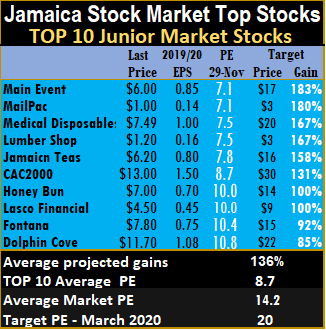
 Importantly, the company is on the way to earn 70 cents per share for 2020.
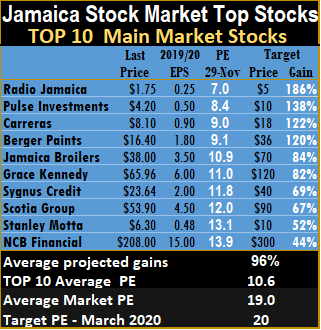
The average gains for the IC TOP 10 stocks are 136 percent for Junior Market stocks and 96 percent for JSE Main market Top 10 stocks.
The top three Junior Market stocks, is now led by Main Event with projected gains of 183 percent, followed by MailPac Group with 180 percent and Medical Disposables with potential gains of 167 percent.
Radio Jamaica remains the lead stock with projected gains of 186 percent, followed by Pulse Investments in the number two spot with projected growth of 138 and Berger Paints with likely gains of 120 percent and percent is next.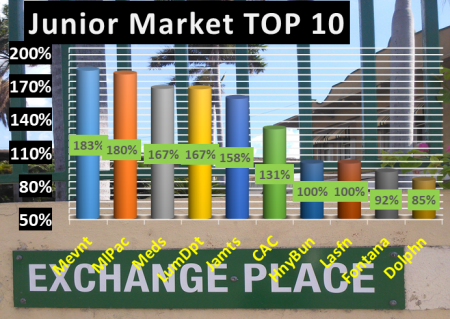
The JSE Main Market closed the week with the overall PE of 19 up from 18.8 and the Junior Market at 14.2, an improvement over the previous week’s 13.8, based on current year’s earnings. The PE ratio for Junior Market Top 10 stocks averages 18.7 from 7.8 last week with the Main Market PE at 10.6 up from 10.4.
The TOP 10 stocks now trade at a discount of 39 percent to the average for Junior Market stocks and main market stocks trade at a discount of 44 percent to the overall market.
IC TOP 10 stocks are likely to deliver the best returns to March next year. 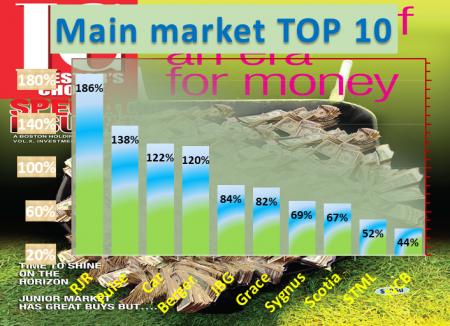 Projected earnings, along with the PE ratio for each company’s current fiscal year, are used in determining potential gains with the likely gains ranked in descending order with highest-ranked being the most attractive. Potential values will change as stock prices fluctuate and will result in movements of the selection in and out of the lists for most weeks. Earnings per share are revised on an ongoing basis as new information is received that can result in changes in and out of the list.
This report is compiled by persons who may have an interest in the securities commented on.