Inflation in Jamaica is tamed. At least that is what data out of the Statistical Institute of Jamaica (STATIN) is suggesting, with negative inflation for the first four months of the year.
According to the latest data on the Consumer Price Index (CPI), the inflation rate for April 2020 was 0.2 percent. The increase for April comes on the heels of low price increases from December last year, leading to a rise of 0.5 percent in the CPI index followed by January, with a negative price movement of 1.1 percent.  February ended, with an increase of 0.7 percent, while March had a decline of 0.3 percent and with the April fall, the year to date movement came out at negative 0.5 percent.
The inflation rate for April is not directly comparable to the previous periods, but whatever difference there maybe is unlikely to be material. Statin updated the basket of goods and services used in the compilation of the index. Accordingly, the products and services included in the new CPI basket and the weights associated with each item have changed based on a 2017 Household Expenditure Survey. The difference between the old and new weighting is not substantial, with Food and Non-Alcoholic Beverages weighting of 37.4 percent previously, is now down to 35.8 percent. The group of Housing, Water, Electricity, Gas & Other Fuels is up to 17.8 percent from 12.8 percent previously. Transport is now at 11.2 percent versus 12.8 percent in the old basket. Recreation, Sports & Culture is at 5 percent compared to 3.4 percent in the previous measure. The only other change of note was the areas of Insurance & Financial Services that is now 1.1 percent. Previously it was grouped with Personal Care, Social Protection & Miscellaneous Goods & Services that amounted to 8.4 percent of the overall basket, with the new weighting for the new category, down to 5 percent.
According to STATIN, the reduction in the GCT rate, from 16.5 percent to 15 percent, impacted the inflation rate for April 2020. The ‘Food and Non-Alcoholic Beverages’ recorded an increase in its index of 0.3 percent. The inflation rate for the division ‘Housing, Water and Electricity’ was 0.2 percent due to a rise of 3.1 percent in the index for the group ‘Water Supply and Miscellaneous Services Relating to the Dwelling.’ The Transport division declined by 0.5 percent and was mainly attributable to the reduction in the costs of petrol.
Jamaica’s inflation is tamed
Big inflation spike in 2019
The Statistical Institute of Jamaica (STATIN) reported that the annual inflation rate in Jamaica to December 2019, was 6.2 percent, a sharp increase from inflation over the last four years.
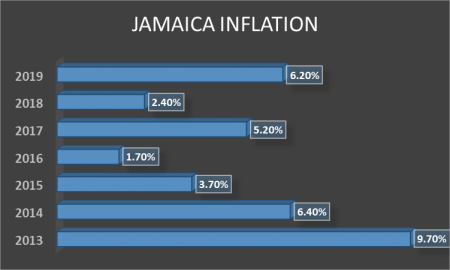 According to data from the Statin, inflation in 2018 was 2.4 percent, down from 5.2 percent in 2017. In 2016 the inflation rate ended at 1.7 percent and 3.7 percent in 2015, 6.4 in 2014 and 9.7 percent in 2013.
Jamaica’s Central Bank, in response to the sharp rise in the inflation for the year, stated, the outturn “represents a sharp jump when compared with the 3.4 percent recorded in September 2019. This inflation outturn was not anticipated and was higher than the Bank of Jamaica’s target of 4.0 to 6.0 percent.”
The release from Bank of Jamaica, stated, “the higher inflation rate was primarily influenced by faster increases in food and energy-related prices in the consumer price index (CPI). The heavily weighted Food & Non-Alcoholic Beverages division of the CPI increased over the year to December by 10.7 percent, when compared with 6.7 percent in September 2019. This was primarily related to higher prices for vegetables and starchy foods, the consequence of adverse weather conditions (drought followed by heavy rains) that affected the Island between June and October 2019.
BOJ interest cuts overnight rate.
There was also news of crop-related diseases affecting some items. Housing, Water, Electricity, Gas & Other Fuels reflected higher rates for electricity and water, which was partly related to increases in international oil prices in the December 2019 quarter. This division increased over the year to December to 1.5 percent, compared with a decline of 3.2 percent in September 2019.”
The release continues, “despite the higher headline inflation, underlying inflation, which excludes the immediate influence of agriculture and energy prices, remained stable and below 3.0 percent. At the end of December 2019, the annual rate for this measure was 2.9 percent, which was unchanged compared with the rate in September 2019. This underscores that the Jamaican economy continues to reflect some slack with economic growth below its potential. It also highlights that the jump in inflation is likely to be temporary as expected tempered movements in agricultural prices dampen inflation over the next three to six months.”
Jamaica’s inflation up 0.8% in March
 Inflation in Jamaica rose 0.8 percent in March and brings the year to 0.7 percent date data released by the Statistical Institute of Jamaica (STATIN) shows and the fiscal year inflation to 3.4 percent.
According to Statin, the movement was mainly attributable to a fall of 0.9 percent in the index for the heaviest weighted division Food and Non-Alcoholic Beverages and a 1.5 percent rise in the Housing, Water, Electricity, Gas and Other Fuels division at resulted from a 2.7 percent increase in the group ‘Electricity, Gas and Other Fuels’. Also contributing to March’s inflation rate was an increase of 1.1 percent in the index for the ‘Transport’ division. This was mainly attributable to the rise in petrol prices.
Food prices pressure November’s inflation

Food category was main contributor to November’s inflation.
According to STATIN, the “movement was mainly the result of a 1.2 percent rise in the index for the heaviest weighted division Food & Non-Alcoholic Beverages. Transportation moved up by 1 percent due to higher petrol prices and airfares, and Education increasing by 0.2 per cent, as a result of an increase in the cost of CSEC examination fees. The impact of the month’s inflation was however tempered by the 0.9 percent fall in the index for the division ‘Housing, Water, Electricity, Gas and Other Fuels, with lower cost for electricity being the main contributing factor.”
Year-to-date inflation is 4.6 percent, while inflation for the past 12 months is up 4.9 percent and the fiscal year-to-date movement was 3.6 per cent.
The relatively large revaluation of the Jamaican dollar against the US dollar since September, will have a moderating impact on inflation going forward.
Moderate inflation for Jamaica
 Price increases in Jamaica for February this year was moderately up resulting in inflation over the past year to less than 4 percent. The Consumer Price Index for the month of February 2017 increased by 0.2 percent, following an upward movement of 0.4 percent in the previous month.
Price increases from a year ago is up 3.6 percent and for the fiscal year-to-date, 3.7 percent.
Two divisions mainly contributed to this increase. Prices for the Food and Non-Alcoholic Beverages division rose the most by 0.3 percent and the division of Housing, Water, Electricity, Gas and Other Fuels was up by 0.6 percent. Higher rates for water and sewage and increases in wages for carpenters, masons, painter, plumbers and electricians were the main factors that impacted the movement for the division Housing, Water, Electricity, Gas and Other Fuels. Lower prices for some petroleum products locally resulted in a decline in its index of 0.3 percent in Transportation.
Fall in the price of oil on the world market could impact ongoing inflation if the trend continues but recent tax increases locally with negate some of that.
Inflation set to fall below 2% for 2016
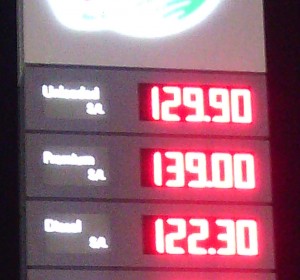
Fuel prices at the pumps in May 2015.
The calendar year-to-date inflation is only 0.3 percent, while the year over year movement is 1.8 percent. IC Insider is forecasting the full year inflation to end just below 1.5 percent, barring major negative developments. If the forecast is closely achieved, it would be the lowest rate in four and a half decades and will better the 3.66 percent achieved in 2015, the previous lowest rate over the same period. The rate for 2016 would be well below the 4.2 percent forecast by the IMF for the calendar year and the Bank of Jamaica the fiscal year forecast to March 2017 with a target of 4.5 percent to 6.5 percent.
 According to Statin, inflation for August was driven mainly by the division ‘Housing, Water, Electricity Gas and Other Fuels’ which recorded the highest movement, 1.8 percent, primarily due to the increase in rates for electricity and water. The group ‘Food and Non-Alcoholic Beverages’ division increased by 0.4 percent and was influenced by the upward movement in the group ‘Vegetables and Starchy Foods’ up by 0.9 percent. The increases were partially offset by a fall in ‘Transport’ by 0.2 percent, due to lower petrol prices on the local market for the month of August.
The low level of inflation comes against the back ground of a 5 percent devaluation of the Jamaican dollar versus the US dollar and a tax package earlier in the year that saw an increase in the price of petroleum as well as a fiscal deficit that is close to zero and well below forecast.
Food prices push inflation in August

‘Vegetables and Starchy Foods’ had the strongest impact on the division moving up by 8.5%
‘Food and Non-Alcoholic Beverages’ recorded the highest movement for the month of 2.1 percent. ‘Vegetables and Starchy Foods’ had the strongest impact on the division moving up by 8.5 percent as drought conditions persisted in the growing areas. The upward overall movement was, however, tempered by declines of 2.3 percent and 0.5 percent in the divisions ‘Housing, Water, Electricity, Gas and Other Fuels’ and ‘Transport’ due to lower petrol prices and reduction in air fares.
Other divisions that recorded increases are: ‘Alcoholic Beverages and Tobacco’ 0.2 percent, ‘Clothing and Footwear’ 0.3 percent, ‘Furnishings, Household Equipment and Routine Household Maintenance’ 0.2 percent, ‘Health’ 0.1 percent, ‘Recreation and Culture’ 0.4 percent, ‘Miscellaneous Goods and Services’ 1.3 percent, while ‘Restaurants and Accommodation Services’ recorded a 0.2 percent increase. ‘Education’ and ‘Communication’ remained unchanged.
Inflation jumps 1% in May
 Inflation jumps 1 percent in May, the Statistical Institute of Jamaica (Statin) stated in a release today, compared to the index for April. An increase of 0.7 percent in ‘Food and Non-Alcoholic Beverages’ and 3.6 percent increase in the index for the division ’Housing, Water, Electricity, Gas and other Fuels’ were the major reasons for the sharp climb. The movement in the index for May 2014 resulted in a calendar year-to-date inflation rate of 2.4 percent. Inflation declined in April by 0.7 percent compared to March this year.
According to Statin, the division ‘Food and Non-Alcoholic Beverages’ was impacted by increases of 1.9 percent and 1.6 percent in ‘Bread and Cereals’ and ‘Milk, Cheese and Eggs’ respectively. There were declines of 0.4 percent and 0.3 percent for the classes ‘Fruit’ and ‘Vegetables and Starchy Foods’ respectively. Within the division ‘Housing Water, Electricity, Gas and Other Fuels’ the advance in the index for ‘Electricity, Gas and Other Fuels’ of 7.3 percent was moderated by the fall of 3.4 percent in the index for ‘Water Supply and Miscellaneous Services Related to Dwelling’
The other divisions that recorded increases in the All Jamaica ‘All Divisions’ index were: ‘Alcoholic Beverages and Tobacco’ 0.5 percent, ‘Clothing and Footwear’ 0.2 percent, ‘Furnishings, Household Equipment and Routine Household Maintenance’ 0.5 percent, ‘Health’ 0.2 percent, ‘Transport’ 0.4 percent, ‘Recreation and Culture’ 0.1 percent, ‘Restaurants and Accommodation Services’ 0.5 percent, and ‘Miscellaneous Goods and Services’ 0.5 percent.
Inflation plummets
Inflation rate for February plummeted to just 0.1 percent or annualised at only 1.2 percent. The movement in the index for February 2014 resulted in a calendar year-to-date inflation of 0.6 percent.
The latest monthly out-turn is the lowest for since January and February 2011 and except for July 2012 with a negative inflation rate, no other month has come close to it.
The main contributors to the movement were the 0.2 percent advance in the index for the division Food and Non-Alcoholic Beverages, the heaviest weighted division, and increases of 0.7 percent each for the divisions Clothing and Footwear and Miscellaneous Goods and Services.
The impact of these increases however was moderated by a 1.2 percent decline in the index for the division Housing, Water, Electricity, Gas and Other Fuels as a result of the decline in the cost of electricity, water, and sewage rates. ‘Alcoholic Beverages and Tobacco’ rose by 0.2 percent, ‘Furnishings, Household Equipment and Routine Household Maintenance 0.6 percent, ‘Health 0.2 percent, ‘Transport’ 0.1 percent.
Negligible movement was recorded for ‘Recreation and Culture’ 0.4 percent, ‘Restaurants and Accommodation Services’ 0.1 percent, ‘Miscellaneous Goods and Services’ 0.7 percent, ‘Education’ and ‘Communication’ for the period under review. There was zero inflation in the rural areas during the month.
Related posts | Inflation moderates slightly | 2013 inflation 9.7%, worse than 2012
Inflation moderates slightly
Jamaica’s inflation moderated slightly in January this year, according to data released by Statistical Institute of Jamaica (Statin) compared with the December 2013 inflation rate.
Statin says that the inflation recorded by the All Jamaica Consumer Price Index was 0.5 per cent. Jamaica’s inflation rate for December 2013 was put at 0.6 percent by Statin in an earlier report released in January.
All divisions recorded an inflation rate below 1.0 per cent, with the exception of ‘Furnishings, Household Equipment and Routine Household Maintenance’, which recorded an increase of 2.9 per cent. This movement was due mainly to the increase of approximately 12.0 per cent in the National Minimum Wage which took effect on January. The highest weighted division, ‘Food and Non-Alcoholic Beverages’ moved up by 0.4 per cent a slightly lower movement than the 0.5 per cent recorded for December 2013, as lower prices were paid for vegetables and starchy foods.
 The upward movement in the index recorded for the divisions for January were as follows: ‘Food and Non-Alcoholic Beverages’ which moved up by 0.4 per cent, ‘Alcoholic Beverages and Tobacco’ 0.1 per cent, ‘Clothing and Footwear’ 0.2 per cent, ‘Housing, Water, Electricity, Gas and Other Fuels’0.7 per cent, ‘Health 0.3 per cent, ‘Transport’ 0.1 per cent. ‘Recreation and Culture’ 0.1 per cent, ‘Restaurants and Accommodation Services’ 0.5 per cent, ‘Miscellaneous Goods and Services’ 0.7 per cent, ‘Education’ and ‘Communication’ recorded negligible movement for the period under review the release stated.
The Index advanced in all three regions: Greater Kingston Metropolitan Area (GKMA) 0.6 per cent, Other Urban Centres (OUC) 0.4 per cent and Rural Areas, 0.5 per cent.