In today’s trading on the Jamaica Stock Exchange the prices of 8 stocks rose and 9 declined as 28 securities traded resulting in 8,384,697 shares trading valued at $39,568,098 but the two main market indices fell a bit to add to the losses on Wednesday. The advance decline ratio at the close was an improvement on Wednesday’s 5 to 9.
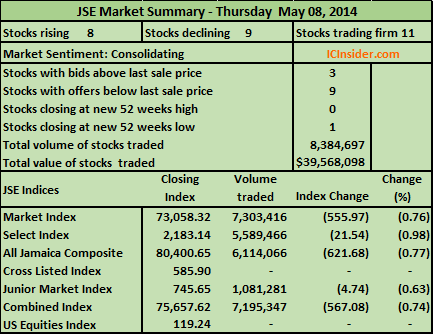 Main Market| 6 companies in the main market advanced and 7 declined as the indices moved down with the JSE Market Index shedding 555.97 points to 73,058.32 and the JSE All Jamaican Composite index fell by 621.68 points to close at 80,400.65 just a shade from the low for 2014 of 80,359.75 reached on January 7th.
Gains| Stocks recording gains at the end of trading in the main market are Carreras that gained 8 cents to close at $33.65 with only 1,000 units changing hands, Desnoes & Geddes trading 72,966 shares to close with a gain of 20 cents at $4.30, Jamaica Money Market Brokers 73,808 ordinary shares to close at $7.30 with 3 cents gain, Jamaica Money Market Brokers 8.50% preference share 72,000 units to close up a cent at $3.51, Sagicor Group with 415,594 shares to close at $9.10 up by 20 cents and Seprod with 968 units to close at $11 with a 20 cents gain.
Firm| There were 7 stocks in the main market to close without a change in price, with Gleaner trading 548,887 shares in closing at $1.10, Jamaica Broilers with 1,030,997 shares and closed at $4.85, Jamaica Money Market Brokers 8.75% preference share with 1,104,250 units and closed at $3.03, Mayberry Investments 20,560 shares as the price closed at $1.71, Proven Investments 8% preference share, 13,100 units to end at $5.09, Radio Jamaica 10,000 shares and closed at $1.28 and Scotia Investments with 18,790 units and closed at $23.10.
Declines| The number of stocks that declined in the main market are Cable & Wireless with 2,869,910 shares in losing 5 cents to end at 35 cents, Caribbean Cement with 71,784 shares to end at $3.50 with a 50 cents fall, Grace Kennedy 51,906 shares while closing at $56, down by 50 cents, National Commercial Bank 33,961 units as the price ended at $18 with a loss of 50 cents, Pan Jamaican Investment 4,000 units, closing at $48.50 for a fall of a cent, Sagicor Real Estate Fund traded 3,464 units at $6 as it shed 50 cents and Scotia Group with 885,471 shares in closing at $20.06 for a 49 cents drop.
Junior Market| The JSE Junior Market Index declined by only 4.74 points to close at 745.65 as 8 stocks traded with 2 advancing and 2 declining.
Gains| Stocks recording gains at the end of trading in the junior market are Caribbean Producers trading 456,206 units to close at $3.10, up 10 cents and Lasco Distributors with 424,000 shares to close at $1.35 with a gain of 5 cents.
Firm Trades| Stocks in the junior market that traded to close at the same price as the day before are Access Financial with 6,000 units and closed at $11.50, Blue Power 4,000 units and closed at $9.01, General Accident Insurance 53,068 units, closing at $1.50 and Lasco Manufacturing with 77,934 shares as the price closed at $1.20.
Declines| Stocks declining in the junior market at the end of trading are Lasco Financial with 21,800 units at $1.25, down by 5 cents and Paramount Trading in trading 38,273 shares, landed at a 52 weeks low of $2.68 with a decline of 23 cents.
IC bid-offer Indicator| At the end of trading the Investor’s Choice bid-offer indicator had only 3 stocks with the bid higher than the last selling price and 9 stocks with offers that were lower, continuing to indicate a negative market sentiment.
More losses for the market
JSE Market gains 2,000 points
Scotia Group traded as high as $22.89 before closing at $20.50 and was the main factor in the big jump in the Jamaica Stock Exchange two main indices while the prices of 9 stocks rose and 8 declined as 27 securities traded resulting in 5,724,168 shares trading valued at $32,909,845.
 Main Market| The prices of 5 companies in the main market advanced and 6 declined as the indices jumped as the JSE Market Index gained 2,054.10 points to 76,042.79 and the JSE All Jamaican Composite index jumped by 2,296.84 points to close at 83,737.81.
Gains| Stocks recording gains at the end of trading in the main market are Cable & Wireless with 1,290,256 units to close with a 2 cents gain at 44 cents, Carreras traded 3,594 shares to close with a gain of a cent at $33.57, Gleaner gained 5 cents to close at $1.15 with 20,000 units changing hands, Jamaica Money Market Brokers 1,494 units to close at $7.27 up by 5 cents and Supreme Ventures with 79,975 shares to close with a gain of 5 cents at $2.10.
Firm| There were 6 stocks in the main market to close without a change in price with Desnoes & Geddes trading 1,064 shares and closed at $4.50, Jamaica Broilers 715,645 units and closed at $4.85, Jamaica Money Market Brokers 8.75% preference share, 654,081 units to close at $3.03, Jamaica Producers 96,627 units at $18.26, Mayberry Investments 2,040 shares in closing at $1.70 and Scotia Group 868,539 shares to close at $20.50 but traded as high as $22.98.
Declines| The number of stocks that declined in the main market are Berger Paints with 10,000 units in losing a cent to end at $1.67, Caribbean Cement with 25,899 shares to close at $3.90 by falling by a cent, Hardware & Lumber 36,100 shares to close at $10.50 for a $1.20 fall, National Commercial Bank 57,933 shares to close at $18.10 for a 20 drop, Pan Jamaican Investment 2,400 units to end 23 cents lower at $49.05 and Sagicor Group with 23,157 shares in closing at $9.03 for a 47 cents fall.
Junior Market| The JSE Junior Market Index declined by 6.86 points to close at 747.40 as 10 stocks traded with 4 advancing and 2 declining.
Gains| Stocks recording gains at the end of trading in the junior market are Dolphin Cove that traded 1,000 units to close at $8.23 with a gain of 3 cents, Medical Disposables 391,382 shares to close with a one cent gain at $2.05, Jamaican Teas up 29 cents to end at $3.50 for 49,470 shares and Lasco Manufacturing traded 1,035,268 units to close up a cent at $1.20.
Firm Trades| 4 stocks in the junior market that traded to close at the same price as the day before with Access Financial Services trading 4,044 units at $11.50, Caribbean Producers with 200,000 units to close at $3, Consolidated Bakeries 108,000 to close at $1.10 and Lasco Financial Services 31,200 shares at $1.20.
Declines| Stocks declining in the junior market at the end of trading are General Accident that traded 7,000 units at $1.50 as the price lost 10 cents and Lasco Distributors with 8,000 units, closed 5 cents lower at $1.35.
IC bid-offer Indicator| At the end of trading the Investor’s Choice bid-offer indicator had only 3 stocks with the bid higher than the last selling price and 8 stocks with offers that were lower.
Market directionless
In Thursday’s trading on the Jamaica Stock Exchange, the market was directionless with advancing stocks numbering just below declining ones and the IC market indicator showing investors in a tussle over the immediate future direction of the market. Prices of 6 stocks rose and 8 declined as 20 securities traded resulting in 3,602,192 shares changing hands valued at $19,621,158 in another lacklustre session.
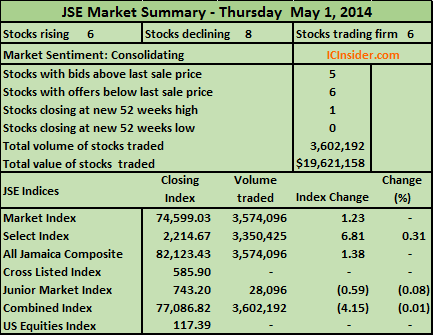 Main Market| All advancing shares in the market was in the main market and all but one stock that declined was also in this market, but the indices moved up slightly, with the JSE Market Index inching up by just 1.23 points to 74,599.03 and the JSE All Jamaican Composite index edging up by only 1.38 points to close at 82,123.43.
Gains| Stocks recording gains at the end of trading in the main market are Berger Paints trading 89,657 unitss to close with a gain of a cent at $1.68, Caribbean Cement gained 21 cents to close at $3.91 with 20,500 units changing hands, Carreras traded 443 shares to close 6 cents higher at $33.56, Ciboney with 50,000 shares by increasing by a cent to close at 12 cents for a new 52 weeks high, Grace Kennedy 7,439 shares with a gain of $1 to close at $58 and Jamaica Money Market Brokers with 451,214 ordinary shares to close up by 4 cents at $7.24.
Firm| There were only 5 stocks in the main market to close without a change in price as Gleaner with 228,484 shares closed at $1.10, Hardware & Lumber traded 3,300 units and closed at $11.70, Mayberry Investments with 3,060 units closed at $1.70, Scotia Group had 59,888 units changing hands to close at $20.62 and Seprod traded 685 shares in closing at $10.84.
Declines| The number of stocks that declined in the main market are Cable & Wireless with 1,500,888 units while losing a cent to end at 40 cents, Desnoes & Geddes with 76,472 shares to end at $4.30 as the price lost 30 cents, Jamaica Broilers with 450,872 shares to close at $4.86, down 4 cents, Jamaica Producers that traded 6,600 units to close at $18.26 while losing 4 cents, National Commercial Bank 571,665 shares as the price closed with a 10 cents lost, at $18, Sagicor Group had 50,529 units changing hands to close with a fall of 71 cents to $9.50 and Salada Foods 2,400 shares to close 45 cents lower, to end at $7.50
Junior Market| The JSE Junior Market Index declined by 0.59 points to close at 743.20 as only 2 junior market stocks traded at the end of the trading session.
Gains| No stock gained at the end of trading in the junior market.
Firm Trades| Lasco Manufacturing was the only stock in the junior market that traded to close at the same price as the previous trading day with 27,096 units to end at $1.20.
Declines| Caribbean Producers was the only stock declining in the junior market at the end of trading as the price fell 9 cents to close at $2.91 as it traded a mere 1,000 units.
IC bid-offer Indicator| At the end of trading the Investor’s Choice bid-offer indicator had 5 stocks with the bid higher than the last selling price and 6 stocks with offers that were lower.
Carib Cement turns profit
Aggressive pricing and increased cement sales helped Carib Cement Company turn a big loss last year into a profit this year. For the quarter ending September, profit jumped to $169 million, a marked change from a $245 million loss in the similar quarter of 2012.
For the nine months, profit was only $32 million reflecting a very poor first quarter resulting from a loss incurred along with a big foreign exchange loss of $689 million and interest of $349 million. The nine month figures may not appear great, but when viewed against a mammoth loss of $1.45 billion in the same period in 2012, the extent of the about turn is vivid.
Admittedly, the parent company had to step in to restructure loans that were lent to Carib Cement and were choking them, thus cutting interest cost. Revenues climbed 50 percent to reach $3.2 billion in the quarter and $8.89 billion for the nine months, an increase of 30 percent. The improvement flowed from increased volume of cement and clinker sales which accelerated in the third quarter by 34 percent over the 2012 quarter. For the year to date, volume sales climbed 7.6 percent, as exports declined in the 2013 nine months period. Export sales rose in the latest quarter by 44 percent and local sales by 19 percent, year to date it is up by only 10 percent.
 Price increases | Since last year, the company has increased the price of its product on a number of occasions. In January, cement prices increased by 16.5 percent on average, 3 percent in April, 1 percent in July and in October, a 2.7 percent increase, which was on top of a 9.2 percent increase in July last year.
The full 2013 results should come out to be in the order of 20-25 cents per share if all goes well, but it’s the 2014 numbers investors should be focusing on from now as it looks like earnings could well be in the 80 cents per share range, which would see a big hike in the stock price. The situation could get even better if some of the major infrastructure works that have been announced come on stream along with any pick up in the housing market.
All this is why IC Insider has now upgraded the stock to Buy Rated. There are still risks involved. Cement plants are notorious for bad news flowing from accidents or other major setbacks, as is the case in the company parent Trinidad Cement. The company seemed to have been doing very well only to be hit by problems in the factory, as well as in Barbados, and just barely reported a profit in the September quarter. While the company has depended on Trinidad Cement to bank roll it, the group is under strict dictates of its lenders.
Balance sheet | End of the period cash funds were down to $149 million from $244 million at the end of December last year. This needs to be rebuilt to reasonable levels to provide for smooth operations and for the company to be able to ride out any storm they may encounter.
Even if the company was able to continue the profits levels seen in the third quarter, it is going to take about 7 to 8 years for them to wipe out the huge accumulated loss of $7.5 billion and be in a position to start paying dividends again. It may well happen before that time frame due to the likely impact of inflation in driving up profits in the years ahead and, if the Jamaican economy starts to grow at a reasonable pace, sales of cement could surge and boost profits.
Both Trinidad Cement Limited (TCL) and Caribbean Cement Company are IC Insider Buy Rated stock.
Related posts | Cement profit surge – not so fast | Carib Cement profit mired in concrete | Cement could be good for your pocket
Cement profit surge – not so fast
Caribbean Cement Company is reporting a major change in fortunes in the latest quarter ending June from a loss of $497 million in the first quarter to a profit of $359 million in the June quarter. For the six months to June, the Group is reporting loss of $137 million, compared to a loss of $1,204 million in the corresponding period of 2012.
The loss of $137 million is after charging $701 million of non-cash foreign exchange losses compared to $136 million of foreign exchange losses for 2012. In the June quarter, Forex loss is $252 million but interest cost fell by $62 million and is down $60 million for the year to June. The bright light is not all that it appears to be at first sight as the results benefited from the write back of $591 million of withholding taxes on interest that was due to the parent company which have been reversed. The write back results from the restructuring of the parent company debt into preference shares.
Management states that, “We note that even before the write back of the withholding taxes, operating profit for the second quarter had improved over the prior quarter from $98 million to $153 million. This improvement is principally as a result of increased revenue from the 3% price adjustment in the domestic market in April and a doubling of export sales volumes in the second quarter, due primarily to our entry into the very vibrant Panama market.”
 The numbers are saying that excluding extraordinary charges or income and assuming business is maintained at least at the current levels then a small profit should be eked out quarterly. The preference shares which are redeemable are effectively participating shares and are entitled to receive the same amount of dividend per share as the ordinary shares. There will only be a total of 115 million preference shares to 851 million ordinary shares.
Sales | Revenues for the quarter is up to $3 billion from $2.4 billion last year and $2.68 billion in the 2013 first quarter. Local sales in tonnes was the same as the first quarter but exports grew to 68,000 versus 33,000 in the first quarter. Local tonnage is up year to date by 20,000 tonnes but exports are below last year six months by 34,000 tonnes. Last year the local company exported cement to Trinidad as the plant there was under strike.
The restructuring of US$75 million of debt due to Trinidad Cement, contributed shareholder’s equity moving from negative $2.939 billion at the beginning of 2013 to positive $4,501 million at the end of June. The restructuring of the debt was completed with the conversion of US$37 million to preference shares, in accordance with the approval given by the shareholders at the Annual General Meeting, and with TCL making a capital contribution of US$38 million to defray the balance.
Caribbean Cement’s management stated that “they experienced operational gains through significant improvements in our plant efficiency, in particular specific energy consumption, following expenditure of approximately US$5 million in capital maintenance and upgrade works earlier in the year. As a result of the improved performance, we have been able to meet our debt obligations over the last six months. With the restructuring of the intra-group debt, the threat of foreign exchange translation losses has been significantly mitigated. We expect to maintain the improvement in export sales and grow these even further as we enter new markets in South America. While we do not foresee any meaningful growth in the domestic market, with careful cost management and the expected growth in export earnings, we expect to maintain these favourable results over the rest of this year”.
The June results is pointing to earnings per ordinary share of around 40 cents for a twelve month period. With these results, the stock which has risen from a low this year of 60 cents to a $1 recently, could enjoy further gains in the period ahead.
Related posts | Carib Cement profit mired in concrete
Carib Cement profit mired in concrete
Badly financially structured, the lone Jamaican producer of cement and gypsum, Caribbean Cement Company continues to be under concrete with huge losses weighing it down and in spite of recent price increases, the company is still reporting losses as shown by the 1st quarter 2013 results. Unfortunately, when analyzed, the interim results do not shed any light as to when its fortunes will not only change for the better but when will it start making returns to its owners.
Although local sales are up from 143,316 tonnes last year to 151,862 tonnes this year, export sales was down and revenues were up to $2.646 billion aided by recent price adjustments. In 2012, revenues came in at $2.3 billion. The improved revenues helped to turn around the profit, before depreciation interest and devaluation losses, to $184.25 million up from a loss of $377 million in 2012. Even without any foreign exchange loss the company needs another 10 percent increase in revenues, net of expenses, to be somewhat safe.
Price increases | In January the company increased cement prices by 16.5 percent on average and 3 percent in April as well. Interestingly, in spite of the January increase and a 9.2 percent increase in July last year and increased volume of local sales, revenue for cement is up only 15 percent over that of 2012, well below the price adjustments. Admittedly, the decline in exports would have impacted income growth.
 As stated by management in a release, total sales volumes declined when comparing first quarter of 2013 with the first quarter of 2012. However, domestic sales volumes, which are essential to the company’s viability, increased by 6.7%. The improvement in domestic sales was entirely due to increased market share as the overall domestic market declined. This increase in domestic sales, along with increases in selling prices and further improvements in clinker production have resulted in a $561 million improvement in Earnings before Interest, Depreciation and Tax [EBITDA] over the corresponding period for 2012.
Management went on to further state, that the negative Group equity increased to $3.44 billion and with the significant build up in clinker inventory during this first quarter as production exceeded sales, the Group could not continue to operate without the financial support of the parent company, Trinidad Cement Ltd. Management is pursuing various strategies to improve both domestic and export sales and it is proposed that a significant portion of the debt due to the parent company be converted into equity during the second quarter.
Messed up | Caribbean Cement has messed up so many times in recent years that it will take a massive change in its financial fortunes to restore investors’ confidence. The first error is that the company totally mistimed the plant expansion by not anticipating the increased in demand in the mid-2000s. As a result, they missed most of the increased demand and the expanded plant only caught the tail end of it. Secondly, the company missed a glorious opportunity in 2004, when the stock price was sky high, to raise added capital in the local market to help fund the expansion. Finally, there is no evidence that they forged the right political connections or presented a viable plan to ensure continuity in cement supply, thus opening the market to unneeded imports which severely hurt them and from which they continue to reel.
Minority shareholder to be battered | The contemplation to convert debt to equity by the parent company, could negatively affect shareholders’ value if the conversion is to ordinary shares. If the conversion is to redeemable preference shares that would be a far different proposition, as preference are quasi debt and equity.