Prestige profit fall blamed on T&T economy

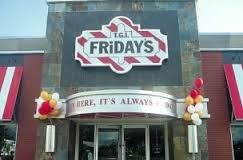
Prestige Holdings brand – TGIF


For the first half 2017 Prestige Holdings revenue increased 6 percent to TT$505 million but profit before tax decreased by 24 percent to $24.6 million, from $32.2 million in the previous year.
Profit attributed to shareholders decreased by 31 percent to $15.8 million, from $23 million the year before, as cost rose faster than income by 9.6 percent while revenue was up 6 percent.
Earnings per share were 26 cents for the 2017 half year. Gross profit margin held at 35 percent for both quarters in 2017 a 1 percentage point slippage from 2016 six months period resulting in profit for the May 2017 quarter ending at $6.7 million after tax compared to $10.6 million in 2016.
Earnings per share were 26 cents for the 2017 half year. The results were generated from an average of 119 restaurants. “The difficult economic environment in Trinidad and Tobago continues to weigh heavily on many sectors of the economy and on consumer spending. Despite this trend, across the majority of our restaurants we experienced stable or improved sales as a result of the strong market position of our brands, as well as attractive and innovative value food offerings. However, profitability fell short of prior year as a result of higher food costs and other inputs as a result of higher commodity prices, the depreciation of the Trinidad and Tobago Dollar and the higher tax rate, when compared to the corresponding period in 2016,” Christian E. Mouttet, Chairman of the company told shareholders in a written report accompanying the results.
The company indicates that they are implementing initiatives on containing cost driving sales and transactions of all our brands.
A fourth Starbucks restaurant was opened in May 2017 at Gulf City Mall in San Fernando, and the company plans to open at least one more Starbucks restaurant in this financial year.
“While we do not anticipate any improvement in the Trinidad and Tobago economy in the second half of 2017, we expect to maintain the positive sales experienced in the first half. We also expect that the initiatives to manage our higher costs coupled with new and innovative menu offerings will yield an improved performance in the second half but the full year’s performance will not likely be comparable to the prior year,” the chairman further stated in commenting on the company’s outlook.

The stock which is listed on the Trinidad and Tobago Stock Exchange, last traded at $10.64, but had no bids on Friday with an offer at $10.74 to sell 750 units.

More declines for Junior Market – Tuesday

Trading which dropped sharply on the Junior Market on Monday declined even more on Tuesday with only 401,316 units changing hands down from 671,349 units trading on Monday. Traded valued also declined to $2,286,974 from $3,163,547.
At the close 16 securities traded, up from 21 on Monday with the market index posting a loss of 16.66 points to end at 2,970.41 as the price of 6 stocks advanced and 5 declined. Trading closed with 3 stocks having a higher bids than the last traded price and 3 closing with lower offers.
The Junior Market ended trading with an average of just 25,082 units for an average value of $142,936 compared to 31,969 units for an average value of $150,645 on Monday. The average volume and value for the month to date amounts to 55,788 units valued at $307,527 compared 58,347 units valued at $321,243 previously. In contrast, June closed with averages of 395,969 units valued at $1,799,200 for each security traded.
At the close of the market, Access Financial Services lost 4 cents to close at $46.01 in trading traded 413 units, CAC 2000 gained 1 cent to end at $6.73 with 10,000 shares trading, Caribbean Producers lost 10 cents and closed trading with 17,628 units, at $3.40, Consolidated Bakeries ended with 29,635 units changing hands, to close at $2.62 General Accident closed trading with 2,960 shares to end at $2.70, Honey Bun . lost 14 cents to close trading with 2,000 shares at $5.70, ISP Finance dropped 50 cents and closed with 12,000 units changing hands at $13, Jamaican Teas ended trading 9,700 shares at $4.20, Jetcon Corporation traded 12,961 shares and rose 5 cents to end at $4.54, Knutsford Express traded 750 shares to end at $14.50, after falling 20 cents, Lasco Distributors closed at $6.37 after trading 164,442 units, Lasco Financial ended with 500 shares changing hands to end at $3.60, Lasco Manufacturing fell 3 cents and ended with 117,131 shares trading at $4.77, Main Event rose 32 cents with 3,048 shares trading to end at $5.50, tTech added $2 trading 17,148 units to close at $10 and Eppley 9.5% preference share lost 5 cents to close at $6 with 1,000 units trading.

Trinidad’s Readmix goes private

TCL now has 97.23% of Readymix shares.

Trinidad Cement (TCL) acquired most of the shares of Readymix following the offer to minority shareholders to buy out their shares at TT$11 each.
Following the offer TCL now owns 97.23 percent of the Readymix shares. TCL in a recent release advised the minority shareholders that they can still sell their shares to the company and they also advised that an application was made to the Trinidad Stock Exchange to have the Readymix shares delisted.
Readymix has struggled to make a profit recently and with the Trinidad economy in recession, the situation became worse and would require finding areas of cost to cut to get the operations into a state of minimal cost. Acquisition of all the shares would end up reducing cost in a number of areas.

Devon House I Scream same old taste new experience

Inside the new Devon House Ice Cream store.

Ice Cream is a welcomed delicacy, meant to be a titivating experience for the palate. What better way to fill the delectable urgings than to make the experience of acquiring the sought after product, pleasant, if not delightfully.
Devon House Ice Cream, a favourate with Jamaicans and visitors alike, saw an increasing number of patrons descending on its primary point of sale, in droves in what was then a crammed and uninviting space particularly on weekends and public holidays. The company operating the store, has moved the experience to a much higher level, with their new and spacious store at a new location at Devon House.
A recent visit, admittedly, around 1 PM on a Sunday, made the experience noticeable. There was abundant space, with good spacing for the cashiers section hosting a number of machines for booking orders and a wide expanse for orders to be placed and collected. Gone are the limited space that required patrons to move outside while waiting on orders to be filled. Gone too are the numbering system now replaced by stanchions guiding patrons towards to area for delivery of the orders.
All in all it is a much improved experience and one that customers are sure to delight in, especially when they compare it with the former slave trade like experience of persons being cramped into a small space awaiting orders.

SOS solidly BUY RATED

Stationery and Office Supplies reported earnings of 26 cents per share for 2016 and IC Insider.com forecast 40 cents pretax for the current year from just over $90 million in pretax profit, a near doubling in profits over the $53 million reported in 2016.
Revenues increased 11 percent in 2013, just 5 percent in next year, 14 percent in 2015 and 12 percent in 2016 and 20 percent for the first six months of 2017, hitting $702 million in 2016 and seems on target to get to around $850 million for 2017.
Pre-tax Profit in 2016, pre-tax profits jumped 279.5 percent to end at $53 million compared to only $14 million in 2015, and $8 million in 2014.
Improvement in the Company’s revenues has been attributable to organic expansion driven by the achievement of deeper penetration in the market for the Company’s products and services but inflation and devaluation of the Jamaican dollar versus the United States currency would also play roles. Improved profit and cash flow generated in the last two years helped to fund increased inventory making more choices available to customers and that is reflected in a noticeable pick-up in sales. The Company has expanded its product offerings, adding to the list of brands it distributes and venturing into manufacturing its own brands of furniture – Image and Torch.
Gross profit as a percentage of sales was a strong 48 percent in 2016, coming from 43 percent in 2015 and 44.55 percent in 2014. Lower cost of sales led to an improved gross profit position of $339 million in 2016, which 26.09 percent increase over that earned in 2015 and 10 percent more in 2015 over 2014.
As at the 31 March 2017, SOS reported first quarter revenues of $220 million, 20.7 percent more than the $182 million reported in the corresponding period for 2016. Cost of sales as a proportion of revenue remained in line with the FY 2016 representing 50.66 percent of total revenue; this percentage was however slightly higher than the 48.75 percent for all of 2016. The company reported pretax profits of $30 million compared to $29.5 million in Q1 2016. A number of factors impacted the 2016 results that resulted in higher profits than would normally be the case as such the 2017 profit are better than the figures suggest. In effect the 2016 first quarter could be around $20 million from normal ongoing operation.
Gross profit for the three month period ended 31 March 2017 was $108.64 million or 16.2 percent more than the $93 million reported in 2016. SOS also reported an increase in administrative costs of 21 percent to $53 million and selling expenses climbed 37.5 percent to $18 million.
Total assets were valued at J$498 million at the March this year comprising current assets of $243 million. Inventories stood at $117 million, receivables $93 million and cash of J$12 million. Total liabilities amounted to J$231 million, with trade and other payables of J$78 million. Shareholders equity stood at $270 million or $1.35 per share.

The company will benefit greatly from listing and sales to climb above recent levels form the increased exposure that will be gained from listing on an ongoing basis as well as the increased working capital that will provide additional choices for customers and help fuel increased sales. IC Insider.com accords the stock BUY RATED with the price to rise sharply after the stock list.

Express Catering stock a fair buy

Ian Dear, Chief Executive Officer of Express Catering

The 100 percent shareholder of Express Catering, Margaritaville St Lucia, are offering up to 327,500,000 of existing shares for sale at $1.50 each, to raise approximately J$490 million from the public. Most of the shares are reserved for special interest groups.
The issue opens at 9 am on Wednesday 12 July and is scheduled to close at 4 pm, Wednesday 19 July 2017.
Up to 16,500,000 shares are Company Reserved Shares, 32,750,000 are Mayberry Reserved Shares, 245,625,000 shares are Key Partner Reserved Shares with 32,625,000 slated for the General Public Shares. The company has 1,637,500,000 issued and this will not change with the issue. The stock will be listed on the Junior Market of the Jamaica Stock Exchange. Mayberry Investments are the broker to the offer.
The stock appears to be a fair buy with growth to come from expansion into the Starbucks franchise to be located at the Sangster Airport and continued growth in visitor arrivals through that airport going forward as the sector expands.
The selling shareholder will use the funds raised in the Invitation for the purposes of the Group’s liquidity inclusive of the continued improvement and expansion of the Company’s operations, working capital and general corporate purposes. The proceeds of sale will also be used to pay the expenses of the Invitation out of the fundraising, which the Directors expect will not exceed J$27.5 million.
Franchises operated include; Quiznos Subs and Salads, Dairy Queen, Nathans Famous Hot Dogs, Domino’s Pizza, Auntie Anne’s Pretzels, Wendy’s, Cinnabon, Moe’s South Western Grill, Island Deli, Viva Fresh Market Grab & Go, Cricket Sports Bar, Connections Bar, Air Margaritaville Arrivals Bar, Jamaican Bobsled Cafe and The Groovy Grouper The Bar.
The Company achieved revenue of US$14.1 million in the financial year ended May 2016, an increase of US$460,000 or 3.4 percent over the previous financial year’s Revenue of US$13.6 million. Revenue for financial years 2013 and 2014 was US$10 million and US$12.2 million respectively. While the financial show gross margins stable around 73 percent of revenue, while administrative and other costs as reported accounts for 58 percent of revenue for 2016 and slightly more for the comparative period in 201. Administrative costs include some items that should be included in cost of sales as they are not administrative expenses. Included here for the 2017 figures in US dollars are; Franchise fee $1,264,282 fuel $39,098, bar and restaurant supplies $373,127, staff cost of $1.39 million and rent of $2.8 million as well as electricity.
Net Profit of US$1.1 million was realized in 2016 up from US$590,000 in 2015. For 10 months of financial year to March 2017 revenue grew to US$11.54 million with net profit before tax of US$1.15 million from revenues of US$11.52 million in the 10 months of the prior year and profit of US$904,144 in the same period the prior year. Profit before tax should end the 2017 fiscal year around $1.25 million for earnings per share of .076 US cents or 9.7 cents Jamaican.
In the period to March 2017 launched a 7 year preference share to raise US$3.5 million. Proceeds from this issue was earmarked for the construction of the Starbucks Coffee outlets at Sangster International Airport, and to settle certain Group obligations.
The board of directors comprises, Winston Dear, Ian Dear, Roland Clarke, John Byles, Tania Waldron-Gooden.
The stock is being sold at a big premium to net asset value of $0.36 with equity valued at US$4.6 million, but at a PE of 15 based on 2017 earnings. Earnings for the May 2018 period could rise to $1.65 million or earnings per share of US 1 cents per share or J$0.13, excluding the new franchise operation. The average of the Junior Market of approximately 12.5.

This SOS IPO who are the connections?

The McDaniel family owned Stationery and Office Supplies (SOS) after 50 years of serving their more than 3,000 clients, are heading in a new direction. No longer content to hug up 100 percent of the company the family is now are embarking enjoining the public to ride on with them to the next level.

In furtherance of this new thrust SOS is now seeking to list on the Jamaica Stock Exchange Junior Market with an initial public offering 50,024,100 ordinary shares, to raise approximately $95,048,200 before expenses. The issue is inclusive of 22,500,000 reserved shares some of which are being sold at $1.60 for staff, with the rest being made available to the general public at $2 per share the offer opening at 9 on July 19th, with the closing set for 4:30 P.M. on July 26th.
The Company reported pretax profits of $53 million in 2016, from sales of $702 million, with earnings of 26.5 cents per share, resulting in a PE of 7.5 before tax. Earnings for 2017 is estimated at around 40 cents on a pretax basis at an attractive PE of 5.6 times 2017 earnings. Revenues for the first six months of 2017, are up almost 20 percent over the similar period in 2016. Office furnishing and fixtures account for approximately 60 percent of sales revenues and stationery and office supplies for 40 percent management advised IC Insider.com.
The Company estimates that the expenses in the invitation will not exceed $12,000,000 inclusive of General Consumption Tax and an expanded marketing and publicity spend, expected to not only drive interest in the IPO but create greater awareness about the company. and its products.
Minimum raise| The Company needs to raise at least $50,000,000 to qualify for listing on the Junior Market. If that amount is not achieved an application will not be made for the shares to be admitted to the Junior Market and all funds will be returned to the persons who made them.
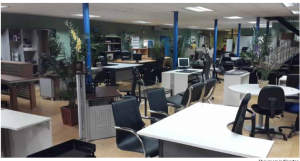
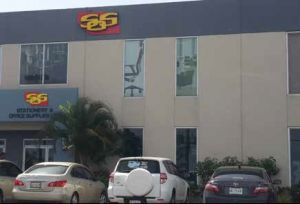
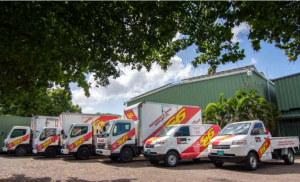
History| The Company started business in July 1965 under the guidance of Richard Hing, George Hew and David McDaniel. In 1970, the Company became wholly owned by the McDaniel family when all of the issued ordinary shares were acquired by David and Marjorie McDaniel. The Company now operates out of a 35,000 square feet warehouse, office and showroom on Beechwood Avenue in Kingston and a 3,000 square feet location in Montego Bay that houses 1,200 square feet of office and showroom space and a 1,800 square foot warehousing facility supported by a staff complement of sixteen. The Head Office currently employs eighty-three team members. Eleven delivery vehicles are operated by the company including trucks, which support delivery to customers.
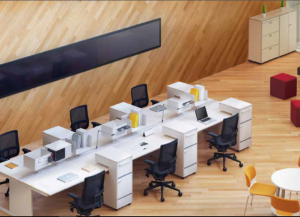
Products|The Company now sells and market office supplies and stationery items, modular office furniture, partitions, metal products, chairs, cabinets and shelving. The Company is the sole local distributor for the leading international brands in office furniture – Fursys and Boss. In 2011, lower priced items were introduced to meet growing demand, by introducing the first of two proprietary brands, the first being the “Image” brand and shortly thereafter in 2012, the Company introduced its second brand “Torch”. SOS also does a small amount of sales to the eastern Caribbean and will be seeking expand business into that Region. According to the company’s management, the increased warehouse space will be critical to this effort. A lesser known service the company carries out, is the servicing of office equipment. This area they indicate has room for increased revenues and profit.

During the last six years, the Company added commercial shredding to its suite of services offered to the general public.  The service has become popular among entities which have large volumes of waste paper and other sensitive material that stores data, but are concerned about improper disposal methods. The Company’s states that its “shredding facility meets international best practice standards and has the capacity to shred up to 5,000 pounds of paper per day as well as the destruction of tapes, hard drives and compact discs. The Company’s shredding facility offers the customer the ability to view an on-line real-time video stream of the shredding process being undertaken on-site on their behalf, or if preferred the customer may also be present when the shredding process is being undertaken”.
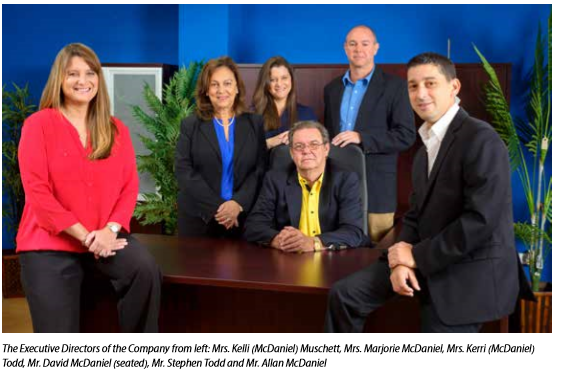
The directors of the company are, David McDaniel, Marjorie McDaniel, Allan McDaniel, Stephen Todd, Kerri (McDaniel) Todd, Kelli (McDaniel) Muschett, Anthony Bell, Gary “Butch” Hendrickson and Evan Thwaites.

Radio Jamaica looks promising

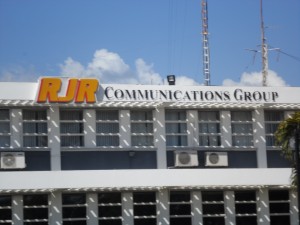
Radio Jamaica generated revenues of $1.2 billion in the March 2017 quarter, $156 million less than the December quarter but had $49 million more in direct expenses in the March quarter when it was expected that direct expenses would have fallen in keeping with the reduced income.
The group also reported lower profits in the March quarter compared with the December quarter and suffered a loss before taxation of $30 million and $65 million after an increased taxation charge of $35 million, bringing the full year taxation provision to $75 million. RJR ended the fiscal year with profit after tax of $145 million or just 6 cents per share. Results for 2018 should be much better as staff cost will fall with reduction in staffing while some one off cost that affected profit, should not recur.
In the March quarter, general expenses fell by $110 million from the December quarter to reach $562 million. The sharp change could result from reclassification of some expenses to direct cost, resulting in the jump in this area in the last quarter of the fiscal year. In the December quarterly report, the company stated that “increased cost of $64 million was incurred largely from further operational investments and one- off costs”. The areas that incurred the cost are continued rollout of 1 Spot Media, legal expenses incurred in protecting copy rights and defending legal action and repairs to broadcast transmitters. This was reconfirmed by Managing Director, Gary Allen in response to questions posed by IC Insider.com as the reason why profit in the Television segment had fallen even as revenues rose.
“The figures have seven months of the old structure. Only five months of HR synergies were realised in the financial year under review, as redundancies took place in September/November” Gary Allen, Managing Director advised IC Insider.com, in response to our question of how much staff cost is in the 2107 figures for person who were made redundant?
Prior to the merger investors were advised of major cost reduction and improved revenues that will flow from the merged entity. Allen stated ‘they have started with the HR synergies. Others are being realised as we integrate systems in the operations. Most elements will be implemented by the end of 2018/2019.”
Cash flow from operating activities was $363 million but $248 million was spent on acquiring fixed assets with the group ending with cash and equivalent of $291 million at the end of the year. RJR also has investments in bonds and Government of Jamaica securities amounting to $487 million.

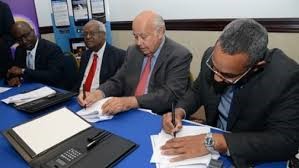
Gleaner & RJR execs signing merger agreement in 2015

The RJR Group underwent major changes with the acquisition of the Gleaner media business. Comparing the 2017 fiscal year’s results with that of 2016 makes little sense with the latter having very little financial data of the acquired business.
Data contained in the segment results, provide some indication as to the performance of various parts of the group. The performance of the segments in 2017 over 2016 show, Audio Visual generating just $65 million more in revenues in 2017 to end with $1.868 billion and contributed $72 million to profits compared to $157 million in 2016, Audio comprising radio operations had revenues of $711 million compared to $567 million and contributed profit of $238 million versus $112 million, Independent Radio coming on stream and growth in Outside Broadcasts contributed to the increase. The print division showed revenues of only $78 million in 2016 and a loss of $190 million saw a major about turn, with revenues of $2.8 billion and profit of $173 million for 2017.

Allen went on to state that “the market will remain competitive and the economic conditions of Jamaica will continue to impact media spend. Improvements will come from those able to leverage market leadership positions, product diversification, overseas earnings and new marketing strategies. RJR has all the necessary ingredients to meet these challenges and the opportunities on the horizon.”
The stock traded at $1.60 on the Jamaica Stock Exchange on Friday and with IC Insider.com projecting earnings of 25 cents per share for 2018 fiscal year ending in March, the stock seems attractive coming against a back ground of continued growth in the Jamaican economy.

Jamaica Broilers’ profit jumps 28%

Jamaica Broilers

The financial year to April 2017 was a good one for Jamaica Broilers Group, with attractive revenue and profit growth. For the full year, profit after tax attributed to the company’s shareholders rose 28 percent to $2.23 billion from $1.74 billion in 2016.
Sales revenues grew 15.3 percent to $44.44 billion for the year from $38.52 billion in 2016. The group enjoyed a 17% increase in revenues in the fourth quarter to $12.32 billion up from $10.52 in 2016 but profit but rose from $900 million to $1 billion at a slower pace than the growth in revenue.
A fall in the pace of growth in gross profit was a major factor in the slower growth in the last quarter as direct cost rose limiting gross profit to a rise of 13 percent to $3.57 billion in the quarter from $3.16 billion in 2016.
Segment results showed the Jamaican segment generating revenues of $31.96 billion up from $28.4 billion but segment results fell from $3.6 billion to $2.87 billion. Revenues for the US based operations grew to $10.86 billion from 8.8 billion and generated segment profit of $1.3 billion compared to $1 billion in 2016. Other Caribbean Countries generated revenues from third parties of $1.6 billion up from $1.3 billion in 2016 and contributed $944 million to profit up from $254 million in 2016.
While some Jamaican companies are by passing cheap borrowed funds for expansion purposes, Jamaica Broilers with equity capital of $14.4 billion has $7.7 billion in debt. The group holds $2.76 billion in cash with loan receivable of $2.55 billion of which $500 million is due within 12 months. Cash flow from operations is attractive at approximately $3 billion for 2017. During the past year $749 million was expended on the acquisition of fixed assets compared to $800 million in 2016 and the group paid dividends of $420 million for the 2017 fiscal year, up from $311 million in the prior period.
Forecast for 2018 is for EPS of $2.60, up from $1.85 for 2017. The stock closed on the Jamaica Stock Exchange on Friday at $18 at 10 times 2017 earnings but 7 times 2018 earnings compared to an average of the main market of 13.7. IC Insider.com rates the stock a buy for growth and income.

D&G & HEART sign traning agreement

Noel DaCosta, Chairman, D&G Foundation congratulates, Antonette Richman on completion of level 2 of the Skills initiative as classmates look on.

D&G Foundation through a partnership with the HEART Trust NTA, 2500 young Jamaicans will be trained under the Foundation’s Learning For Life Project Employability Programme.
With the targeted number of trainees this year, project employability is poised to help the Foundation deliver on its ambition of training 15,000 young apprentices by 2018, a release from the foundation states. Approximately 12,000 Jamaicans have already benefited from training programmes under the Learning For Life Programme since its inception in 2008. Funding for the programme is provided by the D&G Foundation which is the charitable arm of Jamaica’s beer producer Desnoes and Geddes.
Full tuition support for qualified students enrolled in the various modules at HEART in the first phase of the programme is covered by the Foundation. The project started on June 5, also includes courses in Social Media Management, Small Business Management.