 An unprecedented cinematic journey, ten years in the making and spanning the entire Marvel Cinematic Universe, Marvel Studios’ Avengers: Infinity War brings to the screen the ultimate, deadliest showdown of all time.
Iron Man, Thor, Black Panther, Spider Man, Hulk and the rest of the Avengers unite to battle their most powerful enemy yet – the evil Thanos. As the Avengers and their allies have continued to protect the world from threats too large for any one hero to handle, a new danger has emerged from the cosmic shadows, that challenges the entire team. A despot of intergalactic infamy, his goal is to collect all six Infinity Stones, artifacts of unimaginable power, and use them to inflict his twisted will on all of reality. Everything the Avengers have fought for has led up to this moment – the fate of Earth and existence itself has never been more uncertain. This intense and highly anticipated film features an all-star line up with Academy Award® nominees; Robert Downey Junior (Iron Man), Don Cheadle (War Machine) and Denedict Cumberbatch (Dr. Strange). They are joined by Chris Hemsworth (Thor), Mark Ruffalo (Hulk), Chris Evans (Captain America) Tom Holland (Spider Man) and Golden Globe® Award winner Tom Hiddleston (Loki). The film is produced by Marvel Studios and distributed by Walt Disney Studios Motion Pictures. Avengers: Infinity War is the sequel to 2012’s The Avengers and 2015’s Avengers: Age of Ultron, and the nineteenth film in the Marvel Cinematic Universe (MCU).
Deadliest showdown of all time – Avengers
Godfather of ETFs for Destination Experience

Reggie Browne
Destination Experience announced the participation of Reggie Brown, Senior Managing Director at Cantor Fitzgerald for the May 17-19 summit in Kingston.
Brown is widely considered the Godfather of Exchange Traded Funds by global authorities including Forbes and Bloomberg because of his influence in listing over 25 percent of the ETFs traded in the US.
Brown has over three decades experience and presides over one of the most complicated operations on Wall Street. The Exchange Traded Funds business at Cantor facilitates about one trillion dollars in trades annually for global pension funds, asset managers, wealth managers and broker dealers.
Cantor Fitzgerald is a financial services firm operating in 20 countries specializes in institutional equity, fixed income sales and trading, is expected to bring great value to the financial services sector in the Caribbean.
Jamaica financial services sector and participants in the local market have much to benefit from Brown’s experience, wisdom and vision as he shares his words on ETFs and asset allocation in the modern economy.
Trinidad Cement Q1 profit inched higher

Trinidad Cement
The Trinidad Cement Group generated revenue of $429 million during the March 2018 quarter, an increase of just 2 percent compared to 2017.
The Group recorded a 5 percent increase in profit for the period to $27 million versus $26 million in 2017 and EPS of 6 cents. The results benefited from increased demand for cement in Jamaica and Guyana and increased export dispatches from Barbados the company reported, but there was “lower revenue from the Trinidad operations, due to lower sales volumes arising from the contraction of the construction industry,” management stated.
Group earnings before interest, taxes, depreciation, loss on disposal of property, plant and equipment, and restructuring costs was $92 million for the period, down from $98 million in the 2017 quarter. There was higher costs from the planned equipment maintenance executed during the quarter at the Jamaica plant. The Group achieved a 55 percent reduction in finance costs to $13 million from nearly $28 million in the March 2017 quarter. Restructuring of loans in 2017 resulted in a 276 basis point reduction in the effective interest rate, potentially reducing finance cost by 30 percent. A net total of $167 million was repaid to lenders since April 2017, thus reducing the principal outstanding and finance costs.
Cash generation was impacted positively by better working capital management, improving to $105 million versus 2017. The Group invested $23 million in capital projects in the quarter and repaid $97 million of debt. The reduction in the loan will have a further positive impact on finance costs going forward.
Shareholders equity fell to $767 million from $1 billion in 2017 but is up on the December position of $753 million. Borrowings was $818 million with $244 million to be repaid within a twelve months period.
The TCL Group’s financial, operational and strategic direction is dedicated to producing favorable results notwithstanding the current restraints and challenges facing Trinidad and Tobago’s economy, management advised shareholders in their comments accompanying the results.
Going forward, there should be strong increase in demand from Guyana with the discovery of oil in commercial quantities, while the rest of this year should see a pickup in sales as well as lower finance in the Jamaican operation that should help boost profit for the overall group.
The stock last traded at $2.62 on the Trinidad and Tobago Stock Exchange at a PE around 10 times 2018 earnings.
Republic is going higher soon
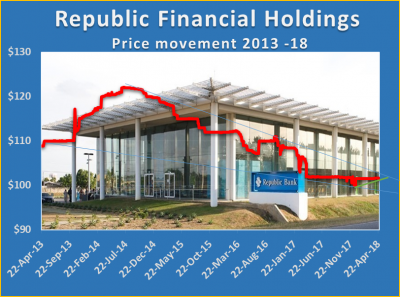 Trinidad’s Republic Financial Holdings should be heading higher on Trinidad and Tobago Stock Exchange, sooner than many investors may think.
One reason is that the financial powerhouse, just posted pretty strong results, with profit before taxation rising a healthy 22 percent, to $490 million in the March quarter and a still respectable 14 percent for the half year. Increased taxation wiped out a bit a of the top line gains leaving profit at 3 percent higher for the quarter at $333 million and an increase of 4 percent at $694 million, for the half year. The improvement arose from slightly lower cost in the current year than for the previous one and an overall 8 percent increase in net income for the quarter to $1.17 billion from $1.08 billion in 2017 and 4 percent rise year to date to $2.34 billion. Earnings per share rose to $4.02 for the half year from $3.90 and compares favourably with $7.75 million reported for the fiscal year to September 2017 and gives it a PE around 12 on 2018 full year earnings and Friday’s closing price of $101,
Improvement was generated by the bank in Ghana, where that subsidiary moved from a small loss of just over $1 million to a profit of $68 million and the Cayman Islands’ operations that moved from a profit of $82 million to $113 million. Barbados also should marked improvement with profit of $149 million compared to $111 million before.
Helping the performance is increased lending, with loans rising from $34.4 billion at March 2017 to $37.4 million in 2018, a solid 9 percent increase.
The other factor why the stock price is set to move, is that the it peaked at $122 in 2014 and slid downward since and seems to have found a bottom. Added to that, is a wedge formation showing in a technical chart of its price movement that seems set to steer the price upwards in the months ahead.
IC Insider.com would normally give the stock a BUY RATED accolade, concerns linger about the Trinidad economy from which it earns the vast majority of income and profit, and what is seen as an overvalued currency.
Note that all prices are in Trinidad & Tobago dollar.
John Burbank for Destination Experience

John Burbank
Hedge Fund Investor, John Burbank for is slated to be one of the presenters Destination Experience annual Jamaica conference.
Destination Experience announced speaker, John Burbank, Founder and Chief Investment Officer of Passport Capital for their upcoming Visionaries’ Summit, May 17-19 2018 in Kingston. Burbank founded Passport in 2000 with less than $1 million and shot to fame based on his lucrative bet against subprime mortgages in 2006 ahead of the global financial crisis. His fund made 220 percent the following year, as global markets were in their slow drift towards collapse. Passport Capital’s assets hit a peak of about $5 billion before a globally challenging period for hedge funds in 2017. As the Wall Street Journal describes him, “he made his name buying up credit default swaps ahead of the financial crisis, resulting in a more-than 200% gain for his main fund in 2007. That year, he made $370 million personally, Forbes estimated.”
They have now shifted their primary focus to cryptocurrencies while also operating their Special Opportunities Fund. Burbank is very bullish on cryptocurrencies in the future, and has taken a substantial position in Overstock.com (NASDAQ:OSTK) and counterpart tZero, which raised US$100 million in presale for its US$250 million ICO this year. Overstock has vociferously embraced cryptocurrency in recent times and is run by Dr. Patrick Byrne, its Founder and Chairman. Byrne attended The Destination Experience Visionaries’ Summit in 2017 and predicted a boom in cryptocurrencies that ensued that year in his presentation. Those who bought into his vision made tremendous returns. Burbank is also a strong advocate of the potential embedded within crypto-assets and anticipates that Blockchain technology is going to drive rapid change in every macro sector in the world.
Burbank’s wealth of experience in macroeconomic analysis and quantitative tools, as well as his experiences in exploring crypto-assets stand to offer significant value to our financial services sector.
Supreme Ventures Q1 profit jumps 49%
 Profit jumped a sharp 49 percent in the quarter to March, to $618 million for Supreme Ventures from $416 million in 2017 from Sale revenues that rose 14 percent for the quarter, to $15.3 billion from $13.4 billion in 2017.
Improvement in profit margin in the in the quarter rose to 11 percent from just 6 percent in the 2017 to deliver a strong 40 percent in jump in gross to $1.7 billion, as operating cost climbed 12 percent, to $13.6 billion compared to the similar quarter in 2017.
Administrative and other expenses rose 34 percent to $903 million in the quarter from $674 million in 2017. Finance cost rose 76 percent in the quarter to $15.5 million from $8.8 million in 2017.

Supreme Ventures traded at $11.75 on the JSE on Friday.
Segment results showed mixed fortunes with Lottery showing sharp improvement in profit from $556 million to $796 million Gaming moved from a profit of $21 million to a loss of just 42 million. Horse racing losses more than doubled to $40 million from $19 million Sports betting loss fell to just $3.7 million and Pin Codes profit fell from $32 million to $23 million.
Earnings per share rose to 23.5 cents for the quarter, from 16 cents in the 2017 quarter.
Gross cash flow brought in $686 million but addition to fixed assets offset by loan inflows, tax payment and of $443 million and paying $527 million dividends led to a small net cash outflow leaving cash and equivalent at $2.25 billion.
At the end of March, shareholders’ equity stands at $3.2 billion with borrowings at just $504 million. Current assets ended the period at $5.7 billion well over current liabilities of $2 billion.
The stock traded at $11.75 on the Jamaica Stock Exchange with a PE ratio of 12 times 2018 earnings.
Iron Rock post vast improved results
 Iron Rock experienced strong growth in the first quarter this year with gross written premium increasing 150 percent to $155 up from $62 million in 2017.
The company generated a loss for the period of $4.6 million well below the loss of $27.3 million recorded in the previous year’s March quarter. Net earned premium also rose sharply to $38.4 million from $9.7 million in the first quarter of 2017 for an increase of 296 percent. Other income consisted primarily of investment income for the period totalled $10.5 million 2017 of $6.2 million.
Claims Incurred for the quarter increased 36 percent to $17.3 million from $12.7 million in 2017. Operating Expenses 21 percent to $37.6 million from $31 million in 2017. The company incurred a reduced Underwriting Loss of $15 million versus a loss of $33.5 million in 2017.
The stock ended at $3 on Junior Market fell at the close of trading on Thursday.
NCB Q2 profit rises 22% before tax
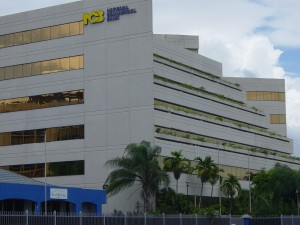
NCB Head Quarters in Kingston Jamaica.
NCB Financial Group recorded an increase of 17 percent in net profit of $11 billion for the six months ended March 2018 over the prior year, pretax profit for the six months was up just 1 percent.
Profit for the March quarter before taxation, rose a strong 22 percent over the similar quarter in 2017 to $8.26 billion but with taxation more than doubling profit after tax climbed just 9 percent to $6.4 billion.
Net operating income grew 22 percent to $35.3 billion over the prior year and 26 percent for the latest quarter. Improvements in foreign currency and investment activities 109 percent in the quarter to $4 billion and by 97 percent in the six months period to $7.2 billion. Net interest income increasing by $1.3 billion or 9 percent and was driven by the consolidation of Clarien Group (CGL). Net fee and commission income grew by 11 percent or $749 million, mainly as a result of higher transaction volumes for point of sale and e-commerce channels, increased investment banking and pension fee income and the consolidation of CGL. Operating Expenses excluding loan loss provision rose 30 percent to $24.5 billion for the half year and 29 percent to $11.5 billion for the quarter.
The Group’s loans and advances, net of provision for credit losses, increased by $127 billion or 61 percent to $334 billion to March. In addition to the consolidation of CGL, the president Patrick Hylton reported that “there was growth in all business segments’ loan portfolios: retail up 22 percent, corporate up 11 percent and credit card receivables up 25 percent. Nonperforming loans totalled $15 billion up from $5.9 billion at the end of March 2017.” The increase was due to the inclusion of CGL which has a non-performing loan ratio of 9.9 percent.
NCB declared a dividend of 70 cents stock unit. The dividend is payable on May 28, for stockholders on record at May 11. The stock closed at $95 on the Jamaica Stock Exchange before the results were released.
Carib Cement post fall in Q1 profits
Carib Cement reports lower Q1 profit for 2018
Revenues rose 6 percent in the March quarter this year for Caribbean Cement, compared to the first quarter of 2017 to $4.3 billion, but profit before taxation slipped modestly to $510 million from $528 million last year.
Increased taxation, from $67 million to $176 million dragged profit down to $348 million or 39 cents per share versus $460 million in 2017 or 54 cent per share.
“This performance was mainly driven as a result of the scheduled annual maintenance of Kiln 5 and Mill 5, during February and March of 2018,” the directors reported to shareholders and they went on to state that “our investment in maintenance efforts will no doubt increase our operational efficiencies with the goal of driving exports, in due course.”
Operating cost rose over 2017 by 10 percent to $3.7 billion, at a faster pace than revenues but repairs and maintenance jumped 75 percent to $345 million and staffing cost rose 18 percent to $542 million. Cost is set to fall sharply with the buyback of assets that were leased from Trinidad Cement which will reduce the $3 billion per annum charge that was incurred in this area in 2017.
Net cash generated by operating activities for the period of $856 million, but $1.5 billion was expended on capital improvement, including the installation of a new coal mill. According to management, the coal mill project currently in the final stages, and production is expected by the end of the third quarter of this year. This will continue to contribute to the plant’s operational efficiency and also to a reduction in operating costs. Cash on hand at the end of the quarter amounted to just over $1 billion.
The first quarter results left accumulated losses at $2.9 billion with shareholders’ equity at $9.3 billion. The stock closed on the Jamaica Stock Exchange at $38.51.
Cement signs buy back agreement
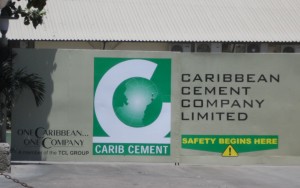
Caribbean Cement paid $1.3 billion as initial payment on the buy back of kiln.
The company reported that they made the initial payment of $1.3 billion towards the acquisition representing a significant investment in plant and equipment, improving the company’s asset base.
In March, Caribbean Cement announced that it signed a memorandum of understanding agreeing to the termination of the operating lease and the purchase by CCC of the assets covered under the Lease.
Agreement is for approximately USD$118 million to be paid to TCL and redemption of an aggregate number of 52 million preference shares held by TCL for approximately USD$40.5 million to be paid over a nine-year period, starting in 2018 and sourced from at least one third of CCC’s profits available for distribution from the previous year. CCC will also seek financing to fund the Asset Acquisition and the Redemption.
The agreement flows from concerns of minority shareholders who at the company’s last annual General meeting, at which shareholders were given the commitment by management that the best structure would be identified to acquire ownership of the assets.
The company paid $3.3 billion in 2017 for the lease of the assets that was installed to facilitate expansion of the plant.