 Trading in the foreign exchange market declined on Thursday. On Thursday the Jamaican dollar slipped slightly against the US dollar but gained against the British pound and Canadian dollar as purchases of all currencies by dealers amounted to the equivalent of US$22,936,813, compared with US$30,557,484, on Wednesday and selling of the equivalent of US$23,541,033 versus sale of US$32,121,997, previously.
In US dollar trading, dealers bought US$21,139,764 compared to US$26,518,924 on Wednesday. The buying rate for the US dollar remained stable at $115.21 and US$22,178,470 was sold versus US$30,223,008 on Wednesday, the selling rate was up 1 cent to $115.81. The Canadian dollar buying rate fell 84 cents to $93.07 with dealers buying C$617,645 and selling C$513,762, at an average rate that fell 21 cents to $95.98.  The rate for buying the British Pound dropped $1.41 to $172.84 for the purchase of £818,194, while £529,793, was sold, at an average rate that fell $1.41 to $175.48. At the end of trading it took J$131.48 to purchase the Euro, $1.97 more than on Wednesday, according to data from Bank of Jamaica, while dealers purchased the European common currency at J$128.85 for a rise of $1.53 on Wednesday’s rate. Other currencies bought, amounted to the equivalent of US$70,686, while the equivalent of US$134,057, was sold.
Highs & Lows| The highest buying rate for the US dollar, rose 5 cents to $116.05. The lowest buying rate advanced by $3.11 to $94.61 and highest selling rate remained at $121.23, while the lowest selling rate dropped $1.86 to $94.61. The highest buying rate for the Canadian dollar fell 80 cents to $96.  The lowest buying rate rose 37 cents to $76.36, the highest selling and the lowest selling rates remained at $98.78 and $92 respectively. The highest buying rate for the British Pound, dropped 30 cents to $176.50, the lowest buying rate remained at $140.69, the highest selling rate fell $8.63 to $181.37 with the lowest selling rate falling $2.50 to $169.50.
FX levels drop sharply Thursday
Are Proven & NCB buying 36% of Guardian?
Investment banker Proven Investments and National Commercial Bank, Jamaica’s number one banking group, are lining up to acquire some large blocks of shares in Guardian Holdings, the Trinidad & Tobago company.  IC Insider has confirmed that the targets are – Tenetic Limited block of 35.84 million, which, amounts to 15.46 percent of the company and Arthur Lok Jack’s direct holding of 6.29 percent or 14.59 million units. Arthur Lok Jack’s is listed as having a beneficial interest in Tenetic. Royal Insurance Trinidad holds 22.33 million units or 9.63 percent and RBC Trust T&T controls 4.99 percent or 11.57 million shares.
Lok Jack wants out, as various sources indicate that his holdings were partially funded by borrowings and he now needs to liquidate the debt. Royal Bank, according to our sources, is moving completely out of the Caribbean region. This sale would be another aspect of their exiting. RBC sold the Jamaica operations last year to Sagicor Group and the Suriname operation to Republic Bank of Trinidad, slated to be sold the Cayman operation.
 The acquisition of Guardian would be a complete reversal, returning the company to its Jamaican roots. Guardian was once majority owned by Jamaica Mutual life, but Mutual sold out their holding sometimes before they ran into Jamaica’s problems and folded. The Jamaican entities consider the company to be clean, well run and considerably undervalued. Part of the plan is to increase the dividend payments, which is just a third of profits and relist the shares on the Jamaica Stock exchange once more. No time frame was given when the deal will be sealed, but Proven has just raised approximately US$30 million in a rights issue of shares, so they are well prepared to take up their share with borrowings being a part it of the funding.
Guardian traded in Trinidad at TT$14.26 or U$2.23 on Wednesday. This would mean that the sale to Proven and NCB stands at a whopping U$$188 million, representing approximately 84.33 million units or 36.37 percent of the current share capital of 231.9 million units.
Guardian is primarily a Life Insurance company but also owns a general insurance arm. NCB operates the well known OMNI Life Insurance Company. Part of the likely synergy in future would be a merger of general insurance companies with Omni to be sold to the Life Insurance arm, enjoying economies of scale. The possibility exists that and the expanded general Insurance company could be listed on the stock exchanges within the Caribbean, thus spreading the risk associated therewith.
Guardian reported total revenues of TT$4.8 billion in 2014 and profit to shareholders of TT$401 million. Total shareholder equity stood at TT$2.9 billion and net asset per share TT$2.65. Dividends paid was 57 cents, covered by profits to the tune of just over three times.
 Last year Proven acquired a block of shares in Knutsford Express bring their total holdings to 20,000,002 units or 20 percent of the company and 49 percent of Access Financial Services.Proven Investments is chaired by the leading Jamaican Lawyer, Hugh Hart, a former senator and minister of government under the Jamaica Labour Party regime of the 1980s. Some of the top shareholders include directly, or through companies they are connected to are Hugh Hart, Garfield Sinclair, CEO of Cable & Wireless Jamaica, Christopher Williams, President, Proven Investments and former manager of NCB Capital Markets, an NCB subsidiary; Senator Mark Golding, Justice Minister; Peter Bunting, Security Minister and Paula Kerr-Jarret. Transport and Works Minister Omar Davies is also a holder of shares in the company.
Patrick Hylton, President of NCB, is a director of Massy Holdings, of which Lok Jack is the Chairman.
US$78m bought US$81m sold Tuesday
 Trading in the foreign exchange market saw a big jump in both buying and selling volumes as the Jamaican dollar slipped against all it major peers. Purchases of all currencies by dealers amounted to US$78,256,318 equivalent, compared with US$45,348,873, on Monday and selling of the equivalent of US$81,132,131 versus sale of US$39,052,916, previously.
In US dollar trading, dealers bought US$75,998,214 compared to US$40,589,132 on Monday. The buying rate for the US dollar rose 36 cents to $115.54 and US$79,709,830 was sold versus US$36,727,675 on Monday, the selling rate was up 2 cents to $115.76. The Canadian dollar buying rate fell 76 cents to $93.43 with dealers buying C$1,081,653 and selling C$723,573, at an average rate that rose 12 cents to $95.55. The rate for buying the British Pound fell 67 cents to $172.32 for the purchase of £876,475, while £490,547, was sold, at an average rate that inched up 10 cents to $174.81. At the end of trading it took J$129.18 to purchase the Euro, 70 cents less than on Monday, according to data from Bank of Jamaica, while dealers purchased the European common currency at J$126.63 for a fall of 72 cents from Monday’s rate. Other currencies bought, amounted to the equivalent of US$76,311, while the equivalent of US$84,322, was sold.
Highs & Lows| The highest buying rate for the US dollar, fell 10 cents to $116.20. The lowest buying rate remained at $94.36 and highest selling rate rose 32 cents $121.23, with the lowest selling rate jumping $19.36 to $113.30.  The highest buying rate for the Canadian dollar fell $1 to $96. The lowest buying rate was unchanged at $75.36, the highest selling rate rose 68 cents to $98.18 and the lowest selling rate gained 20 cents to $91. The highest buying rate for the British Pound, declined 50 cents to $175.50, the lowest buying rate dipped 33 cents to $140.44, the highest selling rate declined $2.64 to $178.83 with the lowest selling rate falling 40 cents to $169.20.
Guardian Media profit up 17%
Guardian Media has a respectable first quarter for 2015 in spite of a tight economy in Trinidad with the sharp fall in the price of oil. The improvement did not come from the main business of news dissemination, instead it came from the multi-media segment. Guardian reported profit before tax for the quarter increasing by 32 percent to reach $6.03 million, from $4.57 million in 2014. After accounting for corporate taxes, profits grew 17 percent to $4.48 million from $3.84 million in 2014.
 The print segment made less profit before taxation than in 2014, with $1.24 million reported in 2015 versus $1.69 million in 2014 while the Multi–media segment generated $4.8 million compared with $2.9 million in March 2014.
Whilst revenue grew marginally from $44.4 million to $45.1million, management of operating costs and the realization of operational efficiencies and a reduction in finance cost from $495,000 to $243,000 resulted in the increase in profitability.
Cash flows increased by $2.4 million for the 2015 quarter resulting from cash inflows from operations rising by $11.6 million compared with $9.2 million in 2014, leaving cash on hand of $113 million. Equity capital ends at $382 million.
“We expect these improvements in performance to continue for the rest of the year,” management stated, in their release to the Trinidad Stock Exchange with the quarterly financial statements.
The stock last traded in January at $19.76 on the Trinidad Stock Exchange. If earnings should continue at the pace of the first quarter the company could earn $1 per share which would place the PE at 20, quite steep for a company in a matured market. At the close on Monday there were no stocks offered for sale and no bids to buy.
More choices for investors
Barita
There were times, not so long ago, when things in the local financial markets were much simpler than they are now. Well up to just a few years ago there were only three unit trust companies operating and about 6 or 7 schemes. At the end of 2014 there were 22 different unit trust offerings and currently there are 27.
NCB Capital Markets added two new ones this year and Barita has just launched two new ones. By the end of 2015 the field is likely to get even more crowded with a number of institutions already indicating that they will be launching new schemes, included are JMMB Securities and Stocks and Securities. Part of the reason for the mush rooming of these schemes is occasioned by the dictates of the IMF and the World Bank who considered the risk financial institutions were taking by issuing repos using government securities as the flip side of the trades as too high and could pose major problems to the financial system. The result is a change in the rules that now require smaller amounts of funds to be routed through managed schemes, where the liability is left with the investors rather than the financial institutions, as is now the case. The market has also changed, with investors looking for a greater number of opportunities to invest in.
Barita Unit Trust is the latest entity to launch new schemes, bringing their suite of schemes to 6 in April. The latest are; the Barita US$ FX Growth Portfolio which invests mainly in international equity, and the Barita JA$ Real Estate Portfolio which invests primarily in commercial and residential buildings for lease or sale.
The US$ FX Growth Portfolio is a US Dollar denominated equity portfolio with investments in foreign currency ordinary and preference shares of countries within the Commonwealth, Caricom and the United States and may extend to other sovereign governments as prescribed by the Financial Services Commission and the Bank of Jamaica. A minimum purchase of 100 units is required to open an account, the current price per unit is US$1.

Barita Property Fund invested in 138 Student Living shares
The real estate portfolio is JA$ denominated with investments in commercial or residential buildings for lease or sale and may also become financiers of real property developments and or participate in construction or financing of such structures.
Real Estate Portfolio investments must be held for a minimum of three years with a moratorium of 6 months’ notice required for encashment of the investment. At the launch, the managers stated that the fund has started off with an investment in 138 Student Living shares that are listed on the Jamaica Stock Exchange (JSE). A minimum purchase of 100 units is required to open an account and the current price is $5,000 per unit.
How the new funds will perform is left to time. What is known is the Cameron Burnett who is associated with the US dollar equity fund, has been investing in the overseas’ market for several years successfully, the fund should benefit from his experience. Hopefully, they will be able to navigate what is set to be a choppy period ahead for the US stock market, with interest rates set to go up.
Locally, real estate values should grow at an increasing pace as the government keeps the target of a balance fiscal operation firmly in sight and be committed to achieving it, which will lead to lower interest rates and higher asset values.
Barita Unit Trust is a subsidiary of Barita Investments a JSE listed stock.
Ansa Mcal 2014 profit falls
 “The Group delivered top line revenues of $1,439 million compared to $1,305 million in 2012 an increase of 10 percent, but this translated to a 6 percent increase in pre-tax and after tax profit, over the prior year, thanks to lower interest cost. The real issue is that profit fell in the quarter before charging interest on loan funding, but for this, profit would have been down as the group reported operating profit of $211 million down from $222 million in 2011 first quarter” was, IC Insider in comments in early 2013 on Ansa Mcal first quarter results of that year.
What has happened since? According to the group’s 2014 audited accounts, profits are down for 2014, having picked up slightly in 2013. Sales revenues amounted to $6.1 billion, down slightly from $6.2 billion in 2013, generating profit before tax of $1.07 billion down from $1.14 billion in 2013 and earnings per share of $3.97 versus $4.31. Profit after tax due to the group’s shareholders amounted to $685 million, a decline of 8 percent from $742 million in 2013. In 2012, the group reported profit of $634 million, in 2011, profit of $597 million that was down on the $621 million earned in 2010, reflecting a continuous trend of little or no growth, which has been typical of many of the Trinidadian companies in recent years. The group boast total assets in excess of $13 billion at the end of 2014.
“Strong gains in our automotive, trading and distribution segment offset the decline in manufacturing, packaging and brewing segment” was what Management advised shareholders of in their report to them.

Carib Beer – one of the best known products make by the Ansa Mcal Group
Buy hold sell| The group is financially strong, with a well-diversified portfolio of businesses that can help it weather economic storms. With the price of oil having fallen, inflation and interest rates on the rise again in Trinidad & Tobago, the group’s main market, it is difficult to see a major resurgence in Ansa’s fortunes in the medium term.
The PE of the stock is around 17 times earnings, the dividend yield is a low 2 percent with a dividend of $1.30 per annum. The stock trades on the Trinidad & Tobago Stock Exchange and is best left alone until there are clear signs of profit uplift.
JPS costly power losses

Kelly Tomblin – CEO JPS
The cost to the wider society the loss in business opportunities and jobs lost due to higher operating cost, that makes some entities not as competitive as they ought, have not yet been quantified, but is likely to be far greater than the $27 million mentioned above. According to data from JPS, system losses increased by just over 1 percent last year, ending the year at 26.65 percent. That is huge, and is well over the 10 percent experts say it should be. JPS in a recent report to its shareholders said “Electricity theft resulted in a net penalty of US$18.4 million to JPS on the cost of fuel used in electricity generation.”
Faced with the massive theft of electricity, the company began curtailing the hours of service to certain communities where according to the company more than 70 percent of the electricity provided was being stolen. The move irritated the Office of Utilities Regulation and some politicians forcing the company to back off. Unfortunately, the issue of theft has been a longstanding problem which the government who have responsibility for keeping order in the society have failed to address, forgetting that it has wider implications for economic growth and development.
Supreme’s gaming loss cut by $103m
 Supreme Ventures cut losses in the hospitality segment by a massive $103 million but the segment still lost $47 million leaving more work to be done to remove the losses and put it into a profitable position. The company was not so lucky in the sports betting with increased losses of $12 million or 37.1 percent to $45 million.
The change in these areas coupled with growth in new games helped pushed net profit after tax to $405 million for the three-month period, 20 percent increase, compared to $338 million for the comparative three-month period of 2014. Earnings per stock unit for the quarter amounted to 15.36 cents, compared to 12.82 cents for the corresponding period in 2014.
IC Insider had earlier forecasted profits for 2015 to be in the order of 45 cents per share and have now increased it to 60 cents per share, based on the latest numbers.
The strong profit growth came from a 15 percent growth in total revenues of $11.8 billion or a $1.5 billion increase, over the corresponding period in 2014 and flat expenses during the quarter.
“The Sports Betting segment results show an increase in, which was primarily attributable to higher than designed prize pay-out at 75 percent. The prize liability for the corresponding period in 2014 was 61.29 percent.  The Gaming and hospitality segment results show a reduction in losses due to the net effect of the closure of Acropolis Montego Bay, Odyssey and The Castle gaming lounges”, management stated in a release of the quarterly report.
For the December quarter last year, gaming losses amounted to $85 million compared to an average of $126 million in the previous three quarters and sports betting contributed $46 million in losses for the final 2014 quarter. Without the losses in these two areas profit would have been much larger.
At the end of March the company had cash funds of $1.8 billion and should see an annual build-up of around $400 million, even with the increased dividend payments. Equity capital stands at $3.7 billion down from $4 billion in December 2014 and borrowed funds are at only $42 million, leaving the company in a healthy financial position.
The company upped its dividend payment based on these results by 55 percent.
Supreme bumps up dividend again
 Supreme Ventures approved the payment of an interim dividend of 14 cents to be made on 27th May 2015 to shareholders on record as at 14th May 2015 representing an increase of 55.6 percent over the amount paid in 2014.
The approved payment translates to 16 percent rate of return per annum. In addition the company will also be paying the final portion of the special dividend they declared on 2nd March 2015.
The company announced in March, a final ordinary dividend for the year ended December 2014 of 8 cents per share, payable on March 21 and a special dividend of 23 cents per share to be paid on March 21 and 4 cents per share payable on May 27.
SVL paid dividends of 3 cents per share on January 8, last  year as well as 3 cents in March, 9 cents in May, another 3 in September and 5 cents per stock on December 9, last year. The final regular dividend for 2014 brings the total relating to the 2014 profit to 19 cents per share or 54 percent of profits for the year. The total dividend payment just approved by the company totals 31 cents per share and is just short of the total profit for 2014, of 35.2 cents per share.
The company just reported a 20 percent increase in after tax to $405 million for the three-month period to March. The latest announcement of the results and dividends are likely to push the stocks much higher in the coming week.
Big gains in Buy Rated stocks

TCL posted the highest gains of 172% of all IC Insider’s Buy Rated selections
IC Insiderreports on the listing from time to time do investors can see the movements in the individual stocks. In 2014, the Trinidad companies were out performing those in Jamaica and worse most of the junior market stocks that took a hammering, as interest rates climbed up to the first quarter of 2014. Much has changed since then and now stocks in Jamaica are beating the performance of those in Trinidad.
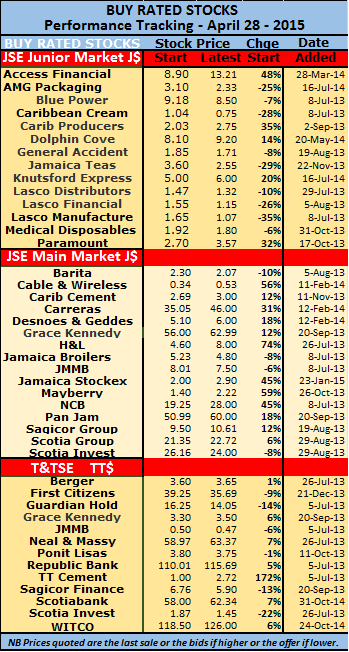 IC insider’s selections have been doing well for JSE main market but so well for the juniors.
There have been 5 winners and 9 losers in the junior market providing an average loss of just 2 percent. The JSE main market has 12 winners, so far and 4 losers, for an average gain of 22 percent and TTSE has an average gain of 11 percent with 7 winners and 6 losers. Two previous winners were removed from the Trinidad list.
A number of the Jamaican companies are reporting strong results for the first quarter of 2015 this bodes well for stock prices, the same can’t be said for the Trinidad companies that are mostly reporting flat profits. The other critical factor is that interest rates have been rising in Trinidad which is negative for stocks and they are falling in Jamaica which has already given stocks a big shot in the arm. Currently investors are focused on the bigger main market stocks but the junior will come into their own later on.
NCB has gained 65 percent since last year’s low but should head much higher, Carib Cement with very strong first quarter result should be well up from the $3 it close at on Tuesday. Trinidad is clearly not the place for much investment, unless ones eyes are on the longer term future.