
Treasury bill rates on the decline and heading lower.
Investors chased $1.8 billion in Government of Jamaica Treasury Bills on offer on August 16 and pushed down the rates lower than in July, in the process.
The fall in rates helped the country’s central bank to lower its new benchmark overnight rate, by 25 basis points to 3.5 percent effective Friday August 25. The Treasury bill offerings, in tranches of $600 million each, replace $1.32 billion that matured in August. The offers with maturities of 91 days, 182 days and 273 days, resulted in average rates of 5.49 percent for the 91 days instrument, down from 5.63 percent in July, 5.99 percent for the 182 days bill down from 6.13 percent, with the 273 days bill, clearing at an average of 6.32 percent down from 6.5 percent in May.
The trend in interest rates is clear, with the downward drift resuming and needs to break below 5.8 percent for a sustained decline to take hold. It will only be a while, for Treasury bill rates to hit 4.5 percent but that is unlikely to happen until 2018. The accompanying chart shows the movement in the 182 days Treasury bill rate in red within a downward sloping channel pointing to lower rates ahead.
 Government of Jamaica Treasury bill rates seems headed to 4 percent by early 2018 if current trends on inflation, exchange rate stability and world oil prices hold.
 During 2016 inflation was negatively affected b a 7 percent decline in the value of the Jamaican dollar against the United States currency, that would have contributed to most of the inflation except the portion relating to increased taxes, imposed last year. Devaluation if any, should be more moderate in 2017, as foreign exchange flows continue to be strong, therefore inflation should moderate with the absence of devaluation of the local dollar.
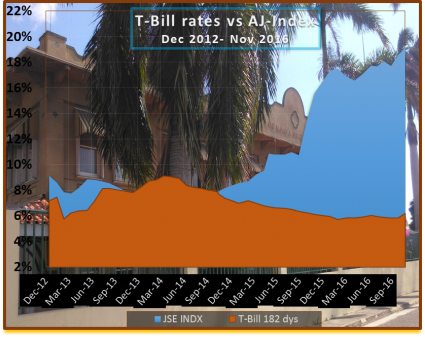 The latest issue of Treasury bill offerings saw the 182 instrument climbing 40 basis points to 6.2 percent while the 91 days T-bill rose marginally to virtually hold at 5.70 percent just a tad above the average in October.
 Rates on
 The 182 days instrument fell by 21 basis points to 5.73 percent but the 91 days instrument climbed back above the 6 percent mark to end at 6 percent, up from 5.94 percent in January.
