
Knowledge of a country’s economy is important in making investment decisions. Past performance while important is no guarantee that the future will be the same or better than the past. The Jamaican economy is looking good for 2024, with prospects of slower growth than for 2023, even as the Bank of Jamaica (BOJ) maintains a tight monetary policy that could persist for much of 2024.
Barring increased interest rates, the Jamaican economy should grow around two percent in 2024, which will be down from around 2.7 percent in 2023. Growth in tourism and production at the Alcoa Alumina plant has now moderated from the sharp recovery in the early part of 2023, providing the stimulant for higher growth in 2023 but that added stimulant will not be there in 2024 as output from these sectors return to more normal levels.
 In support of the above, the September quarter shows GDP growth moderating to 2.10 percent, this level of growth is unlikely to change much over the next few quarters. But BOJ could ease the tight monetary policy to provide some breathing space for increased production of goods and services, but this will have to await continued moderation in inflation, and there will be a lag of months for such easing to start feeding into increased production when such easing takes place. The early months of the year will be a guide as inflation should continue to moderate as the months unfold and pave the way for some interest rate reduction.
Inflation, although down sharply from the highs in 2022, is still not fully under control, with the average for 2023 running close to the upper end of the central bank’s target of 4 to 6 percent. Some developments that should help in bringing the rate down, include world oil prices that have fallen in 2023 to the low US$70 level and prices of some other commodities continue to fall into the latter part of 2023 and will have a moderating effect on inflation going forward. Some local costs may have an upward push on inflation but traditionally the period of December to April is usually months of very low inflation and in many cases, negative price movements as local food prices tend to normalize.
A tighter labour market locally could put upward pressure on wages and prices, but tighter monetary policy now in place from last year and some major wage adjustments from 2023 to compensate for loss of purchasing power then, may mean that the expected high wage adjustments may not feed into price rise as may otherwise be expected and could hold prices down for a while.
 Despite the tourism sector returning to the usual historical growth levels it is expected that this sector will contribute to growth in 2024 and help stimulate growth in industries with a strong linkage to the sector. Assuming fair weather conditions, Agriculture, the star performer in the economy for several years should return to positive growth in 2024 in recovering from declines in 2023 and the sector will be helped by continued growth in the tourism sector that feeds off it. The BPO sector seems poised to continue to add to growth but there are issues with available manning. With continued growth in housing, road construction and the need for factories and warehousing space, the construction sector could hold its own during the year, but there may well be a lull in the sector with the two south coast roads coming to completion in 2023 or early in 2024. The Montego Bay perimeter road should take over but may not fully fill the gap.
ICinsider.com don’t see interest moving higher and most likely will start to decline before midyear with inflation within reach of the BOJ target of 4-6 percent in 2022 and with treasury bill rates seeming to peak in the 8 percent region and remaining relatively stable for several months. Certificate of deposit rates have been holding stable around 10 percent for months.
BOJ interest cuts overnight rate.
Unemployment at 4.5 percent in July last year is expected to fall further in 2024 towards the 3.5 to 4 percent region as more workers are needed to man the economic expansion. Companies will need to find innovative means to keep production going by implementing cost saving initiatives, otherwise, this could mean wage increases could rise above normal in order to retain or attract new workers.
The above is good news for the private sector overall that should see increasing demand for goods and services.
The banking sector showed loans growing at an annual pace of 13.5 percent per annum up to $1,216 billion to September over the $1,071 billion at the end of September 2022, data from Bank of Jamaica shows. Increased loan rates may be negatively affecting some areas and thus stymie demand. With what could be a year of reducing interest rates engineered by BOJ there could be even faster loan growth in 2023 than in 2022. Data for the September quarter show loans increasing by nearly 4 percent or 16 percent annualized compared with just 2 percent in the June quarter or 8 percent for twelve months.
Remittances in 2023 are down by 1.2 percent to the end of September to US$2.53 billion and appear that it will be just short of the US$3.44 billion generated in 2022 but should come in at just over $3.4 billion for the year. Based on trends it may be steady in 2024.
 Jamaica’s Net International Reserves continue to grow and are at a healthy $4.75 billion in December, last year, data released by Bank of Jamaica shows, a huge improvement over $3.98 billion in December 2022.
With continued growth in tourism, the resurgence in the Alumina sector and relatively stable remittances, improvements in local exports and continued growth in the BPO sector, the country should be enjoying record inflows of foreign exchange in 2024, putting BOJ in a good position to lower interest rates during the year as the reserves have been significantly built up.
Developments on the foreign exchange front will result in greater stability in the exchange rate for the local dollar as the tight monetary policy resulted in a US$770 million increase in the NIR and is likely to result in further build-up in the NIR in 2024. Investors should not be surprised if there is some revaluation of the local currency as well, especially in the first half of the year as the tight monetary policy pressures demand for foreign exchange.
The manufacturing sector should continue to continue positively to growth following expansions taking of a number of large companies.
The entertainment and transportation sectors seem poised to get a shot in the arm and benefit from the rebound in tourism, increased employment in the country and the general buoyancy in the wider economy.
Investors should pay attention to developments in the political seen as developments here can cause economic disruptions and muddy the investments environment.
 The present government will be in power for four years at the end of August, but they have seen a reversal a huge lead over the opposition party in 2022 evaporated in one poll, with the opposition party having a slim lead. Another polling body done in August had the governing party leading with an increased margin over the previous poll, that showed both parties in a close race. Local government elections are due by February 2024, and barring some major negative development these elections appear ae set to proceed as planned. If the opposition does well in these elections it could result in the political heat being turned up a notch or two on the government going forward and could well trigger the calling of General Elections earlier than September 2025.
The above are positive developments but investors cannot ignore the impact that the war in Ukraine hand the Israeli-Hamas war can have going forward that could affect the world economies.

 Recent data emanating out of Sangster International Airport in Montego Bay shows 403,600 passengers being handled in November, 7.3 percent more than the 376,100 handled in November 2022, with the pace of growth down from 10.3 percent in October and the Kingston Airport processing 123,000 passengers, 6.6 percent fewer than the 131,700 handled in November 2022. Passenger activity in Kingston declined for a third consecutive month with October down 8.9 percent compared with October 2022.
 this marks the 6th month of decline in remittances for the year to date, data from jamaica’s central bank shows.
 Statin also stated that inflation for October came in at points 0.8 percent, sharply down from the same period last year at 1.5 percent. October’s inflation is worse than the 0.5 percent that occurred in September this year. But spike in oil prices would have played a big role in October inflation. The fall in oil price to the low $70 levels currently, is signalling that inflation in November is likely going to be moderate with the year to date inflation then heading for the low 4 percent range.
 Recent data from a large number of listed companies show sluggish revenues growth and lower profit for the September quarter compared with 2022 as well as the first half of 2023, added to this, tourist arrivals slowed considerably in recent months compared to the earlier part of the year and that industry has been the major driver of economic activity this year and added to that the construction sector has been in decline and could worsen.

 Remittance inflows to Jamaica in August slipped by 5.9 percent or US$18 million, the worst monthly decline for 2023, with total inflows of US$289, down from US$307 in August 2022, data out of the Bank of Jamaica show. The decline beats the 5.8 percent decline in April, with a slippage then of US$17 million.
 Some 47,000 more persons were employed in July 2023 compared to July 2022 and reflects an 8.5 percent increase over the 43,300 newly employed in April this year.

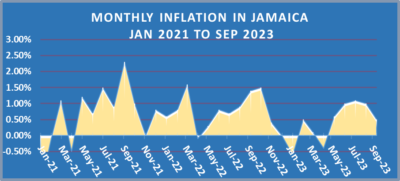 If the rate for September holds or falls in October the twelve month rate will fall below 5 percent.