 NCB Capital Markets purchased 466,435,712 on behalf of a client. Shares held by the NCB group were part of the transaction. NCB Jamaica Limited had 360,807,145 or 28.27 percent of the company and NCB Capital Markets Ltd. A/C 2231 had 105,283,757 or 8.25 percent. Steven Gooden of NCB Capital Market only comment is “a release will be made after the close of the Jamaica Stock Exchange today”.
The transaction is clearly not one of a name change as that would have been done as a block transaction. As a result of the transaction, Seaboard is acquiring 21 percent and Jamaica Producers 11.59 percent of the outstanding Kingston Wharves shares. Producers will now own approximately 42 percent of the company. Jeffery Hall CEO of Jamaica Producers confirm the groups interest in the deal and advised of a release after trading on the Jamaica Stock Exchange, to provide the full details.
 Jamaica Producers Group already owns 431,777,188 or 33.83 percent of the company and would end up with just over 70 percent of the company. The transaction which was mostly done at $6.50 per share or $1.49 above Tuesday closing price cost $3 billion and would effectively trigger a compulsory takeover offer to the minority shareholders if it was all purchased by Jamaica Producers. The transaction took place in three main blocks that were all done at $6.50,and include 300,345,000 units costing 1,952,242,500, 60,462,145 shares costing $393,003,943 and 105,283,757 at a cost of $684,344,421. Apparently, the largest block was sold to more than one party to the transaction and would have been the reason for the split up of it. This arrangement could mean that Jamaica Producer’s Group would not be a majority shareholder and therefore not trigger the take over clause. the increase in the price exceeds the 15 percent rule of the JSE but the stock had closed Tuesday with a bid of $5.75 which was a set up to allow for the traded at todays price.
In 2012,Jamaica Producers had increased their holdings in Kingston Wharves when they bought Three Hundred and Fifty Seven Million Five Hundred and Fifty Thousand (357,550,000) ordinary shares of KWL at a price of $5 per share to help fund the company’s expansion and modernization in pursuit of increased business expected to flow form the Panama canal expansion.
the transaction will boost NCB 2014 earnings as it comes days ahead of the bank’s year end and whatever gains there will be, will be in the incorporated into the results.
Insider sells 1m JMMB stock
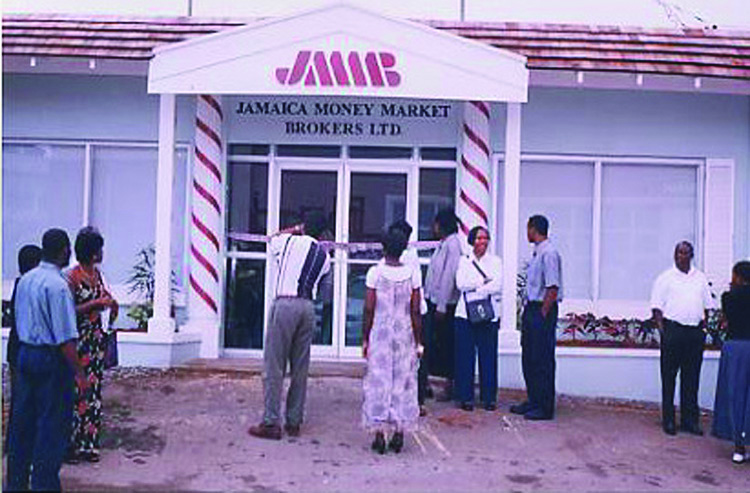
 Jamaica Money Market Brokers advised the Jamaica Stock Exchange that a connected party sold 1,000,000 of the Group’s shares, on September 18, 2014.
The sale was executed through Scotia Investments which seems strange, as onlookers would consider that a connected party to group would have used the JMMB brokerage house instead of a non-related entity.
Why Dividend matters
Investing in stocks is not only for those big capital gains that create excitement for many investors. Dividends are an important part of the investment returns, but are often underestimated. They carry additional message, than the pure pay out of profits to shareholders. Dividends provide cash flow while one waits on a stock to increase in value. Stock prices move up and down over time.
 Because of such movements and that sometimes, good companies have bad patches, when profits fail to grow much and can hold the stock price down for long periods, investor can just collect dividends while waiting on the return to stock price growth. Look at the example quoted below, while the stock price gained nearly 700 percent, since the end of 1993, the dividends have grown by over 2,000 percent in the same period. The exciting thing is that investors got paid every year since 1993. The amount accumulated over that time is large, amounting to $23.58 cents per share or more than the increase in the stock price.
Best Signal| The level of payment or future payments, may well be the best signal that investors will get from within a company that the stock price is set for upward movement. Dividend yields on stocks usually fall well below the interest paid on government paper. History dictates that yields usually return to their norm over time. We can use the level of present or future dividends as a predictor of stock prices. At the heights of the stock market in Jamaica, dividends yields fell to round two percent on average. Yields currently are 7% for many stocks, in the case of

Carreras one of Jamaica’s best dividend payers
Carreras well over 10 percent, suggesting huge gains ahead for stocks, not taking the sharp fall in interest rates, locally into consideration from high teens.
High priced stocks| New investors should not be afraid of what some persons will regard as expensive or high priced stocks, if they have the qualities to rise in value above lower priced stocks. The absolute price of a stock is not determinant, if an investment in it is warranted or not.
History confirms that a good dividend policy will provide an attractive rate of return on original investment over time. A very good example is Scotia Group. In 1993 they paid out $220 million or fifteen cents per share but paid out $4.98 billion or $1.60 as dividends, this fiscal year. The stock price at the end of 1993 was just over $3 and is at $20 now and yet the stock is undervalued presently. Those returns happened during one of the most turbulent periods, in the local capital market.
 Useful indicators| Some useful indicators to follow are, financial results, one wants to see a nicely rising trajectory of earnings. Take the chart of Access earnings and revenues this is a excellent example of the picture an investor ought to be looking for. It is not surprising that the stock price of Access has done so well since it was listed.
Information such as major expansion, could mean increased sales and with that profits ahead. Developments within the economy, lower interest rates are major factors that influence the movement of stock prices. An increased dividend payment is another good indicator that things will be better going forward, as companies are unlikely to increase dividends, if profits are not growing.
KLE Group director sells out
 Two directors KLE Group sold 8,100,000 and 5,896,500 stock units of the company, on September 9, 2014, at $1 per share, bringing to three the number of directors who sold off large portion of their holding in the floundering group, within two months. One former director, Craig Powell, dumped part of his holdings, on Friday July 11, on the Jamaica Stock Exchange. Stocks and Securities acting as brokers on behalf of the seller and buyer, executed Powell’s trade at 90 cents each for the 7,181, 043 units, in July.
Powell is not the only director that has sold shares in the company. According to a listing of holdings in March, Kevin S. Bourke a director, held 10,435,250 shares, the same as of the end of 2013 and so did the CEO Gary C. Matalon with 9,295,250 units held directly, in his name, but with a total of 16,073,628 shares that he is connected with. Zuar A. Jarrett had 10,178,500 units at the end of 2013, this was down to 6,896,500 in March. Stephen Orlando Shirley had 10,111,500 units at the end of December, but 6,761,500 in March and David A. Shirley had 6,227,750 without any change in holdings, The sale are unlikely to be coming from the lesser amounts as they are no disclosure that directors bought more shares since March to have driven up their holdings. There are only two directors with enough shares to match the recent sales of 8.1 million units, either Matalon or most likely, Kevin S. Bourke. The 5,896,500 units sold looks very similar to Zuar A. Jarrett holding less 1 million units. On the same day the directors sold the shares recently, 1,849,709 shares was also sold. The latter amount seems part of JCSD Trustee Services – Sigma Optima shares which totalled 2,849,709 units in March. The sales took place against the back ground of the company reporting one of the better quarterly results since listing.
A senior manager sold Scotia Group advised of the sale of 15,960 shares on September 8, 2014 from shares held under the Employee Share Ownership Plan.
A senior manager sold 40,000 National Commercial Bank shares during the period August 18 – 26, 2014, the company reported.
JMMB profits down in June quarter
 JMMB Group posted net profit of $558 million and earnings per share of 34 cents for the quarter to June this year, but this was a huge 26 percent lower than the $754 million earned in 2013. Total revenues grew by 16 percent from $2.07 billion to $2.4 billion in the quarter helped by three acquisitions in two years.
Increased expense ate up the added income and more, pushing profit down sharply in the process. This is in contrast to the March quarter when profits rose 5 percent for that quarter. Interest margin got squeezed, falling from 69.3 percent in the 2013 quarter to only 63.74 percent this year as the Group’s Net Interest Income grew year-over-year from J$1.18 billion to only J$1.29 billion, an increase of J$112 million or 9.5 percent. This increase was driven mainly by expanded business lines through acquisition of Intercommercial Bank Limited (IBL) in October 2013, coupled with managing the Group’s investment portfolio and cost of funds.
Other operating revenues, comprising securities trading, foreign exchange margins from cambio trading and commission income increased by 12.4 percent, 95.5 percent and 32.1 percent respectively, driven mainly from increased volume.
Expansion of the Group through acquisition of IBL in the third quarter of 2013/14 resulted in operating expenses moving to J$1.72 billion compared to J$1.13 billion for the prior year. IBL contributed J$323 million or 28.6 percent, while the remaining J$272 million or 24 percent was due mainly to integration costs, growth in subsidiaries in the regional markets, and normal inflationary increases. The Group acquired of 100 percent of AIC Securities Limited, a Trinidad and Tobago based company for TT$5.36 million (J$92.7 million), on 30 April 2014. In Trinidad and Tobago operations are now poised to provide a full range of services to our clients, management stated.
Assets| At the end of June total asset of the JMMB Group increased by J$8.7 billion or 4.2 percent for the period, moving from J$206.7 billion at March 2014 to J$215.4 billion. This increase in assets was mainly funded by client deposits, long-term subordinated debt and repurchase agreements. The company acts as agent and earns fees for managing clients’ funds on a non-recourse basis under a management agreement. At 30 June 2014, funds managed in this way amounted to J$29,609,590,000 (2013 – J$23,242,771,000).
Interest rates down| During the quarter interest rates on treasury bills in Jamaica started to decline and would have resulted in some pressures on margin as commitments at fixed rates to customers would mature and then re-priced. Future looks like JMMB should still end up with earnings around $2 per share for the current year, but much will depend on how well they do in managing their investment portfolio and the impact that lower interest rates will have on valuations.
Investor’s Choice latest issue is out
 The manufacturing sector plays an important role in the local economy. It employs around 77,000 persons and contributes to the country’s exports and foreign exchange earnings, as well as a major contribution in supplying goods, to the local market. The latest issue of Investor’s Choice, is now out, and features the local manufacturing industry and its various elements, including its contribution to the wider economy.
Other stories include, government’s mistakes cost big bucks, celebration of Carimac's 40th, big surge in JNBS profit and much more.  Copies can be purchased at 12 Merrick Avenue, Kingston 10. Contact – Tel. 929-2993 or 926-2204, email Investorschoice@cwjamaica.com
Dividends steady at Scotia companies

Scotia Group Jamaica (SGJ) and its subsidiary, Scotia Investments Jamaica (SIJL), approved a third interim dividend for the current financial year ending October, to be paid on October 16, 2014.
SGJ dividend will pay 40 cents and SIJL 45 cents per stock unit, to stockholders on record at September 25, 2014. The stocks of both companies will trade ex-dividend, effective September 23, 2014. The payments are consistent with amounts previously paid, from 2013 on a quarterly basis.
Lending at Scotia Bank jumps
 Loans at Scotia Group, grew 10 percent since July last year, to hit $144.6 billion at the end of July this year, from $131 billion. While loans grew by only $2 billion up to April, from October last year, it jumped $8 billion in the latest quarter, a 20 percent increase annualised, a strong increase for a banking group that commands a large 39 percent of the commercial banking loan market.
The robust growth in one quarter coming after two quarters of slow growth, raises the question, if there are lumpy new loans booked in the last quarter, that are not likely to be repeated soon, making the increase not reflective of what may be expected going forward. The question was put the Scotia’s CEO Jacqueline Sharp.
“We did have some lumpy commercial loans in Q3, but we also are seeing pick-up on the retail side. So we do expect loan growth to continue, but just not as fast as the growth that took place in Q3” Sharp said.
Cargo Handlers’ impressive June quarter
 Cargo Handlers made profit of $31.6 million for the third quarter, ending June and $83 million for the nine months. The 2014 results are up 40 percent from $22.6 million and 31 percent over the $63.6 million earned last year, respectively.
Revenues excluding interest income, grew 32 percent for the Montego Bay based and junior listed company, over the June 2013 quarter, to hit $56 million, and reached $155 million for the nine months to June, an increase of 23.5 percent over the $126 million in the prior year. Some of the growth is driven by $3 million in management fees relating to management of the petroleum transport business, pending finalization of acquisition of the transport company. Movement in the value for the local dollar also played a role in the revenue growth, management confirmed with IC Insider.
Other operating expenses grew from $17.7 million to $22.6 million, an increase of 12.7 percent for the June quarter, and reached $65 million in the nine months, up by 17 percent. Administrative cost were flat for the quarter at $2 million and up from $6.4 million to $7.8 million for the year to date.
Earnings per share rose from 60 cents to 84 cents in the quarter and $2.22 for the nine months. Earnings for 2014 which ends in September, should be $3 per share. For the year to September 2013, the company earned $2.27 per share.
The company had earlier indicated that the acquisition of the transportation business should be concluded during February. At the time of reporting, this has not yet been concluded. From all indications, concerns regarding the transport company’s audited financial reports seem to be at the heart of the delay. Cargo Handlers had deposited $69 million against the purchase. Most of these funds seem have been used to acquire fixed assets which jumped by $48 million in June this year. Cash is down to $77 million and investments at $16 million at the end of June. The company remains debt free.
A dividend of 50 cents per share was just declared by the company and is payable in March 6 and another of $1.30 per stock unit will be paid on September 16. The dividend yield at the current stock price of $14.10 is 12.76 percent. The stocks is priced at a PE of just under 5 times 2014 earnings, but supply and liquidity are very low.
Scotia Investments reports down profits
 Scotia Investments Reports profit of $1.34 billion for the nine months to July and net profit for the quarter, of $504 million. For the year to July, profit is down $82 million or 6 percent from the same period last year, but up $89 million or 21 percent above the $415 million earned in the April quarter and down from $563 million in the 2013 quarter.
Earnings per share (EPS) for the period, is $3.17 compared to $3.36 for the same period last year, and should end up in the $4.40 range, by this October year end. Return on Average Equity (ROE) is 13.87 percent, down from 16.10 percent last year.
Operating Income, comprising net interest revenue and other income of $3.19 billion for the nine months, is down $48 million from the same period last year. Total operating income for the quarter was $1.13 billion, up $58 million or 5 percent recorded last quarter, Net income for the quarter of $580 million was flat quarter over quarter, but is down $113 million or 16.3 percent from the July 2013 quarter, due to a big jump in interest cost. Net interest income after impairment losses for the nine months period is $1.8 billion, down $288 million or 14 percent below the same period last year.
Non-Interest Income|Non-interest income, amounts to $1.4 billion for the period, up $240 million or 21 percent over the year to July 2013 and $549 million for the quarter, up $55 million or 11 percent compared with the last quarter; due primarily to gains on financial assets. The 2014 outturn represent an increase over the earnings of $486 million generated in 2013 July quarter. Non-interest income, includes fee income, securities trading gains and net foreign exchange trading income.
Total operating expenses for the period were $1.26 billion, up $50 million or 4 percent compared with the same period last year; $396 million for the quarter, down $47 million or 11 percent from last quarter due mainly with increased asset tax but the cost is up from the $366 million incurred in the 2013 quarter.
“Overall, our fund management business has grown 9 percent year over year; and our flagship money market fund, The Scotia Premium Money Market Fund has experienced a 105 percent increase year over year, with a net asset value of over $9 billion,” Lissant Mitchell, CEO of Scotia Investments said.
“Total assets of $73 billion remained flat year over year and quarter over quarter; consistent with our strategic initiative to focus on growth of our off-balance sheet portfolios. Assets under management including the company’s custody book were $135 billion as at the end of the period, up $21 billion or 18 percent above last year and $6 billion or 5 percent over last quarter. The growth was driven by the improved net asset values on managed funds.” The Investment Bankers reported to shareholders.
The company’s stock traded at $21.40 on Friday with a PE ratio of 4.75 that is low but presently reflects overall market conditions. There is not much supply on sales at current prices. The forward PE is lower than the above. The company’s performance is not electric presently but lower interest rates on government paper that has be falling since May and continue growth in their asset portfolio should have improve profits for 2015. As such the Buy Rated accolade remains.