Cable & Wireless’ makeover

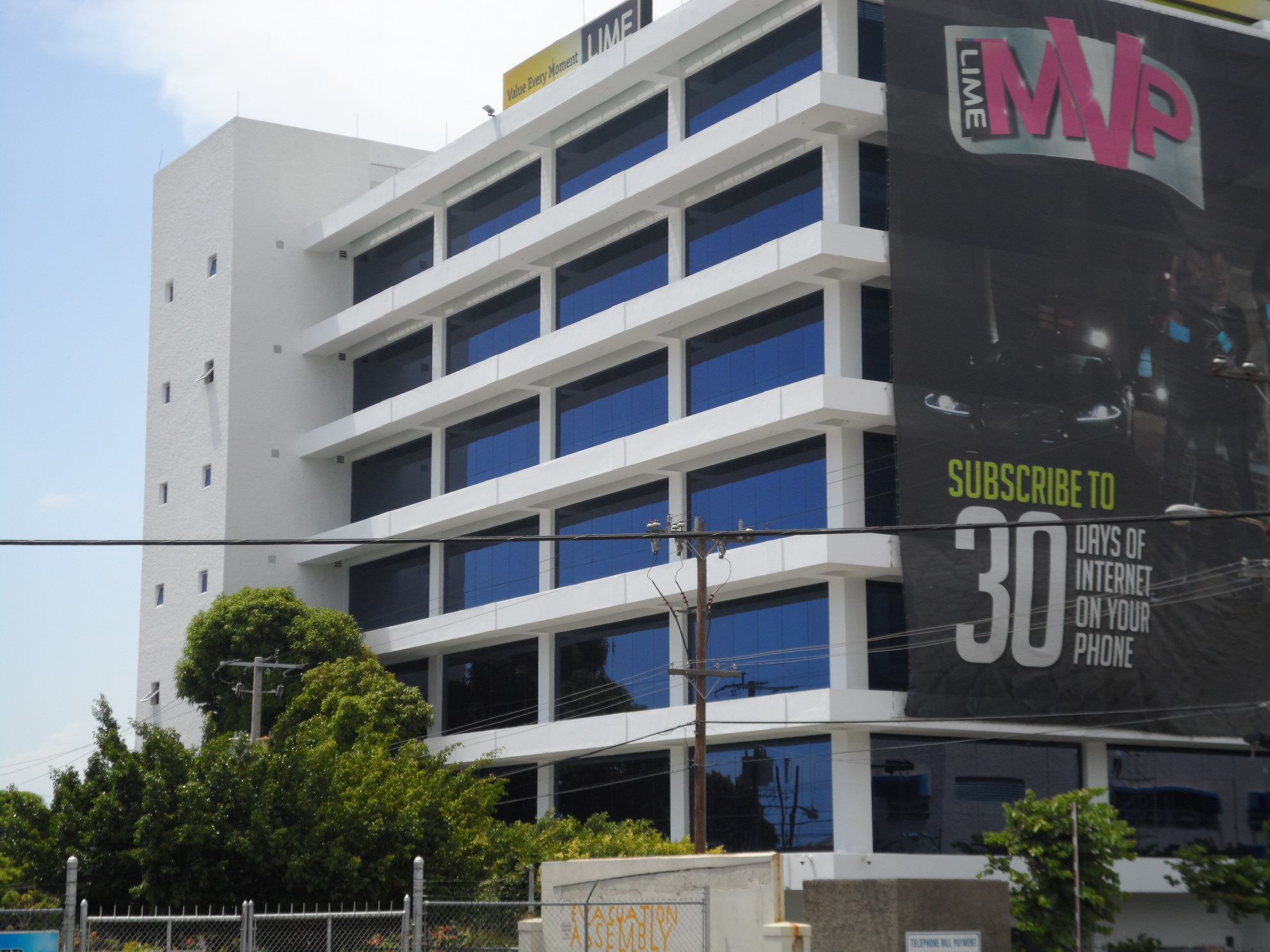
Cable & Wireless HQ - the stock is in demand with the merger of Flow and C&W gathers pace.

Cable & Wireless HQ – the stock is in demand with the merger of Flow and C&W gathers pace.

Cable & Wireless seems to be going through a period of rebirth having ceded a great deal of their territory to the completion in past years, as the parent company chopped and changed top management. They are now growing again with pretty strong top-line gains with a stable management team.
There was much growth in the financial year to March and since then the industry has seen much change, with number portability, Flow being acquired by Cable & Wireless and Digicel acquiring Sportsmax.
“We gained around 20,000 new prepaid mobile customers resulting from number portability almost the same as left, revenue for the average new customer is more than the ones we lost” Garfield Sinclair, Chief Executive officer of Cable & Wireless (C&W) stated in a presentation to shareholders and some C&W senior staff at Wednesday’s annual general meeting of the company. Sinclair also stated “we gained four more postpaid customers to each one lost as a result of number portability”.
In a wide ranging presentation at the AGM the C&W CEO stated that the merger of the Flow and C&W has many challenges, none more so than the integration of the staff. The physical plant with differing technologies also pose challenges and with take time to be fully complete. But the CEO stated that they were making progress on all fronts as he commended the Human Resource team in the work they have done in the staff integration so far.

C&W CEO Gary Sinclair

C&W CEO Gary Sinclair

By October we would have completed the upgrading and expansion of our 4G network system on the south coast of the island to accommodate increasing demand by customers and by November that on the north coast, should be complete.
“We now have almost 900,000 cell phone customers, 250,000 landlines and 80,000 data only customers”, Sinclairstated. At the end of the fiscal year to March C&W indicated that the cell phone numbers were around 820,000 but Sinclair confirmed to IC Insider that the numbers are now at 875,000. The annual report stated that in the “peak season Christmas a record 65,000 mobile customers were added to the network”. The 2015 numbers suggest a continuation of the strong gains being made in the acquisition of mobile customers. The name change from LIME to Flow is likely to enhance the prospects for increased mobile customers. The continued growth augurs well for increased revenues and the company’s move to restart generating positive profit.
“Investors have to judge us on the EBITDA not on accounting profits that is the basis used in our industry”, Sinclair said. In this regard he said that by the end of the current fiscal year EBITDA that was at 20% of revenues in 2015 should be at 30 percent. This would work out at around $7.5 billion assuming revenues continue to grow at the 2015 pace on a standalone basis and would result in an absolute profit for the company, the first for several years. In the June quarter EBITDA rose a very strong 82 percent, with net results seeing a sharp fall to a loss of just $303 million, from a loss of $712 million in 2014 as revenues grew 13 percent to $5.45 billion, for the June 2015 quarter, aided by a 17 percent growth in mobile subscribers and 27 percent increased mobile revenues. Operating expenses were static at $4 billion but finance cost was up to $1.1 billion from $962 million in 2014, depreciation was down and amortization up.
EBITDA while an important measure, especially in the expansion phase it cannot be the sole target, ultimately investors want a return on investment and net profit ultimately is the most important measure so that dividends can be paid.
While there were few details of the merger with the Flow operations, that is expected to be a big boost to the system with more revenues and lower cost with some of the cost squeezed out from the elimination of duplications.
ICooled profits hike at Lasco Manufacturing

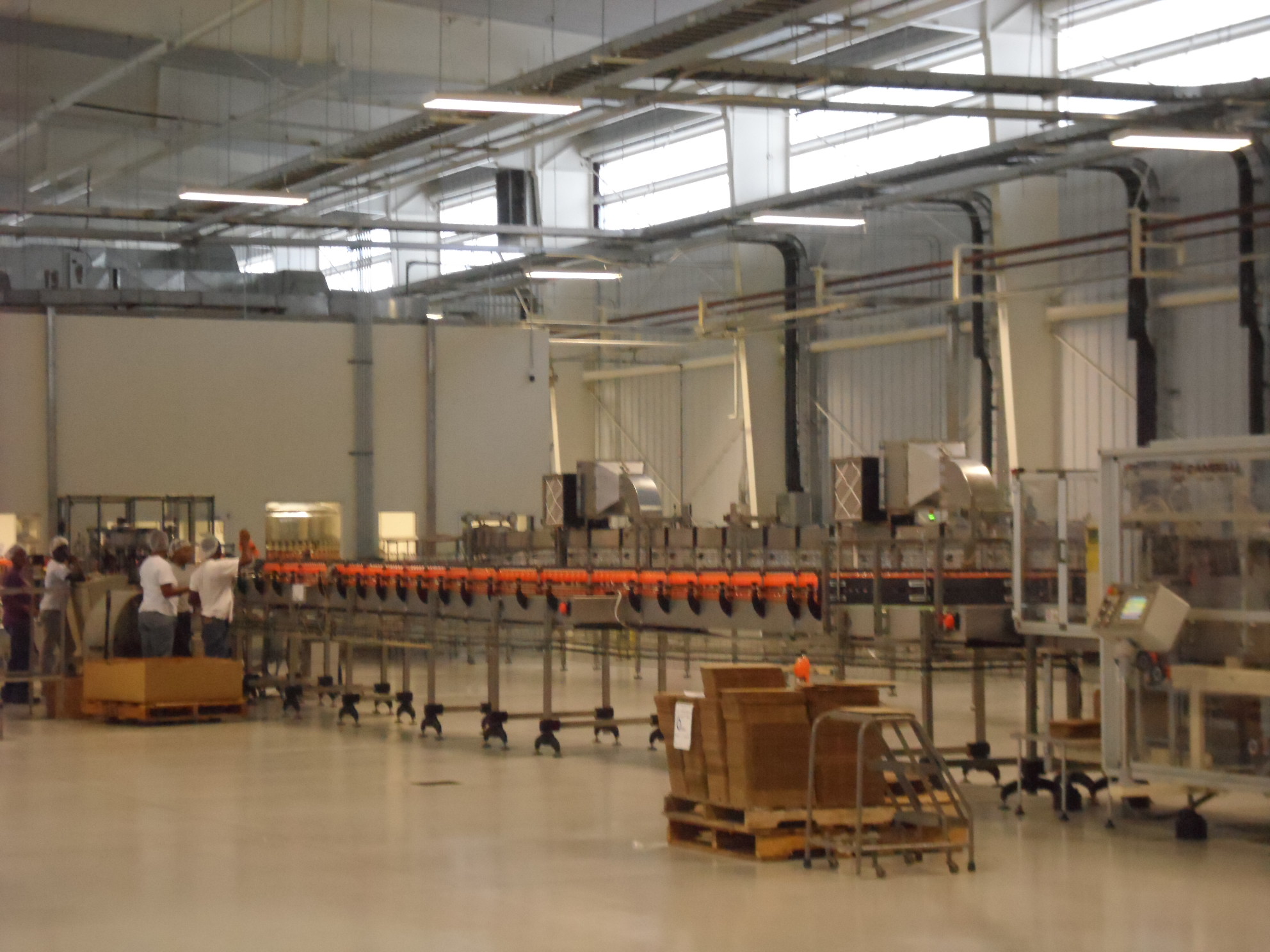
Lasco Manufacturing's bottling line.

Lasco Manufacturing’s bottling line.

Lasco Manufacturing generated total revenues of $1.44 billion, 34 percent more than the $1.08 billion in the June quarter of 2014, resulting in a 75 percent jump in profit to $247 million or 6 cents per share from $141 million in 2014 and slightly ahead of the $243 million for the March quarter.
Gross profit margin for the quarter climbed to 33 percent from 29 percent in 2014 but gross profit jumped 50.50 percent well above the growth in revenues, a positive development for continued strong growth in profit going forward.
Operating Expenses climbed 29 percent to $185 while finance cost rose from $32 million to $42 million as a result of construction phase of the factory completed, resulting in the interest on the funds used in construction being expensed as opposed to being capitalised during the construction phase.
With new factory facilities completed and in use, depreciation ended at $67 million for the fiscal year up from $27 million in 2014 but is set to jump in 2016 with only a fraction of the annual charge being booked to March 2015. With more monies to be transferred to fixed assets for the year to March 2016 depreciation cost should climb. At the end of March, net book value of property, plant and equipment amounts to $3.4 billion and includes assets under construction of $1.34 billion. The cost of assets under construction will be depreciated once the property is complete and in use. The estimated additional cost of completion of the facility was $373 million at March, since then more than $150 million was added to fixed assets.
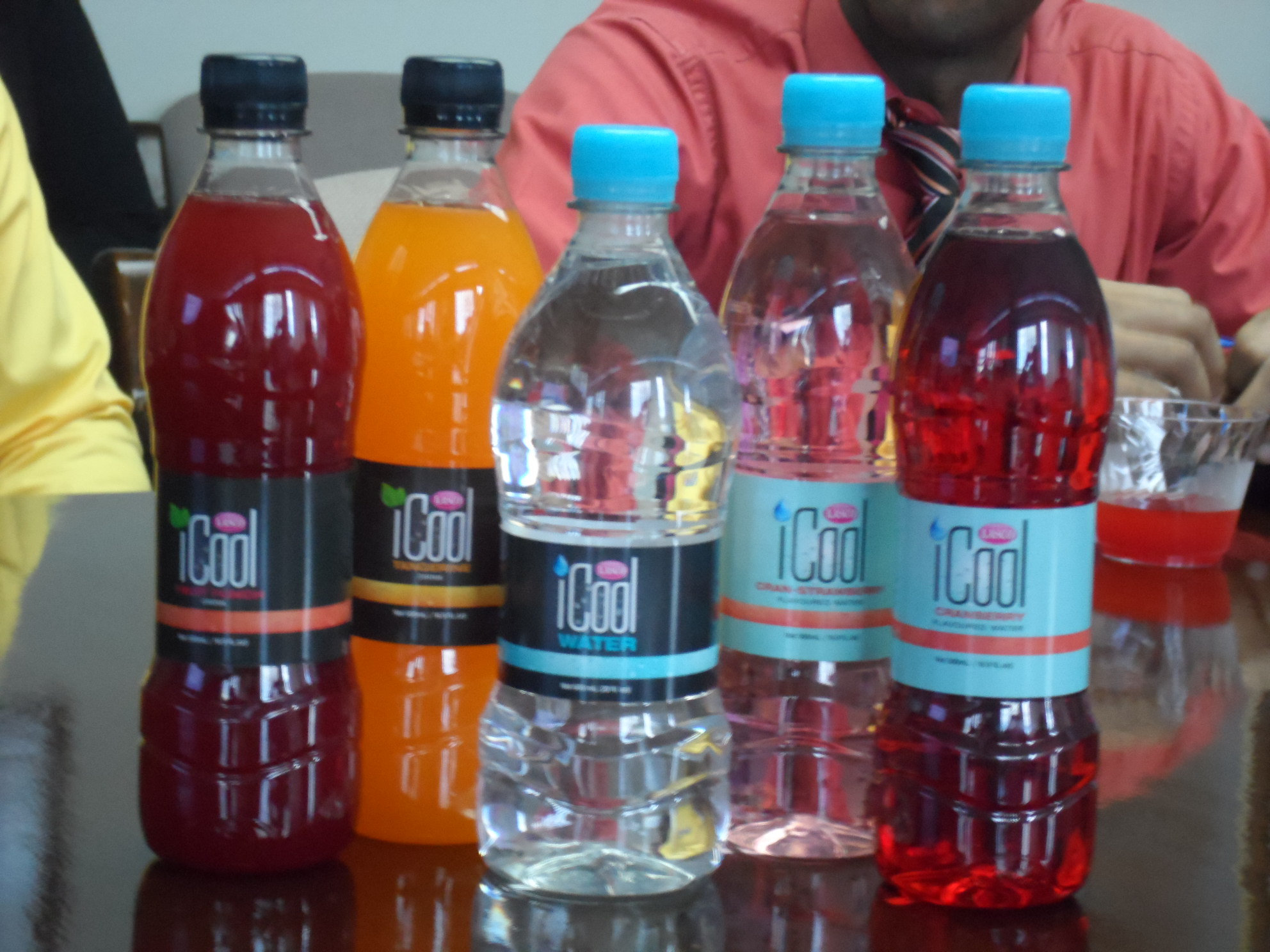
Lasco's new I Cool drink distributed locally by Lasco Distributors, produced by Lasco Manufacturing.

Lasco’s new I Cool drink distributed locally by Lasco Distributors, produced by Lasco Manufacturing.

“Production capacity at the Liquid Plant has already been doubled during this quarter, to meet the overwhelming market demand for our iCool line of beverages. During this year, we will invest further in new equipment to increase its capacity. There will be many more new products to come on line once production capacity is at its normal level”, Chairman Lascelles Chin advised shareholders“. The new Dry Plant at White Marl has now completed the testing and trial phase, and will be fully operational within the next quarter to achieve full efficiency. The existing Red Hills Road operation for this quarter has recorded an increase of 28 percent in net profits over last year. There will be new products coming on stream by the end of the year,” the Chairman further stated.
At the end of the June quarter, Inventories stood at $736 million and is up from $433 million and Receivables jumped to $1.26 billion from $846 million at the end of June 2014. Borrowing stands at $1.86 million against equity capital of $5.8 billion.
IC Insider projects profit at $1.6 billion for the year or 40 cents per share for the year to March 2016, that should jump to around 60 cents for 2017. While the company becomes taxable this year capital allowances plus tax will be a 12.5 percent will result in little or no taxes being paid on profit for the year.
The company is listed on the junior market of the Jamaica Stock Exchange and last traded at $1.90 for a PE of just less than 5 based on IC Insider’s projected earnings. The stock should deliver a healthy increase in price during the fiscal year and the next as the expanded product lines and the new factory deliver increased revenues at reduced cost.
Lasco Manufacturing has been a BUY RATED stock for some time and remains with that status.

Knutsford’s flawed audited statements

KnutsIf the Jamaica Stock Exchange and the Financial Services Commission have the interest of investors at the forefront for protection they would demand the total withdrawal Knutsford Express’ audited reports for 2014 and 2015. The audited statements for both years, are filled with errors or questionable treatment of transactions, raising questions about the accuracy of the entire reports.
The report for 2015 has profit of $69 million or 69 cents per share versus $50 million in 2014 or $1.07 cents per share after deferred taxation of $5 million (2014: $5.6 million). Revenues amount to $454 million, a big 38 percent increase over the $329 million in 2014. Problem is that the earnings per share for 2014 is overstated due to inaccurate computation of the average number of shares issued in 2013. Further, the audited statement while showing earnings per share of $1.07 for 2014 in the income statement, goes on to state erroneously by way of a note, that “using the weighted average number of shares at end of 2015 would result in earnings being 50 cents for 2014”.
Since Knutsford is not taxable for the next 4 years it is difficult to see why the company would need to compute differed tax charge when whatever timing difference is likely to be less than 4 years on which no tax would be payable, the report does not give details so it is difficult to determine what items would result in such differences, but a look at the detailed expenses suggest that at best it would be a one year difference hence there is no need to book the differed tax.
JSE signThe audited financial report states “During January 2014, the Company raised additional capital of $99,862,700 from its initial public offering of 99,999,003 shares for its enlistment on the Jamaica Stock Exchange Junior Market”. This of course is completely wrong since the company issued 26 million bonus shares in 2013. While the public offering was for 20,000,000 ordinary shares, only 4,867,338 shares were offered by the company and 15,132,662 shares were existing shares of the pre IPO shareholders. At the time the IPO came, 95,132,662 ordinary shares were already issued, the average number of shares should be around 60 million rather than 46.8 million used to compute the 2014 EPS which would have worked out around 83 cents. That is around what it is and should be reported as. In addition there is no need to re-compute this figure and the 100 million shares in existence won’t change it one bit.
In the taxation note it states that the company at the end of 5 years “is required to delist and pay all exempted taxes within 5 years or opt to list on the main exchange for the next 5 years to maintain tax exemption received in the last 5 years. That seems to be stated incorrectly, IC Insider went to the manager of the stock exchange for clarification.
“ Those companies that have been given five (5) years will have to remain listed for 10 years as compared to 15 years had they been given 10 years incentive. They are not compelled though to migrate to the main market but can remain on the Junior Market if they are in compliance with capitalization and other Junior Market requirements”, the Stock Exchange reply stated.
Knuts signThe junior market rules require a mentor for these companies. One reason is to ensure that slip up like the above don’t happen. The issue begs the question what are the board of directors doing, after all they sign off on the financial report, they should ensure that information included that they are aware of, are not incorrectly stated.
Income statement| It would have been very informative if the profit and loss statement carried cost relating to functions such as direct operating cost, marketing and sales rather than all cost being lumped into administrative and other expenses, then one would easily see how the operating side of the business is doing before administrative cost.
But other questions remain, the listing of expenses show employer’s statutory payroll contributions at $31.84 million for 2015 and $16.58 million in 2014 versus salaries and related expenses at $86.86 million in 2015 and $54.65 million in 2014, these work out at 27 percent and 33 percent respectively. That of course cannot be correct as it should not be more than roughly 10 percent for Education taxes, National Housing Trust, Heart and National Insurance.

Small profit gain for T&T’s Republic

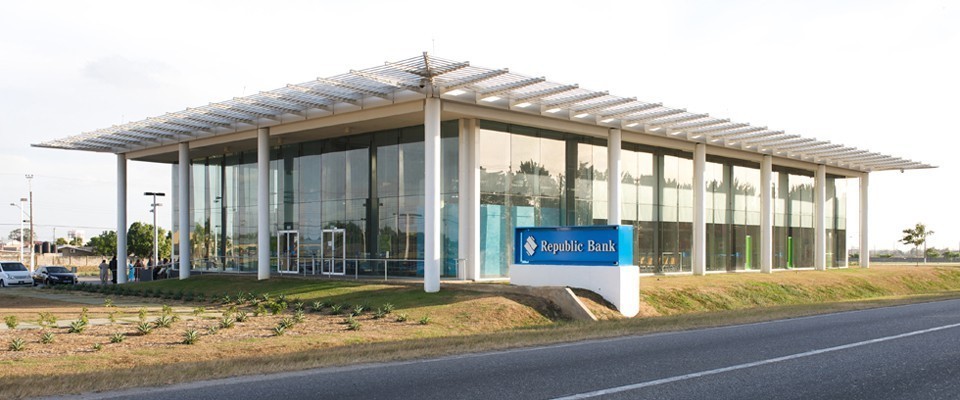
RBTTTrinidad’s Republic Bank reported slightly improved results to June, with profits attributable to the group of $325 million in the June quarter up on the $308 million generated in 2014 and an increase to $898 million for the nine months against $869 million in 2014.
Earnings per share for the quarter is $2 cents and year to date $5.56, earnings for the full year should end around $7.60 up from $7.39 in 2014, placing the PE at a $113.99 stock price at just over 15 time earnings.
Net interest income is up 8.7 percent to $618 million for the June quarter and a slower 5.4 percent for the nine months from a year ago to $1.79 million. Total net revenues climbed 26.7 percent to $1.1 billion for the quarter and 3.3 percent for the nine months to June to $2.9 billion. Expenses rose in the June quarter, to $554 million, from $454 million, is down for the year to date, to $1.56 million from $1.58 billion. Loan loss provisions are sharply in the quarter to $122 million and for the nine months, $145 million was booked versus $79 million in 2014. The bank reports that increased provisions were done for the new acquired subsidiary, Ghana HFC Bank to bring the provisioning policy in line with the group’s and impairment loans and goodwill for the Cayman Islands subsidiary.
With strong growth in loans in the June quarter over March, loans which grew to $27.6 billion in March now stands at $29.7 billion and is up 11.65 percent over June 2014 and 9.7 percent over September 2014 and 10.76 percent over April. A big part of the growth is the consolidation of the financial statements of the 57 percent controlled, HFC Bank into the group, adding loans of $1.27 billion in the June quarter. The Ghanian bank was previously treated as an associate with 39.87 percent ownership but Republic who acquired an additional 17.25 percent under a mandatory takeover offer, raising the holdings to 57 percent in May this year.
In July Republic completed the acquisition of the bank in Suriname that was previously owned by RBC Royal Bank with assets of $3.3 billion, a small increase to the groups $62.33 billion in assets at the end of June.

Loans & profit up at T&T’s Scotiabank

Scotia logoTrinidad’s Scotiabank reported improved results to July, with profits of $157 million in the July quarter, up by 12 percent on the $140 million generated in 2014 and much slower 7 percent increase to $417 million for the nine months against $390 million in 2014.
Earnings per share for the quarter is 89 cents and year to date $2.36, earnings for the full year should end around $3.40 up from $3.18 in 2014, placing the PE just over 18 time earnings based on the stock price of $62.50 it last traded at on the Trinidad & Tobago Stock Exchange. For 2016 earnings should end up around $4 per share all things being equal. All things may not be equal, with reports of negative economic growth in the first quarter of this year and low oil prices, that could result in lower consumption and weaker economic activity.
The July quarterly profit gain is down on the 18.4 percent reported for the April but much more than the $125 million earned in that quarter. For the July quarter revenues jumped sharply by $31 million over April and operating expenses dived by $13 million while loan loss provision was down by nearly $5 million.
Net interest income is up 11 percent to $251 million for the July quarter and a slower 7 percent for the nine months from a year ago to $711 million. Total net revenues climbed 9.3 percent to $378 million for the quarter and 8.2 percent for the nine months to July to $1.08 billion. Expenses fell in the July quarter, to $152 million, from $156 million, is up for the year to date, to $481 million from $466 million. Loan loss provisions are down in the quarter to just $4.5 million and for the nine months $30 million was booked versus $19 million in 2014.
Growth in the loan portfolio is one of the main contributor to increased profit. With only moderate growth in loans in the July quarter over April, loans which grew to $12.8 billion in April now stands at $13 billion and is up 11.3 percent over July 2014 and 11 percent over October 2014. If the bank can maintain this level of growth in loans into 2016 then profits should continue to increase double digit growth levels.
The bank will be paying a 40 cents dividend on October 9 to shareholders on record at September 11, the stock now generates a dividend yield of 2.5 percent.

Knutsford’s sales up 38% cost 44%

  Knutsford Express’ audited report for 2015 shows a big 38 percent surge in profit to $69 million over the $50 million in 2014, from revenues of $454 million, 38 percent more than the $329 million generated in 2014. With that level of revenue increase profit should have grown much faster than it did, and should have been closer to doubling.
New routes added could have been a factor as passenger traffic takes time to build up, more importantly, increased cost in a number of areas seems more the culprit. Expenses for 2015 are up 41 percent but excluding $4.58 million of IPO cost included in 2014, the increase would have been 43.5 percent. The overall increase comes against the fact that fuel rose only 12 percent to $70 million and accounted for 19 percent of cost, down from 24 percent in 2014. Excluding fuel, all other costs are up 50 percent over 2014 and 54 percent, excluding the IPO cost, well over the revenue increase of 38 percent.
Staff and labour cost jumped 72 percent to $126 million and now accounts for 34 percent of cost up from 28 percent.
Telephone cost rose 68 percent to $7.9 million. Rent grew 61 percent to $7.8 million, travelling was up 160 percent to $6 million, advertising and promotion grew only 30 percent to $12.4 million and is one of the items that grew more slowly than revenues.

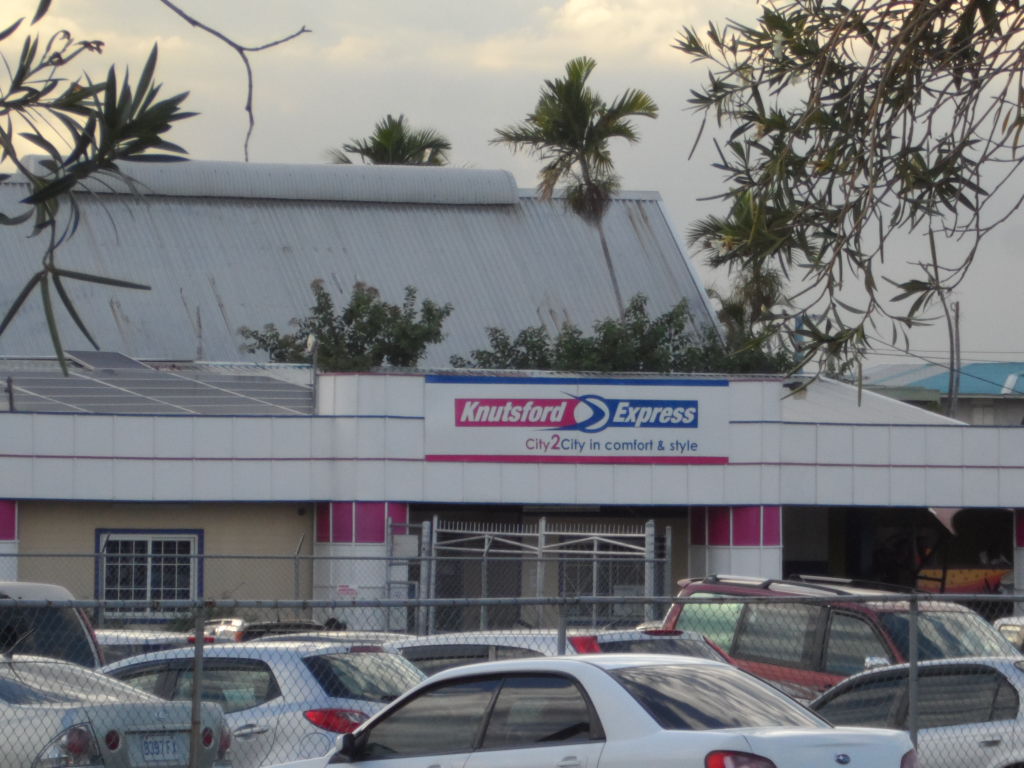
Knutsford's New Kingston depot

Knutsford’s New Kingston depot

Professional fees moved up 90 percent to $7.7 million. Passenger supplies were up 29 percent to $7 million which is well lower than the revenue growth. Parts and supplies grew 60 percent to $38 million. Surprisingly, insurance was only up by 12 percent to $14 million. Cleaning and sanitation increased 200 percent to $4.4 million. Toll fees jumped 163 percent to $7.4 million and would be due to the opening of the new leg of the highway to Ocho Rios while the South Coast routes that were added would add to the original cost. Depreciation and amortization grew to $25 million a 32 percent increase and security climbed 59 percent to $7.9 million.
Some items of cost such as repairs and maintenance actually fell while others such as electricity and office supplies rose more moderately than those above.

Profit falls at Massy

Massy LogoThe results for the nine months for Massy Holdings showed improved profit after tax for both the nine months and the third quarter ending June, in reality profits from normal operations fell in both periods. Revenues increased by 12.7 percent to $9 billion for the first three quarters of the 2015 financial year from $8 billion, due mainly to the acquisition of a subsidiary in Columbia in the last quarter of 2014 that contributed $650 million to revenue and $10 million to pretax profit.
Profit before tax increased by 5 percent from $558 million to $586 million. For the June 2015 quarter profits fell before rebranding cost to $175 million versus $208 million in 2014. In 2014, Massy group incurred $59 million in rebranding before tax and would have suffered a decline in both the quarter and nine months results, excluding this one off cost. Additionally, there was increased interest expense of $29 million above that of 2014 from raising $1.2 billion in 2014 to refinance short-term debt and to fund new projects. Earnings per share for the nine months come out at $3.95 and $1.19 for the June quarter.
Operating profit before finance costs declined to $180 million from $208 million, for June 2014 quarter and for the six months $625 million versus $616 million.
During the nine months, the Insurance division contributed 23 percent more to revenues to reach $249 million percent, and delivered $36 million to profits up from $26 million in 2014. Automotive & Industrial Equipment had revenues of $1.78 billion and profit of $171 million, for 2014 revenues amounted to $1.58 billion with profit of $154 million. Retailing had revenues of $5 billion compared with $4.6 billion and profit of $268 million in 2015 versus $273 million in 2014. Energy & Industrial Gases saw slightly lower profit of $154 million versus $168 million in 2014 from revenues $1.15 billion in 2015 and $772 million in 2014. Information technology revenues of $410 million slightly higher than the $414 million in 2014 and profit of $45 million from $53 million and Other Investments experienced revenues of $349 million, down on the $374 million in 2014 and profit of $60 million from $71 million.
Massy had lower revenue in the critical and home market with reports indicating a contraction in the economy and continued tightness in the Eastern Caribbean markets. With oil prices set to remain at low levels for a while the company could be challenged to grow profits in the near term.

Scotia Group steadies ship

Jackie Sharp - CEO Scotia Group

Jackie Sharp – CEO Scotia Group

Scotia Group reports profit $6.16 billion for the nine months ended July 2015 compared with $7.97 billion for the period to July, 2014. The reduction was impacted by Asset Tax expense of $1.29 billion fully booked from the first quarter as well as an increase in the Asset Tax rate imposed in May 2014.
Profit for the July 2015 quarter, was $2.31 billion, a shade off from the results for the April 2015 quarter of $2.36 billion, but well down on the July 2014 quarter of $2.9 billion. The decline in the quarter is due mainly to a fall-off in net gains on investment assets of $240 million, net interest income of $140 million, foreign exchange trading gains of $220 million and insurance revenues of $230 million.
Earnings per share for the nine months amounts to $1.93 and for the last quarter 72 cents and should end the year around $2.75.
The Group reported lower insurance revenue, lower net gains on foreign currency activities and financial assets in the Investment Management segment of the Group with total revenue for the nine months of $26.3 billion, a decrease of $319 million from the prior year. For the July 2015 quarter, total revenue of $8.62 billion was down $103 million from the April quarter. Net interest income after impairment losses for the period was $16.9 billion, an increase of $76 million versus the same period in 2014.
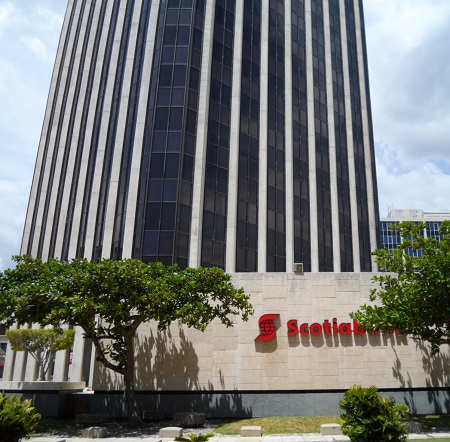
Scotia hq 25 9-14Expenses have been held quite tightly, resulting in an increase of $533 million or 3.7 percent when the Asset Tax is excluded for the nine months, while expenses were just $100 million more in a the third quarter, over the similar period in 2014.
Total assets increased year over year by $23.4 billion or 5.8 percent to $424 billion as at July 2015. The growth was primarily attributable to increases of $4 billion or 2.9 percent in Loans, net of allowance for impairment losses to $148.7 billion, $8 billion or 5.4 percent in investment and pledged assets and $8.8 billion in other assets resulting from higher retirement benefit asset. Loans as a percentage of total assets have declined from 36 percent to 35 percent as of July this year. The ratio needs to be moving in the other direction if profit is to commence growing at an attractive pace. At a quarterly rise around $1 billion the growth in loans is not strong to delivery good bottom line growth and help the stock to be above the average of the market.
An interim dividend of 40 cents per stock unit payable on October 15, 2015, to stockholders on record at September 23, 2015 was approved.

Lower income mauls Scotia Invest profit

SINV signTwo areas of major fall out for income in 2015 pushed profits sharply down for Scotia Investments (SIJL) for the year to July 2015. Gains from financial assets fell in a big way from $266 million in 2014 to only $24 million in the July 2015 quarter and from $576 million in the nine months period last year, to just $173 million.
Net interest income declined by $300 million in the July 2014 quarter and fell $750 million for the year to July, contributing to a disappointing year.
SIJL reported net income of $736 million for the period ended July, 2015, a huge decrease of $629 million, when compared with the net income of $1.36 billion for the period to July 2014. Net income for the quarter was $283 million, down $34 million or 11 percent below the $317 million earned in the April quarter but is down 48 percent on July 2014 profit of $541 million. Earnings per share of $1.74 and for the July quarter, earnings per share of 67 cents.
Total revenues, comprising net interest and other income for the period was $2.43 billion, a reduction of $757 million or 24 percent below the corresponding period last year and $761 million for the quarter, down $95 million or 11 percent compared to the previous quarter.
Total operating expenses for the period amount to $1.34 billion, up $102 million or 8 percent over the corresponding period last year, due partly to the increase in the asset tax rate from for regulated financial institutions and higher salaries and staff related costs. The operating expenses for the quarter were $366 million, down $45 million or 11 percent lower compared to the last quarter.
SIJL will clearly end the financial year below $3 per share to October this year with profits well below the $1.79 billion or earnings per share of $4.23 generated for the 2014 fiscal year.
An interim dividend of 45 cents per stock unit payable on October 15, 2015, to stockholders on record at September 23, 2015 was approved.

Caribbean Producers BUY RATED again

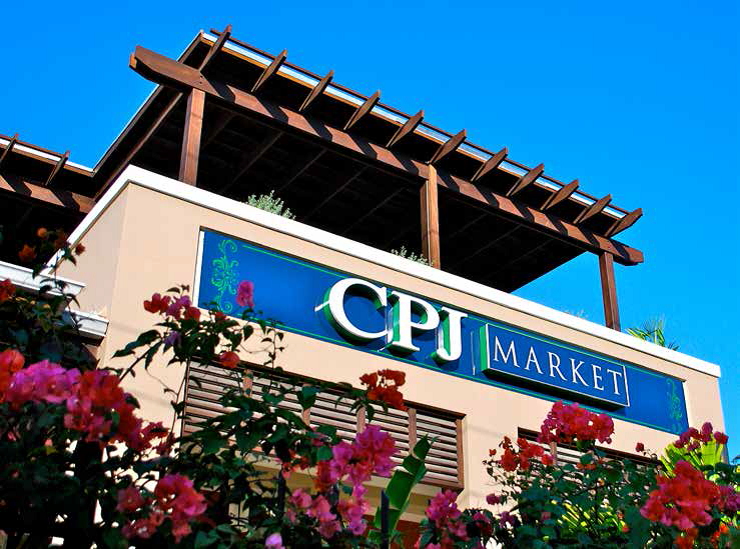
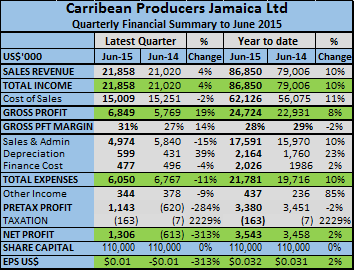
CPJ Mkt PlCaribbean Producers reported profit of US$3.54 million or 32 US cents per share for the year to June 2015, versus $3.46 million or 31 cents in 2014, according to the company’s audited financial statements. Sales brought in $86.85 million during the year compared with $79 million in 2014, a gain of 10 percent and for the quarter sales were up just 4 percent over 2014 to $21.86 million from $21 million in 2014 while profit came in at $1.3 million compared with a loss of $613,000 in 2014.
Profit for the latest quarter is 23 percent higher than the $922,000 earned in the March quarter, a period that is usually the highest earner. Earnings per share ended at 32 cents for the year or close to J$3.75.
Gross profit margin jumped in the June quarter to 31 percent and well over the 27 percent enjoyed in the 2014 quarter and higher than the 28 percent for the full year. Gross profit climbed as well by 19 percent to $6.8 million for the quarter much faster than the growth in revenues and was up by 8 percent for the year a bit less than revenue growth. Selling and administrative expenses fell in the quarter, by 15 percent but was up 10 percent for the year.
Profits seem to be moving in the right direction with cost falling in some areas and profit margin improving. At the current price of J$2.50 the stock is undervalued as it should be moving into the J$3 region with these results. The group has been seeing improvement in the St Lucian operations and that could be improved upon in 2016 fiscal year. CPJ 6-15Caribbean Producers made a profit of $447,000 in the September 2013 quarter but made on $2,500 profit in 2014, the results for this year’s September quarter should be better as 2014 had certain cost associated with new products and the holding of prices for certain items sold to the hotel sector during that period.
The bother continues to be the heavy debt, at $24.76 million which is down from $25.2 million in 2014, while equity is up to $19 million from $16 million in 2014 thus improving the debt to equity ratio quite a bit. The probability exists that there should be an improvement in 2016 as well, as profit continue to perform, thus building up equity.
IC Insider is restoring it BUY RATED stamp on this one.