Profit jumps 92% at Lasco Manufacturing

Profit jumped 92 percent at IC BUY RATED, Lasco Manufacturing for the year to March 2019, to $1.08 billion, from $561 million in 2018 and $707 million for 2017.
The profit for the year got support from a huge 41 percent jump in sales of $1.954 billion for the March quarter, pushing sales revenue up 13.6 percent to $7.57 billion, for the year.
Improvement in profit margin rose to 36 percent from 35 percent in the 2018, as input cost climbed much slower than revenues growth at 10 percent, to $4.8 billion. The effect, operating profit rose a strong 20 percent to $2.756 billion from $2.29 billion. Administrative, marketing and sales expenses rose much slower than growth in revenues at 4.7 percent to $1.5 billion.
The positive out turn reflects growth in volumes, improved operational efficiencies and streamlining and cost control.

Lasco Manufacturing products

Gross cash flow brought in $1.4 billion but growth inventories, addition to fixed assets of $588 million offset by net loan inflows, dividend payment, reduced receivables and increased payables resulted in cash rising by $1.1 billion, leaving cash on hand and bank at $1 billion.
At the end of March, shareholders’ equity stands at $5.85 billion with borrowings at $1.4 billion. Net current assets ended the period $2.26 billion well over Payables of $813 million. The company completed the 65,000 feet warehouse that is expected to simplify logistics and result in cost savings.
Earnings per share came out at 26 cents for the year and is projected at 45 cents for the 2020 fiscal year. The stock traded at $3.25 on the Junior Market of the Jamaica Stock Exchange with an attractive PE ratio of 7.2 times 2020 earnings, well below the market average.
The company will pay a dividend of 3.8 cents per share during the year, resulting a total payment of $155 million.
Big jump in Witco profit

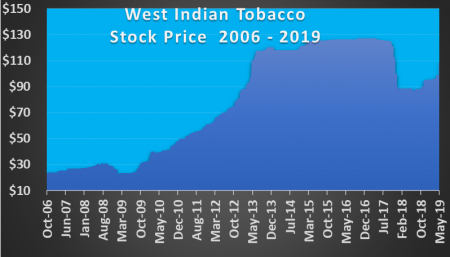
West Indian Tobacco last closed at $110.

Profit before tax jumped a strong 37 percent at the Trinidad based West Indian Tobacco to TT$145 million for the three months period ended March 2019, up from $106 million in 2018.
After providing $45 million for corporate taxes profit rose 38 percent to $100 million.
The impressive results arose from a sharp 21 percent climb in revenues to $227 million and a decline in cost from 36 million in 2018 to $32.4 million in the latest quarter. Also contributing to the improved results, was an rise in gross profit margin to 77.8 percent from 75.3 per cent in 2018 that resulted in gross profit rising 25 percent to $177 million versus $141.5 million in 2018.
The Board approved the payment of a first interim dividend of 83 cents per share payable on June 11 to shareholders on record at the close of business on May 21. Earnings per share climbed to $1.19 from 86 cents in 2018. For the full year, earnings should hit $6.40. The stock that is listed on the Trinidad and Tobago Stock Exchange last traded at TT$110 at a PE of 17.

Strong rise in Wisynco profit

Wisynco Group sent a strong message to investors, why the company’s stock is a must have by posting a strong 38 percent rise in profit for the 2019 March quarter, from revenues that grew 18.7 percent to $6.9 billion.
For the nine months to March, profits grew slower than for the quarter at 32 percent after tax, from revenues that are up 15 percent to $20.8 billion. The second quarter benefitted from the addition of rum and sugar distributions as well as improved efficiency flowing from the new bottling lines installed late in 2018 but suffered from foreign exchange losses of $69 million. Without the currency loss, profit in the quarter would be closer to an increase of 50 percent.
Asked how long the strong growth can continue, Managing director, William Mahfood informed IC Insider.com, “I think it will be for the next couple years, based on the economy as well as our improved efficiencies.”
Profit before Taxation for the quarter increased to $791 million or 35.4 percent compared to $585 million in 2018 for the same quarter. For the quarter ended March 31, 2019, Profits Attributable to shareholders of $694 million or 19 cents per share compared to $504.3 million or 14 cents per share, an improvement of 37.6 percent over the corresponding period of the prior year.

Worthy Park sugar distributed by Wisynco & also Worthy Park Rum.

Gross Profit increased to $2.6 billion or 24.9 percent over the $2.1 billion achieved in the same in 2018 resulting in Gross Margin of 37.8 percent, greater than the 35.9 percent for the corresponding quarter of the previous year. For the half year Gross Profit also increased to $8 billion or 19 percent over the $6.7 billion achieved in the same quarter of the previous year resulting in Gross profit margin of 38.5 percent.
Selling, Distribution & Administrative Expenses for the quarter totaled $1.7 billion or 14.2 percent, more than the $1.5 billion for the corresponding quarter of the prior year. For the half year, cost incurred increased 16 percent to $5.2 billion. The six months increase is just ahead of revenue growth. Finance expenses included a loss of $69 million due to the revaluation of the Jamaican Dollar and pushed the cost in the quarter by 183 percent and 70 percent for the half year to $302 million. The company should benefit from the decline in the value of the local dollar subsequent to the close of the quarter as well as the distribution of JP Snacks’ products.
The group is in a healthy financial position. Current assets stood at $9.2 billion of which cash equivalent stood at $3.3 billion while current liabilities amounts to just $3.9 billion with shareholders’ equity $10.39 billion and borrowings amount to $1.25 billion.
IC insider.com is forecasting earnings of $1 per share for the year ending June and $1.50 for the 2020 fiscal year that starts in July. The stock trades at $14.90 on Friday and is up 36 percent for the year to date and trades at 15 times 2019 earnings and just 10 times 2020.

Carib Cement wipes off losses

Caribbean Cement delivers record profit in Q1.

Profit at Jamaica’s sole producers of cement soared 234 percent in the quarter to March, to $1.1 billion from just $347 million in 2018 and wiped out the years of losses and plunging it into a surplus of $124 million.
The improved profit grew out of sales that rose a mere 2.5 percent to $4.45 billion from $4.34 billion and reduction in certain cost. The results places the company in a position to be able to commence the payment of dividends that seems likely this year.
Improvement in gross profit margin, was significant and may have resulted in profit margin climbing to 66 percent from 56 percent in the 2018, excluding depreciation cost. Input cost fell with the cessation of imported cement, being a part of the cost mix.
Depreciation cost rose 210 percent, to $391 million resulting from the acquisition of Kiln 5 and Mill 5, previously leased from Trinidad Cement. Employee related cost rose just 2 percent to $554 million. Administrative expenses dropped 73 percent to $300 million from $1.1 billion in 2018, a direct result of termination of the kilns. Marketing and sales expenses declined by 7 percent to $169 million. Finance cost climbed in the quarter by 756 percent to $169 million.

CCC Silo

Earnings per share came out at $1.33 for the quarter. IC Insider.com is forecasting earnings of $7 per share for 2019, based on sales increasing faster than in the first quarter. On the low end, the forecast is for earnings not less than $6 per share. At the latest price of $64 for the stock, the PE would 10.6 on the high side and 9.2 times at the lower end. It is worth noting that tax losses amounted to $1.6 billion at the end of 2018. Half of taxable profit can be set off against the tax losses, in any year assessment. The effect is a lowering of the amount of taxes to be charged against profit for the year, as the company did not book deferred tax assets for these losses in the past.
Gross cash flow brought in $1.8 billion, but after making loan payment of $1 billion and making some other payments cash at bank on hand, declined to $303 million from $421 million at the end of December last year. Shareholders’ equity stands at $7.5 billion with borrowings at $10.3 billion, down from $11.39 billion at the end of December. Repayment of preference share will consume $822 million in 2019 with $3 billion, payable annually, to September 2026.

Dropped income & increased cost hit NCB

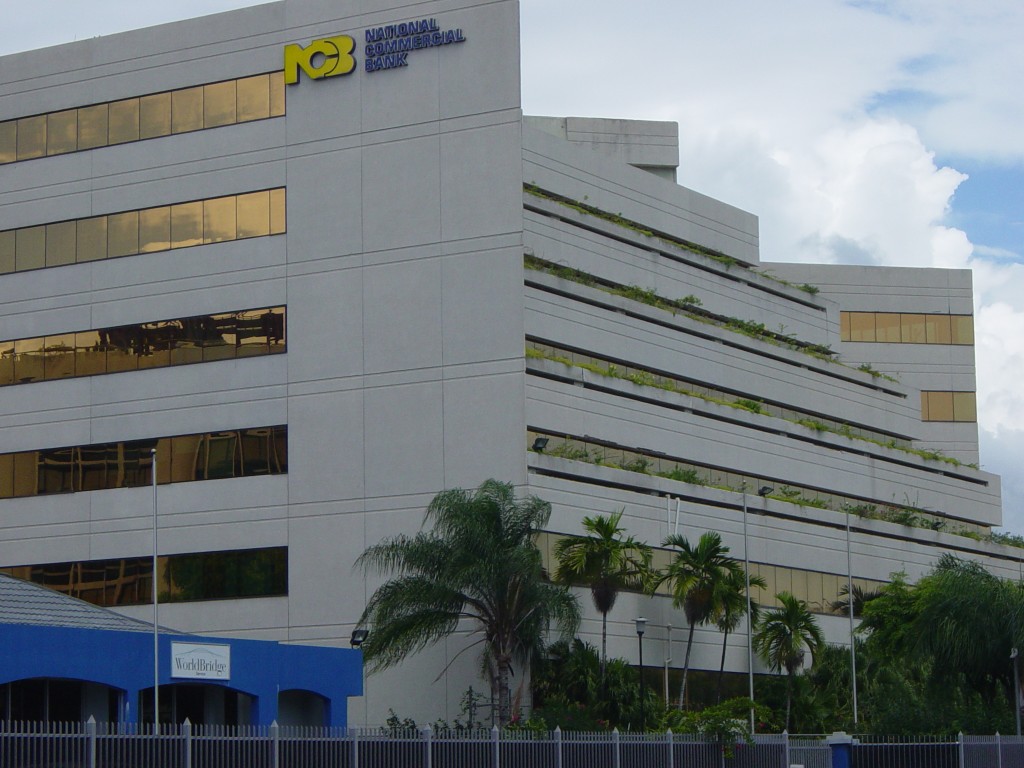
NCB reports lower profit for 2019 

A fall of $2.3 billion in foreign exchange and investment gains at NCB Financial Group (NCB) was the major factor for a fall in profit in 2019 March quarter to $5 billion from $6.4 billion in the similar period in 2018.
Revenues decline, was not the only area affecting the group’s second quarter performance as a $600 million jump in credit impairment losses and increased depreciation and amortization charge of $430 million, added even more pressure to the results.
For the six months to March, the group reports a net profit of $12.4 billion, down from $13.96 billion in 2018. The 2018 results include a gain of $4.4 billion related to the acquisition of Bermuda based Clarien Group. The amount is partially negated by a gain of $3.3 billion arising from disposal of an associated company JMMB Group, with the amount reflected in the 2019 results. Excluding the one-off transactions the results would have been $9.2 billion for the current period compared to $9.4 billion for the prior year. According to NCB, “we have made significant investments to improve our card system infrastructure, as well as to upgrade our ABM network and core banking system, to enhance and improve overall customer experience.”
Segment results were mostly positive with Retail and SME Banking climbing a healthy 25 percent, Payment Services up 20 percent, Corporate Banking jumping a huge 60 percent but Treasury and Corresponding banking was modestly down by just $12 million. Wealth & Investment banking slipped 18 percent but Life Insurance and Pensions jumped 41 percent while General Insurance leaped 155 percent and other fell 152 percent, for a loss $124 million.
The Group’s most critical area of loans and advances, grew 15 percent over 2018, to end at $384 billion, net of provision for credit losses. GHrowth in loans helped to drive net interest income up by 21 percent from $8.36 billion to $10.15 billion in the second quarter, over the similar period in 2018 and for the six months, a rise of 26 percent to $20 million from $15.9 billion. Non-performing loans amounted to $17.7 billion as at March 2019, up from $15 billion at March 2018 and represents 4.5 percent of the gross loans.
Earnings per share $2.04 for the second quarter and $5.07 for the half year. The group declared a dividend of 90 cents payable on May 27. NCB closed trading at $145 on Thursday on the Jamaica Stock Exchange and at TT$8.25 or J$165 on the Trinidad and Tobago Stock Exchange.

Profit rises 29% at PanJam

Stephen Facey Chairman & Paul Hanworth Chief Operating Officer

Trading income at PanJam Investment grew a strong 35 percent to $3.26 billion for 2019 while operating expenses rose just 7 percent to $1.7 billion leading to a 66.6 percent increase in operating profit of $1.55 billion, up from $938 million in 2017.
The major contributor to the increase in operating income was a 151 percent increase in investment income to $1 billion, from $423 million in 2017.
Share of results of associated companies contributed $4.7 billion to profit, compared with $3.9 billion in 2017. After taxation of $311 million and finance cost of $624 million, profit ended at $5.3 billion for an increase of 29 percent. Earnings per share rose to $5.06 for the year.
The group saw growth in profit from Sagicor Group and Downing Street Fund 11 and V but suffered a loss at Chukka Caribbean with revenues falling from $4 billion to $3 billion. New Castle saw a reduction in profit even with an increase in revenues while Caribe Hospitality saw profit rising from $242 million to $271 million of which their share is 32 percent.
PanJam holds equity investments worth $6.8 billion up from $2.4 billion at the end of 2017. The value of investment properties moved from $7.9 billion in 2017 to $8.4 billion and investments in associated companies total $26.3 billion. Total assets at the end of the year was $45.9 billion up from $39.4 billion in 2017. The group borrowed $10.6 billion at the end of 2018, up from $7.5 billion in 2017 and has equity of $34 billion.
PanJam is in the process of upgrading the Oceana building in downtown Kingston to a combination of hotel and residential units slated for sale. There also plans for a business hotel in Montego Freeport in Montego Bay.
The group stocks trades at $81 on the Jamaica Stock Exchange at a PE of 12.5 times 2019 estimated earnings of $6.50 and a net book value of $32. PanJam is a stock Investors should consider holding in the long term portfolio to benefit from growth to flow from expansion in the investment field and real estate holdings.

Sagicor’s good profit poor presentation

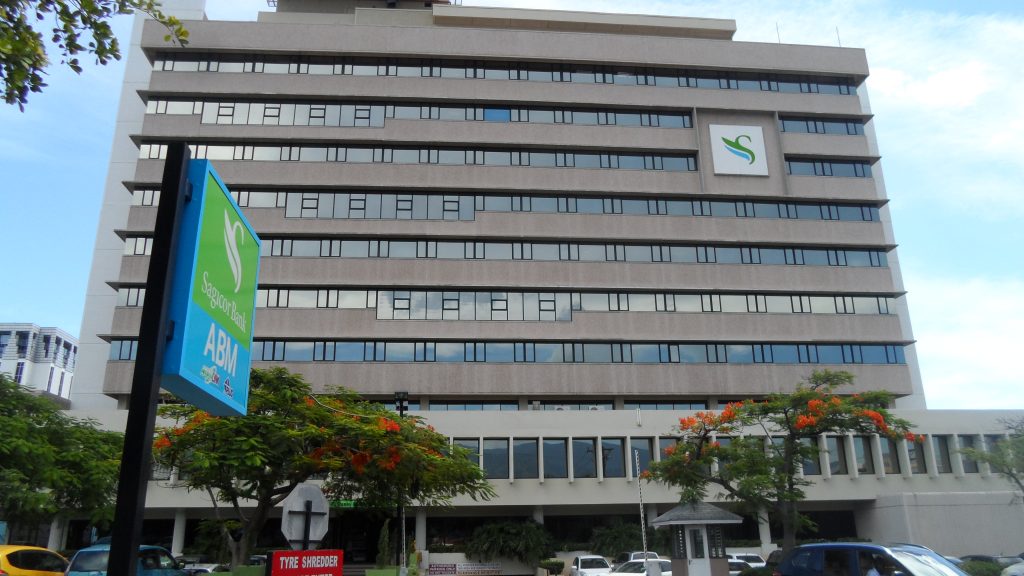
Jamaica Sagicor Group reports increased 2018 profits.

Financial statements are meant to be understood by users. As most readers are not likely to be trained in accounting, the statements should be prepared in a manner for the average user to understand.
The latest audited financial statement put out by the Sagicor Group and audited by PriceWaterhhouseCoopers includes a profit statement that is a picture of confusion and extremely difficult to understand, that is just not good enough and it should be revamped, for greater clarity. It is just not clear how the statement moves from gross premium income through to investment income and then to total income. To determine what is being conveyed, one has to be fully conversant with computing of income statements and need to decipher what each line item really is and what set of figures relate to what item.
The group recorded total income of $70.7 billion up from $69.7 billion in 2017. The major operation areas generated less income that in 2017. Insurance generated $9.8 billion in 2018 compared to $41 billion in 2017 while investment income fell to $24.3 billion versus $26.7 billion in the previous year. Expenses moved from $55.9 billion in 2017 to just $54 billion in the latest period to December 2018. The reduction resulted from a big decline in movement in actuarial liabilities from $10.7 billion in 2017 to just $2.3 billion in 2018.

Reading the statement one has to guess whether the total cost is that of operating profit or expenses, as there is no caption to clarify. The report then ends up with profit before tax of $18 billion, up from $15 billion in 2017, but readers have to search to determine how the amount, was arrived at. After taxation charge of $4.2 billion versus $$2.9 billion in 2017, the group reported net profit of $13.9 billion against $12 billion in 2017. Earnings per share ended at $3.65 but was boosted by gains of $1.5 billion arising from consolidation of Sagicor Real Estate Fund.
At year-end, shareholders’ equity rose to $74.3 billion from $68.5 billion at the end of 2017 while total assets jumped to $394 billion from $352 billion.

Guardian Holdings profit jumps 31%

Guardian Holdings jumps $1 to new 52 weeks’ high.

Profits at the Trinidad based Guardian Holdings, jumped an attractive 31 percent to TT$534 million above the TT$407 million reported for 2017 that is due to shareholders of the group.
The results translate to earnings per share of $2.30 versus $1.75 in the prior year. “Insurance underwriting activities drove the performance led by the Life, Health and Pension business segment which had a stellar performance achieved primarily from improved persistency, expense management and improved product mix,” Henry Peter Ganteaume, the company’s Deputy Chairman, disclosed to shareholders in his commentary accompanying the results.
Net Written Premiums by 6 percent to reach $4.16 billion but gross written premium rose by 7 percent to $5.86 billion. Net income from underwriting activities more than doubled from $403 million to $863 million. The deputy chairman went on to state, “The Property and Casualty business segment returned a satisfactory performance as it was spared major catastrophic events during the year. However, the persistent soft market conditions led to a marginal increase to Net Written Premiums. Also of note were the not-insignificant profits made by our Asset Management and Brokerage businesses. These two ‘segments’ hold promise to become important and non-risk exposed elements of our overall Group earnings profile over the relatively short term. NCB shareholders will be big winners in a successful Guardian acquisition. Net income from investing activities fell from $1,191 million to $982 million, driven primarily by volatility in Global equity markets, which resulted in a Net fair value loss of $12 million in 2018 compared to an exceptional gain of $246 million in 2017”.
Operating expenses increased by 7 percent to just under $1.05 billion. Based on the 2018 performance, the directors propose a final dividend of 48 cents, which will bring the total dividend to 71 cents, an increase of 4 cents or 6 percent over 2017. Shareholders’ equity grew to $3.4 billion at the end December and total assets at $27.3 billion.
Guardian stock closed at a 52 weeks’ high of $19 on the Trinidad Stock Exchange on Wednesday at a low PE ratio of 8.2 times last year’s earnings and no doubt even lower than 2019 earnings. If NCB financial gets approval for the acquisition of majority shares in the company, they would have picked up a gem at a very low price making the NCB’s investors the winners and the Guardian sellers, big losers.

Flat profits at Jamaican Teas

Jamaican Teas

Domestic sales at Jamaican Teas was robust for the first quarter to December last year, with a 16 percent increase in both the manufacturing operation and at the company’s sole supermarket. Exports fell sharply and pulled down overall sales.
JTL’s first quarter revenues from manufacturing operations declined by 10 percent, due mainly to a stock reduction exercise at the main USA distributer, resulting from export sales declining 40 percent, following a very strong 67 percent increase in the first quarter of 2018 fiscal year and a 24 percent increase for the full fiscal year. The group had no sales of houses in the period as the sole scheme that was developed was completed. Sales generated from the property development in the 2017 quarter of $48 million.
The decline in export sales in the December quarter negatively affected results for the quarter for the group. Nevertheless, the Group’s first quarter net profit attributable to the owners slipped 4 percent, from $52 million to $50 million.
The Company is reporting pick up in exports following the closure of quarter, as well as local sales in both the manufacturing and supermarket operations. With the prices of certain stocks rising since December, the group should be enjoying gains in their equity portfolio.
Earnings per share per share from continuing operations finished at 7.3 cents, down from 7.7 cents in 2017.
For financial year commencing, October 2018, the Group adopt the new accounting standard IFRS 9, resulting in all realized and unrealized gains on listed equities becoming part of the profit and loss account.
The Group continues to enjoy improving financial health with equity capital of $1.4 billion and borrowed funds of just $178 million. The quarter ended with combined quoted investments at $454 million, up from $319 million in the previous year and net cash on hand equaled $132 million.
Jamaican Teas is listed on the main market of the Jamaica Stock Exchange and last traded at $4.
Persons connected with IC Insider.com are associated to the company.

Everything Fresh picks up Meat company

Everything Fresh traded at $1.61 on Monday.

Everything Fresh completed the purchase and takeover of Meat Experts for a consideration of $50 million, the company reported to the Jamaica Stock Exchange.
The company expects to spend an additional $30 million for upgrades, the release stated. “Meat Experts is a widely integrated manufacturing operation located in Bog Walk, St. Catherine. It has its own abattoir, cutting, processing, packaging and cold storage facilities and logistics network. This acquisition will add several new products to the Everything Fresh lineup, promote the support of local livestock and produce farmers and reduce costs. Everything Fresh will be serving both its bulk and retail clients with additional products that will be launched under the Meat Experts and Everything Fresh brands. Everything Fresh continues to pursue other salient opportunities which exist,” the company stated.
The acquisition provides diversification for Everything Fresh that was previously a purely a distributor of edible goods including fruits and meats.

Everything Fresh two major owners and directors, Mr. & Mrs. Pullen.


Everything Fresh is listed on the Junior Market of the Jamaica Stock Exchange, with the stock closing at $1.61 on Monday.
The suffered a reduction in revenues in the September 2018 quarter from $450 million to $422 million but the nine months period enjoyed a rise from $1.365 billion to $1.39 billion. A loss of $17.5 million was realized in the September quarter versus a profit of $11 before tax in 2017 and for the nine months, profit declined to $27 million before tax from $35 million in 2017. The acquisition could add between $20 to $30 million in profit for the group, based on the capital involved in acquisition and the upgrade to take place.