Profit jumps sharply at Elite

Drax Hall branch of Elite now completed


Elite Diagnostic last traded on the Junior Market a $6.40 to be up 117 percent for 2019 and is one of three stocks on that market to more than double, this year.
Investors feel there is more to gain from investing in the stock of this technological business as they continue to buy into the stock and pushed the price as high as $7.50 after the company posted full-year results in August.
Elite reported net profit for the June quarter at $24.6 million compared to $3 million for the similar period a year ago. A strong increase in revenues and a fall in repairs of equipment and administrative expenses compared to the year-ago period helped with the strong growth in profit. Profit before tax for the 12 months grew 32 percent to $47.4 million compared to $35.8 million for the similar period a year ago. Gross cash inflows amounted to $103 million but the company had net borrowing of $8 million and purchase of property, plant and equipment amounting to $135 million, down from $295 million purchased in the prior year.
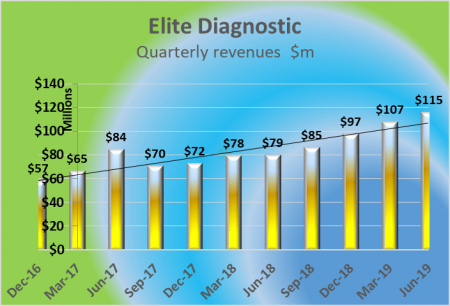
Revenues were $115 million for the 4th quarter, an increase of 46 percent over the $79 million for the same period last year. Revenues for the 12 months to June 2019 jumped 35 percent to $404 million compared to $298 million for the similar period a year ago. The directors in their report to shareholders accompanying the financials, stated, “the increase in revenue was due to greater utilization of the Liguanea branch which also extended their hours of operation”.
Importantly, revenues not only grew year over year but for each of the last 7 quarters it increased quarter to quarter. For the 2020 fiscal year, revenues should hit $500 million from the two Kingston locations. Cost of sales remains static in dollars, in spite of the sharp rise in revenues.
Direct cost rose from $28 million in the June 2018 fourth quarter, to $30 million in 2019 and from $117 in the year to June 2018 versus just $119 million in 2019 and $96 million in 2017. Increased growth from the two existing locations should have a powerful impact on profits, resulting from the near static direct cost.
Administrative cost fell from $36 million to $33 million in the June quarter of 2019 but rose sharply by 52 percent for the year to $152 million. Depreciation charge climbed from $$7.5 million for the quarter to $14 million in 2019 and moved from $28 million to $56 million for the year.
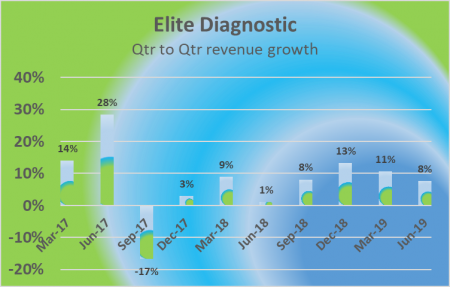
Elite enjoying a long period of increased quarterly growth in revenues since December 2017.

A loss of  $8 million on exchange in the June 2019 quarter and reduced profit by $10 million for the full twelve months. Excluding this loss, earnings per share for the quarter would have been 9.5 cents instead of the 7 cents reported and the full year 16.7 cents versus 13 cents reported. Finance cost climbed from $16 million in the 2018 fiscal year to $20 million for 2019.
The company closed the fiscal year with shareholders’ equity of $447 million, loans borrowed amounting to $196 million, cash funds of $94 million, current assets of $119 million and current liabilities of $50 million.
“Demand for imaging services remains strong and the company continues to execute its plan providing exceptional patient care, excellent service, expanding its services and gaining market share.
The construction of the new St Ann (Drax Hall) location is completed and the company expects to open its doors in September 2019. This new location will have full imaging services and doctors’ offices,” the directors reported.
IC Insider.com forecast earnings for the full year ending 2020 at 55 cents, on this basis the stock is priced at a PE ratio of 12, but the next two years is when the full pay off will take place when the expansions should be maturing.

Lasco Manufacturing Q1 profit up 19%

Revenues at Lasco Manufacturing rose just 3 percent in the June quarter to $1.79 billion but improved profit margin lifted profit after tax by 19 percent to $282 million.
The slow growth in the quarter contrast to a 6 percent rise in revenues in the fiscal year to March 2019 when the company posted revenues of $7.6 billion. The June quarter’s revenues are lower than the $2 billion achieved in the March quarter but are consistent with September and December quarters last year with $1.7 billion and $1.8 billion respectively.
Operating cost rose 7 percent to $330 million but cost of sales declined to $1.19 billion from $1,125 billion in 2018 with the change resulting in gross profit margin rising to 37 percent from 35 percent in 2018. Finance cost was virtually flat at $32 million but taxation rose from $34 million to $40 million. Lasco generated other income of $17 million in the quarter versus just $3 million in 2018. Earnings per share rose to 6 cents from 5 cents in 2018 and are expected to exceed the 26 cents per share realised in the fiscal year to March, with IC Insider.com forecasting 38 cents per share.
According to the managing director’s report, “the positive outturn reflects gains from ongoing improvements in operational efficiencies, reduction in structural costs and streamlining of the operations. Capital improvements for the period totaled $60 million with the main focus during the period being the completion of the powder plant expansion.”
Lasco generated gross cash flow of $348 million for the quarter but paid $250 million in dividends and repaid loans amounting to $106 million. At the end of the period, cash and bank balance stood at $995 million. Long-term loans outstanding amounts to $876 million.

Lasco Manufacturing products.

Loans amounting to $464 million is due to be repaid in the next twelve months. The company seems to be heading into a period of greater maturity, when loans will be repaid from the strong annual cash flows that the company is slated to generate, going forward.
Shareholders equity stands at $5.9 billion and net current assets $2.2 billion, which exceed current liabilities of $1.5 billion.
There has been increased interest in the stock with the recent announcement that the United Cannabis Corporation, the American company that is partnering with Lasco Manufacturing for the production of cannabis-infused water among other cannabis medicinals, has been issued a license to cultivate cannabis through a company called Cannabinoid Research and Development.
The stock traded on the Junior Market of the Jamaica Stock Exchange on Friday at $5.50.

Sales up 24% in 2019 at Knutsford

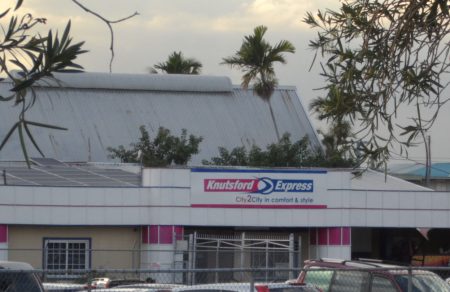
One of Knutsford Express buses.

Jamaica’s cross-country luxury bus operators, Knutsford Express, saw strong growth in revenues for the year to May of 24 percent but net profits rose just 6 percent as the company’s new Florida operations took a bite out of local profits.
For the nine months to February, revenues were up 24 percent, with the February quarter showing a healthy increase of 22 percent. Revenues rose 22 percent from $249 million in the 2018 May quarter to end at $304 million, while revenues for the February quarter rose from $232 million to $286 million and for the full year, it rose from $926 million to $1.15 billion.
Profit rose just 6 percent from $178 million for the full year to $188 million for earnings per share of 38 cents. Resulting from the losses in the foreign operations, profit in the final quarter fell from $50 million in the 2018 May quarter, to $30 million in the same period this year. The company generated income of J$21 million and incurred a loss of J$25 million in the Florida operation that commenced in the February quarter. According to Managing director Oliver Townsend, “the Florida operation is a long term investment which we believe will come into its own in the second year of operations.” Townsend was responding to a query by IC Insider.com as to when this operation would break even.
Knutsford does not break out direct operational expenses, making it difficult to determine the gross profit generated by the company.

Knutsford’s New Kingston depot

In addition, the absence of that critical data makes it impossible for investors to measure the efficiency of the operations. Data extracted suggest it could be in the region of 40 percent. Overall expenses rose 28 percent to $963 million for the year with fuel rising 28 percent and labour cost 30 percent.
The company benefitted from the hub at Sangster Airport resulting in more foreign arrivals utilising the services, especially those journeying to and from Negril, the company reported.
Fixed assets grew to $733 million with additions of $406 million during the year, cash and short-term investments ended at $355 million with borrowings at $215 million and shareholders’ equity of $780 million.
Knutsford trades on the Junior Market and closed at $11.10 on Tuesday, with a PE of 29 based on historical earnings. IC Insider is forecasting profits in the current year to be in the region of 75 cents per share that would result in a PE of 15 and slightly above the Junior Market’s average of 13.

Pressure on Jetcon’s sales easing

Jetcon sales are bouncing back since June after a sharp fall between January and May.

The current year that ends December, is proving to be a tough one for used car dealer Jetcon Corporation with falling revenues and profit for the first half of the year.
In its recent report on second-quarter results, management reported another challenging period following a sharp fall in sales and profit for the first quarter. Revenues fell 26 percent and profits by 75 percent and for the half-year, revenues declined by 23 percent and profit by 70 percent.
The first half performance reverses three years of solid growth for the company. “We are pleased to report that we are now seeing positive developments since June, with sales up 10 percent ahead of 2018, in both June and July. Orders for August, suggest that we will enjoy a much better sales than in 2018. Sales in August last year were below the historical pattern. Our projection calls for higher sales than 2018 in the second half of the financial year,” the company’s management stated in the report accompanying the results.
Revenues fell to $221 million from $300 million in the June 2018 quarter with a fall in gross margin, from 18 percent to 16.5 percent and a decline in pretax profit, to $9 million versus $35 million in 2018. Earnings per share ended at 1.5 cents versus 6 cents in 2018.

Attentive shareholders at Jetcon’s AGM

Year to date, revenues declined to $467 million from $607 million in the similar period in 2018. Gross profit margin declined from 20 percent to 17 percent. Pretax profit decreased from $81 million to $24 million. Earnings per share ended the period at 4 cents versus 14 cents in 2018.
“We reduced prices in some areas to move inventories in the first half of the year and this negatively affected our gross margin. We expect that the discounting will ease as the year progresses,” the management report stated.
Jetcon shares traded on the Junior Market of the Stock Exchange at a 52 weeks’ low of $1.58 on Friday but bounced to $1.70 on Monday.
Persons connected with ICInsider.com are also connected with the company.

The ugliness of Wigton demands action


The capital market got a huge body blow with the release of Wigton Windfarm quarterly results for the first quarter to June that suggests a bright future outcome but the reality is vastly different.

Analysis of the results and historical data show clearly that investors have been unwittingly, duped into believing that the earnings of the company had blasted off sharply from 5.5 cents reported for the 2019 fiscal year, but nothing could be further from the truth. The directors’ report accompanying the June quarterly results is inadequate, as it does not communicate clearly what investors can expect for the rest of the year. There is just very limited historical information to go by to help.
The company posted positive results for the June quarter, with profit jumping 109 percent from $175 million to $366 million with modest foreign exchange gains, resulting in earnings per share of 3.3 cents.  IC Insider.com’s computation puts full year’s earnings at 7 cents assuming revenues grow 6 percent for the year.
Revenues rose 6 percent to $833 million for the quarter with gross profit rising from $606 million to $641 million. Other income comprising $34 million in foreign exchange gains moved from $60 million to $68 million. Importantly, finance costs fell sharply from $358 million to $147 million while administrative expenses edged slightly higher to $79 million from $78 million. The data is showing revenues in the first quarter of 2018 as 32 percent of the full year’s earnings. The next three quarters earned 68 percent or an average of 22.5 percent. If the similar development takes place this year, then earnings in the balance of the year will be just above that for the first quarter, as fixed costs will reduce quarterly profit considerably from that reported in the first quarter.
Going forward, there will be added ongoing costs associated with the listing, including listing fees, registrar services for the more than 31,000 shareholders, production of the annual report and annual general meeting as well as additional staffing.
Directors have a responsibility to communicate critical information to investors so that they can properly interpret the financial information presented and not having to guess exactly what is placed before them.

Jamaica’s Ministry of Finance newest office building

The Wigton’s June quarterly report falls far short of what is expected of a company of its size and with so many shareholders. The quarterly shows that production of energy grew 2.9 percent to 55,331,319 KWH but the directors stated that they expect to produce 169 Giga Watt Hours the average over the past three years. There is no mention of how the first quarter’s production, relates to the full year’s output. There is no mention of seasonality in the report. In fact, a review of the prospectus provides no information about seasonality, a critical bit of information that is missing. “If the company’s business is highly seasonal, IAS 34 encourages disclosure of financial information for the latest 12 months, and comparative information for the prior 12-month period, in addition to the interim period financial statements. [IAS 34.21]”
The shocking discovery is the composition of directors and shareholders of the company. People in authority should avoid conflicts of interest. The big question is, on what basis was the Wigton’s prospectus approved with a board member of the Financial Services Commission shown as a director of the company and subsequently a shareholder? Judges cannot oversee cases involving themselves, to do so, would be a huge conflict.

Wigton profit to help light up JSE

Wigton stock could spike on Wednesday.

Profits drive stock prices like nothing else. The Jamaica Stock exchange should see a big hike at the close of trading as a number of companies release some excellent results days before the main earnings season for the half-year ends.
Some main market companies are reporting big gains in earnings after the market closed on Tuesday and these could push prices up on Wednesday. Wigton Windfarm posted positive results for the June quarter, with profit jumping from $175 million to $366 million with modest foreign exchange gains, resulting in earnings per share of 3.3 cents that should translate to over 10 cents for the year. Revenues grew 12 percent at Kingston Wharves to $3.8 billion, over the corresponding period in 2018 and net profit attributable to shareholders increased by 40 percent to $1.2 billion. For the June quarter, net profit rose 54 percent to $729 million on revenues that rose 12 percent to $19.7 billion. Importantly, Kingston Wharves reported earnings of 51 cents per share for the second quarter (annualized $2 per share) and 82 cents for the half-year.
Jamaica Producers increased second-quarter revenues by 12 percent to $5.4 billion over the 2018 period and net profit attributable to shareholders increasing 52 percent to $399 million.

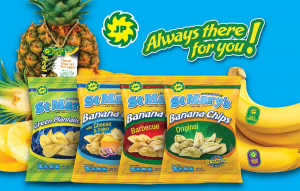
Jamaica Producers snacks

For the half-year, JP posted profit due to the group’s shareholders of $629 million compared to $415 million with revenues that rose from $9.3 billion to $10.16 billion. PanJam Investment reports net profit attributable to shareholders of $3.055 billion for the June quarter, up from $982 million in 2018 and $3.95 billion for the six months from $1.8 billion in the 2018 period.
PanJam results benefited from investments gains and gains from the sale of shares in an associated company. Productivity Business Solutions posted a rise in profits toUS$724,000 in the June quarter compared to a profit of $372,000 in 2018 and a profit of US$184,000 for the six months to June.

NCB solid stock for the future

NCB Financial Group (NCB) produced net profit of $21.3 billion for the nine months to June 2019 with profit attributable to stockholders of $20.7 billion, a marginal increase of $87 million over 2018.
For the quarter to June, NCB reported $8.3 billion in profit attributable to shareholders inclusive of $2.3 billion resulting from the increased value of the near 30 percent interest NCB owned in Guardian (GHL) before acquiring majority shares, during the quarter. Results include the consolidation of two months of GHL’s income coupled with the gain from revaluing the shares that NCB held in GHL previously, as an associated company.
For the nine months ended June, net operating income rose 22 percent to $63 billion from $51.6 billion in the prior year while it increased 28 percent to $24.5 billion in the June quarter over 2018.
Banking and investment activities netted $55.8 billion, up 13 percent over the $49.4 billion for the comparative 2018 period and for the quarter the enlarged group produced $21 billion compared to $18 billion in 2018. A 14 percent growth in our loan portfolio helped in pushing net interest income to $32.4 billion or 27 percent over $25.4 million generated in 2018. For the quarter, net interest income grew to 30 percent to $12.4 billion.
Net fee and commission income rose from $4 billion in 2018 to $5 billion for the June quarter and from $11.7 billion to $13.4 billion for the nine months period. Gains on foreign exchange trading declined sharply from $11.4 billion to $8.7 billion for the nine months period and from $4.2 billion in 2018 to $2.8 billion for the June quarter.
The net result from insurance activities grew 218 percent over the prior year to $7.2 billion from $2.3 billion in the prior year nine months period. For the quarter, net income tripled the $1.15 billion in the 2018 June quarter to reach $3.4 billion in 2019. “One of our Jamaican life insurance subsidiaries benefitted from improved spread performance and changing mortality assumptions, resulting in a significant contribution to the net profit. The consolidation of GHL’s insurance activities contributed 45 percent of net insurance revenues reported for the third quarter,” the group directors reported in their commentary to shareholders.

Operating expenses including loan and securities losses accounted for $46 billion, an increase of $13 billion or 41 percent over the prior nine months in 2018. “The consolidation of GHL and an additional quarter of Clarien’s results in the current reporting period contributed to 43 percent of this increase,” the group reported.
Impairment losses on loans and securities increased by 166 percent to $3.65 billion from $2.46 in the nine months and from just $941 million in the June 2018 quarter to $1.7 billion in the 2019 period.
Total assets grew with the acquisition of majority shares in GHL to $1.6 trillion, an increase of $635 billion or 68 percent over the prior year. “The consolidation of GHL, net of adjustments, added $517 billion in assets to the Group’s portfolio. The Group’s loans and advances, net of provision for credit losses, stood at $412 billion, an increase of $50.5 billion or 14 percent over the prior year, attributable to strong growth in our Jamaican portfolio along with the consolidation of GHL’s $14.6 billion of loans and receivables” the NCB directors report stated.
Customer deposits reached $509 billion at the end of June, an increase of 10 percent or $45 billion over the prior year. Policyholders’ liabilities increased from $39 billion in June 2018 to $422 billion due to the consolidation of GHL. Investment Securities and Reverse Repurchase Agreements Investment securities, including pledged assets, and reverse repurchase agreements amounted to $780 billion. This portfolio grew by 106 percent or $400.6 billion over the prior year, primarily due to the consolidation of GHL’s portfolio valued at $369 billion. Stockholders’ equity amounted to $137 billion, a 10 percent or $12.8 billion increase over the prior year due primarily to an 18 percent increase in retained earnings.
Earnings per share for the quarter came in at $3.42 but that includes one-time income and expenses, ongoing earnings could be in the region of $3 per share or around $12 annually. For the nine months earnings per share reported was at $8.49. Going forward the growth in the loan portfolio is one of the most critical factors to look for in assessing prospects going forward, with the acquisition of the General Insurance portfolio this area is also very critical to growth in the future. There are areas of duplication in the operations of Guardian and NCB accordingly, investors can expect rationalization to come and with that reduced cost and likely more robust sourcing for new business. NCB stock that last traded on the Jamaica Stock Exchange at $220 is a good long term investment.
The Board of Directors declared an interim dividend of 90 cents per ordinary stock unit. The dividend is payable on August 27, to stockholders of record as on August 13.

Carib Cement 2019 profit mixed

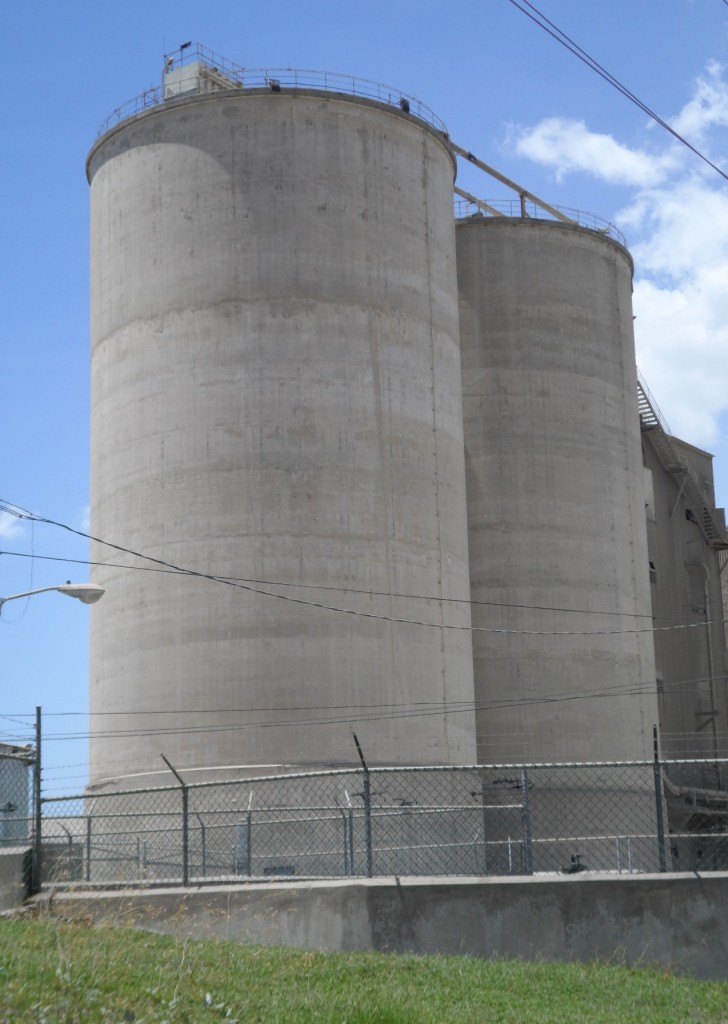
Carib Cement silos

Caribbean Cement revenues climbed 5.6 percent in the June quarter to $4.68 billion and 4 percent year to June, with $9.13 billion booked.
The company reported lower profit the June quarter than in 2018, due mainly to $485 million incurred as foreign currency losses and ended up with profit after tax at $368 million versus $674 million in 2018. Or the half-year profit after tax grew 48.6 percent to $15 billion. The company reported earnings per share of 43 cents versus 79 cents in the similar quarter in 2018 and $1.76 compared to $1.18 in the 2018 six months period.
Expenses excluding depreciation and finance grew 2.7 percent for the quarter to $2.94 billion and fell 21 percent for the half-year to $5.47 billion. The sharp reduction in cost results from the termination of an equipment lease agreement with the parent company and the purchase of those assets. The acquisition of the assets drove depreciation charge for the quarter to $405 million from $340 million in 2018 and $796 million from $467 million for the six months periods. Finance cost including foreign exchange losses rose to $688 million from $412 million for the quarter and $856 million versus $386 million for the half-year.
The results boosted shareholders’ equity to $7.9 billion from $6.4 billion at the end of December last year as the company wiped out accumulated losses of $994 million at the end of 2018 leaving a surplus of $493 million. Borrowing amounts to $9.8 billion while cash funds amount to $394 million and net current assets stood at negative $759 million.
The stock trades at $80 on the Jamaica Stock Exchange main market. IC Insider.com projects earnings for the full year to December at $5 per share that would place the PE ratio at 16, just around the markets PE of 17. With the economy doing well and increased construction activities, investors should have their eyes focused on increased future earnings.

Sagicor Group Q2 profit up 40%

Sagicor Group & PanJam hit new closing highs.

Sagicor Group is reporting profit attrib8uutabel to shareholders for the June quarter of $3.69 billion up from $2.70 billion in the first quarter this year and 40 percent higher than the $2.64 billion in the 2018 second quarter.
For the six months to June net profit of $6.39 billion attributable to stockholders rose 21 percent over the similar period in 2018. Earnings per share come out at $1.64 per share for the half-year and 95 cents for the quarter.
According to the report accompanying the results, “the current year-to-date results benefited mainly from overall good new business and portfolio growth which were both better than the prior year. The 2018 numbers included large impairment charges on Government of Barbados and other bonds. There were other factors that influenced the outcome for the period, these include, The fluctuating rate of the Jamaican dollar to the US dollar which reached a decline of 5.5 percent in April compared to the rate at December 2018 and by June bounced back to a 2.9 percent decline. The Group picked-up both realized trading gains and unrealized revaluation gains for higher US dollar positions. Appreciation of the Jamaica Stock Exchange main index which grew by 23 percent during the six months period. The Group picked-up good trading gains and increased bond prices on USA stock markets.”
Sagicor Bank enjoyed an excellent period contributing net profits of $1.04 billion for the current period, versus $772 million recorded in 2018, from revenues of $6.36 billion, 18 percent more than the prior year.
The stock traded on the Jamaica Stock Exchange on Tuesday at $58.

FX losses cut Wigton 2019 profit

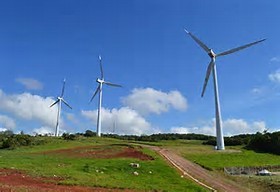
Wigton shares are still the most heavily traded on the JSE.

Profit before tax at Wigton Windfarms fell from $768 million in 2018 to $727 million in 2019 from sales revenue of $2.44 billion for 2019 compared to $2.36 in 2018.
The 2019 results include a net loss of foreign exchange of $177 million. The company retired loans that were denominated in US dollars and swapped them for loans in local currency at interest rates that were higher than the prior loans but removing the risk of exchange rate adjustments.
Costs are relatively stable as well as income. Depreciation accounts for $665 million of the total administrative and operating cost of $1.17 billion. The audited financial statement had finance expenses of $1.05 billion but that figure includes foreign exchange losses of $663 million, partially offset by foreign exchange gains of $486 million.
Taxation charge for the year came out at $173 million. It will be difficult for the company to earn much more for the current fiscal year to March 2019, than the 5 cents per share recorded in 2019.
Wigton ended the year with shareholders’ equity of $2.9 billion, borrowings of $6.3 billion and cash and equivalent of $1.38 billion. Current liabilities were relatively insignificant.
The stock has been trading around 90 cents on the main market of the Jamaica Stock Exchange with a PE ratio of 17 times earnings.