BOJ overnight rate still 0.50%

Bank of Jamaica announced the decision to maintain its accommodative monetary policy stance by holding the overnight policy rate offered to deposit-taking institutions at 0.50 percent per annum.
In announcing the decision to hold the rate Governor of the Bank of Jamaica, Richard Byles, stated, “I think it is important to emphasize that Jamaica’s financial system remains sound, well-capitalized and its current holdings of Jamaica Dollar liquid balances remain adequate. To ensure that orderly conditions are maintained, Bank of Jamaica has taken some pre-emptive measures to assure financial institutions and the public of adequate access to both Jamaica Dollar and foreign currency liquidity during this challenging period. There are a total of eight such measures, three in respect of foreign currency and five to do with Jamaica dollar liquidity.”
The central bank introduced a number of measures including the continued support of the foreign exchange needs of businesses in the real sector through direct sales to authorized dealers and Cambios, as needed. Increased limit on the foreign currency net open positions of authorized dealers by 5 percentage points.
The central bank states that it stands ready to expand the volume of foreign currency swap arrangements with authorized dealers. The stock of outstanding swap contracts now totals US$86 million.
The Bank commenced a bond-buying programme of GOJ securities on the secondary market from financial institutions and is prepared to effect early redemption BOJ securities. The Bank has so far purchased $26.3 billion GOJ instruments.
BOJ removed the limit on the amounts that deposit-taking institutions (DTIs) can borrow overnight without being charged a penal rate.
BOJ interest cuts overnight rate.

Effective today, we have re-introduced a longer-term lending facility, whereby Jamaica Dollar liquidity will be made available to DTIs for periods of up to six months. This enhances the ability of these institutions to secure their liquidity needs over a longer horizon.
We will re-activate an intermediation facility where BOJ will use its balance sheet to facilitate transactions between holders of liquid balances and others who require liquidity if needed. This facility should support a more even distribution of liquidity in the financial system in a context where institutions who could not access inter-bank loans because of the limits placed on them by lenders, can now do so indirectly with the central bank standing in the middle of the transaction.
As of 25 March 2020, the total value of liquidity assistance provided by the BOJ to the market via its short-term lending facilities and its asset purchase programme amounted to $57 billion.
“We believe that these measures will help to facilitate the smooth functioning of the credit market. Support inflation remaining within the inflation target of 4 percent to 6 percent over the ensuing eight quarters and will augment the fiscal measures already put in place by the Government,“ the BOJ governor stated.
The economic outlook, however, is characterized by significant uncertainty relating to the spread of the virus and the consequent depth and duration of the economic impact. In the near term, some upward price pressures can be expected due to supply chain disruptions and weather-related increases in agricultural prices. However, these will be offset by a sharp decline in oil prices and weaker consumer spending power, given the expected decline in economic activity. If the domestic and external responses to the pandemic have to be sustained for most of next fiscal year, the Jamaican economy will contract significantly. In this context, we expect inflation to be at the lower end of the 4.0 percent to 6.0 percent range over the fiscal year as well as the ensuing eight quarters.
The near-term outlook now, however, reflects significant challenges and heightened uncertainty due to COVID-19. Our monetary policy measures, along with the Government’s fiscal stimulus, are aimed at mitigating the impact of this pandemic on the economy and supporting a speedy recovery once the crisis has passed. BOJ states that it will continue to monitor the effects of COVID-19 on the economy closely. The central bank also indicates that it stands ready to deploy additional measures to ensure the continued smooth flow of liquidity to all participants in the Jamaican financial system and to maintain orderly conditions within the foreign exchange market. Actions the BOJ could take include a reduction of the policy rate and the cash reserves requirement,
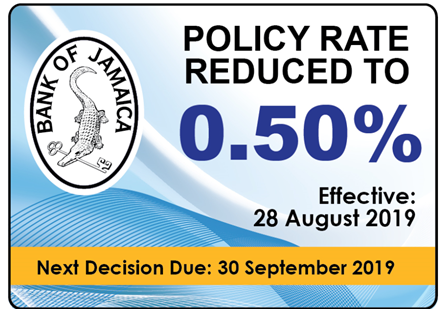
BOJ cuts overnight rate to 0.5%

Bank of Jamaica cuts the overnight policy interest rate by 25 basis points to just 0.50 percent, effective Wednesday, 28 August 2019.
According to the central bank, the decision reflects the bank’s assessment that inflation is projected to average 4.3 percent over the next eight quarters, within the inflation target of 4 percent to 6 percent. Over the medium term, the forecast is for inflation to gradually approach the midpoint of the Bank’s target, albeit at a slower pace than previously expected. The inflation forecast is mainly predicated on the continued impact of low domestic demand conditions relative to the economy’s capacity, slower growth among Jamaica’s main trading partners and declines in international commodity prices. It also accounts for the impact of imminent changes in the fuel mix in the domestic energy sector on electricity rates.
As with previous reductions, the latest lowering of the policy rate is intended to stimulate a faster expansion in private sector credit, which should lead to higher economic activity.
Annual inflation to July 2019 reported by the Statistical Institute of Jamaica was 4.3 percent, up from 4.2 percent to June 2019 and 3.2 percent to July 2018. The marginal uptick in inflation mainly reflected the impact of increases in the prices of food items as well as an increase in electricity rates, BOJ stated. With this outturn, inflation remained within BOJ’s target of 4 percent to 6 percent for the third consecutive month.
Bank of Jamaica anticipates that inflation will decelerate to 3.7 percent in September 2019, as energy-related prices, fall before accelerating to 4.7 percent by December 2019 as food price inflation accelerates in the context of hot, dry weather conditions.

BOJ interest cuts overnight rate.

Inflation is expected to be supported by continued growth in domestic economic activity, partly in response to the lowering of the policy rate over the last eight quarters.
Over the March 2020 to June 2021 quarters, inflation is projected to remain low, in the range of 3 to 5 percent, mainly reflecting the impact of lower oil prices, more efficient domestic energy generation and low inflation among Jamaica’s main trading partners. The influence of these factors will, however, be offset by the impact of Bank of Jamaica’s past monetary accommodation.
Inflation is projected to return to the midpoint of the target, slowly over the ensuing three years. Of note, the projected trajectory of inflation is lower than previously forecasted. This reflects the Bank’s view that inflation expectations are lower than previously assessed and that the projected pace of expansion in domestic demand in the period will be slower due to headwinds from the global economy.

Sharp slash to interest rates

Bank of Jamaica slashed their overnight policy interest rate by a hefty 50 basis points to 0.75 percent per annum, effective 20 May 2019.
This decision reflects Bank of Jamaica’s assessment that inflation will remain low for until the end of 2020 as well as provide added stimulant for faster economic growth.
The reality is that there is a huge disparity between the move by the central bank and government policy. While the central bank lowers the rate to stimulate the economy, the government has artificially helped in keeping bank lending rates much higher than needed by taxing customers of banks by high taxes on banks that is resulting in interest rates being around 3 percent points higher than they should. This is where the focus needs to be and not on lowering on savings rate.
Low inflation is here to stay, despite the central bank’s continued focus on an excessively high 4 to 6 percent range. The lowering of interest rates is hurting savers particularly pensioners who have to rely on savings.
According to Bank of Jamaica, the decision is intended to stimulate an even faster expansion in private sector credit which should lead to higher economic activity, consistent with the inflation target. The move also comes at the same time that the bank announced the lowering of the cash reserves that commercial banks need to keep with the central.
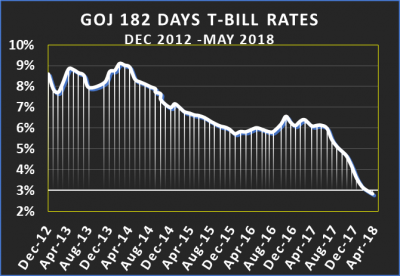
What are the implications, investors looking for yields on local bonds will be getting less on the dollar for savings. Stocks will become more attractive as dividends in a number of cases are paying more than Treasury bill rates that sits at 2 percent per annum. Real estate will benefit from more demand as an alternate form of investing.

2018 interest rate cut was big buy signal

Apartment complex in Kingston – Real estate values to benefit from low interest rates.

Declining interest rate is a huge buy signal for both stocks and real estate investments. If the decline in rates is expected to be prolonged then investors will swicth their investments to take advantage of opportunities elsewhere.
Last year this publication boldly advise readers that the drop in interest rates by the central bank was a huge buy signal for stocks and that investors should be piling into stocks and real estate. Some were skeptical, clearly unaware that there are really two major factors driving stock prices – interest rates and profits. Interest rates have fallen to the lowest levels on record, in Jamaica.
Many who consider the present values of stock to be ioverpriced not factoring the major cahnge the falling rates will have on valuations of both stocks and real estate. A few companies may overpriced currently, but not the vast majority. The incredibly low interest rates being enjoyed by many Jaamicans are not about to change substantially, any time soon. While the low rate of 1.7 percent on treasury bills reached in 2018 won’t last forever, it is expected that it will not go up too far from current levels of just over 2 percent, any time soon.
In May last year, Bank of Jamaica cut the overnight policy rate, by 25 basis points to 2.5 percent that along with a decline in short term Treasury bill rates at the same time.
IC Insider.com stated then, that the moves provided more ammunition for a big surge for Jamaican stocks. The piece went on to state that with a 15 percent fall in BOJ’s policy rate in 2018 so far, stocks are lagging behind, with an increase of just 6.6 percent for the Junior Market and 4 percent for the main market.
The fall in Treasury bill rates was far greater than the rise of the All Jamaica Composite Index, an indication of a lot more upside for stocks based on the downward movement of interest rates.
Investors seem then to be focusing more on profits in valuing stocks than on interest rates so far. That will change the article suggested. The fall in the overnight rate at that time, translated to a 9 percent rise in stock market prices, but rates seem likely to decline some more before settling off, providing more ammunition for greater gains in stock prices.
We stated that with the fall in interest rates, the PE of money is at the high end 40 times income and using corporate bond rates around 12 times, but the PE ratio should be more tied to Treasury Bill rates and that PE is now in 30 range but stocks are mostly in the low teens and below. IC Insider.com further stated that most investors did not appear to be paying much attention to the tsunami that was on the way that will see prices move sharply higher.
With just over five months of 2018 passing, investors have not only warmed to the fall in rates but many are not willing to part with their stocks. Late comers to the party will pay much higher prices than in May and June. Then the Junior Market was up 24 percent and the Main market 31.7 percent and rising. Technical reading of the market suggest that the Main market has another 25 percent run to make before probably cooling for a charge to 720,000 points on the All Jamaica Composite Index in 2019.
The fall in interest rates makes it cheaper to buy real estate with lower interest rates for each dollar borrowed. Additionally, investors will switch funds from fixed interest investments into stocks and real estate thus driving up their values.
Note that this is an updated version of an article posted last year after Bank of Jamaica cut their overnight policy rate.