Dolphin Cove Buy Rated again

dolphinsDolphin Cove now placed on the IC Insider’s Buy Rated list. The company is projected by IC Insider to earn $1.50 per share for 2016 after tax or 44 percent up on the earnings per share for of $1.04 for 2015. If the company achieves the above earnings the PE ratio would be 7.5 times 2016 estimated earnings, versus 8 for the average of the junior market.
As the year roles on the price is likely to increase, based on valuation of 14 times 2015 earnings, placed on the junior market, suggesting the possibility of the price doubling within a year. In addition the company pays regular dividends and this will add to returns investors will get from this stock.
First quarter results to March hit a profit after tax of $185 million for a strong increase of 39 percent above the corresponding period in 2015. The improved profit came from an increase of 11 percent in revenues to $520 million, due primarily to a 35 percent growth in ancillary revenue. Gross profit increased by 14 percent as a result of the growth in revenue and a decline in direct cost of sales while increase in operating expenses was up 5 percent over the 2015 cost to reach $297 million. There was new operating and administrative costs which the directors’ state contributed to the improved service delivery.
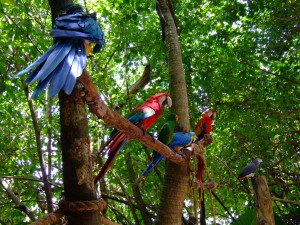
Birds at Dolphin Cove property in Ocho Rios

Birds at Dolphin Cove property in Ocho Rios

“During the quarter the Group made capital expenditures of $130 million to improve the facilities of the Parks which is expected to have a positive impact on our performance going forward. A dividend of 20 cents per share was declared in April and will be paid in second quarter of 2016. The Group was in a strong financial position as at the end of the quarter with improvements in working capital and net assets. We continue to expand our marketing efforts in anticipation of the additional rooms that are expected to come on stream during 2016 and there is the prospects of increased local sales with the recent opening of the Caymanas to Ocho Rios toll road which will significantly reduce the travelling time from Kingston. We also anticipate that our new enhanced website will continue to generate growth in our internet bookings and by extension our revenue. The financial resources of the group remain strong and this will facilitate our plans to expand our operations locally and in other Caribbean countries” the directors stated in their report to shareholders.
The company ended with cash and investments of $385 million, borrowings of $210 million and equity of $2.9 billion.
The stock last traded on the junior market of the Jamaica Stock Exchange at $11.10, but has a bid to buy at $11.25, with offers starting at $12.

JMMB Group reports increased profit

JMMB Group reports 12.3% increased 2016 profits

JMMB Group reports 12.3% increased 2016 profits

JMMB Group reports improved profit of 12.3 percent for the year to March 2016, of $2.3 billion, versus $2.05 billion in 2015 or earnings per share of $1.39.
The improvement flowed from increased net operating revenue net of interest expense of $11.42 billion from $10.32 billion in 2015 but increased cost helped keep the net position down as cost rose sharply by 12.8 percent to $8.78 billion from $7.79 billion in 2015.
Helping in the growth is an improvement in net interest income of $5.5 billion versus $5.26 billion in 2015 and a big jump in net gains on securities trading of $4 billion up from $3.4 billion in 2015.
The company’s stock trades at $9.50, down from $9.99 from Monday’s closing price, in the morning session on the Jamaica Stock Exchange today. The stock now trades at a PE of 6.8 times the 2016 earnings.
The company recently, declared a dividend of 18 cents per ordinary share, to be paid on June 30, 2016 to shareholders, on record as at June 10.

Cable & Wireless reports profit

CW flow hqCable & Wireless reports profit for the year ending March of $1. 2 billion, up from a loss of $8.9 billion in 2015. The company got help from net exceptional credit of $1.2 billion, even without this credit, the company made a small profit after finance cost but before taxation.
Importantly, C&W made an operating profit in the second half of the year of as Mobile revenues climbed by 22 percent.
The exceptional income stems from a reversal of $3.4 billion of restructuring cost written off in the 2015 fiscal year offset by employment restructuring cost in 2016. The company reports profit of $178 million in the March quarter compared with $486 million in the December quarter.
Revenues for the group rose moderately to $23 billion from $21.9 billion in the 2015 period while operating expenses fell to $15.8 billion from $17.4 billion but depreciation rose to $2.3 billion from $1.7 billion. Amortisation cost climbed to $1.1 billion from $848 million while finance cost remained fairly steady at $3.9 billion.
The company’s stock trades at $1.48 up 10 cents in the morning session from Monday’s closing price, on the Jamaica Stock Exchange today.

Shameful, does the JSE care?

Glnr 21834 Investments, (formerly The Gleaner Company Limited) advised the Jamaica Stock Exchange that the Audited Annual Financial Accounts for March, 2016 will be late and unavailable for publication by May 30, 2016. 1834 anticipates that it should be available for publication on or before June 30, 2016.
This is bad news for investors and bad news for the capital market. Both the Stock Exchange and the Financial Services Commission who overseas such matters should hang their heads in shame for such failure that have deprived investors of getting important financial information on the company’s operations for more than 8 months.
In the past several companies have changed their year end, as recently as late last year Desnoes & Geddes and Access Financial changed their but provided investor with results for all relevant quarters, but the Gleaner Company who changed theirs to March from December did not do so. Regulators of the Stock Exchange gave some clumsy excuse why they could not ask for the December quarter results.
The rules of the Stock Exchange are quite clear, listed companies are required to submit a quarterly interim financial report within 45 days of each quarter. In the case where a company opts to release an audited account within 60 days of the year-end, they can opt in lieu of a quarterly report within 45 days.
The focus is on reporting quarterly, that comes before the audited. What seems to escape the regulators at the Exchange is that investors are kings and queens and they are to one to be foremost in the minds of the regulators to ensure that their investment is protected. One of the main means is timely financial information. If the exchange understood this they would have ensured that the Gleaner Company would be demanded to release the December results within 45 days.
Based on the exchange’s inadequate surveillance we now have a situation where the Gleaner Company (now 1834 Investments) have not reported financial for what looks like 6 months and who knows when it will release the information.
Markets thrive on information and that is the reason why the JSE opted long ago to the publication of quarterlies rather than a six months interim and it has served investors well.

First Global’s big year

FGB2015 was a big year for the Grace owned First Global Bank in recording a strong 39 percent increase profit after tax to $440 million over 2014. The strong growth emanated from a sharp increase in Loans and advances of 23 to $21.8 billion at the year end helping to drive interest on loans by 23 percent to $2.56 billion.
Net interest and other income amounted to $3.7 billion versus $3 billion in the previous year, for 25 percent increase.
Customer deposits grew 10 percent to $24.6 billion but interest cost grew to $566 million from $521 million for depositors.
The bank, one of the smaller one in Jamaica enjoyed growth in interest income by over 20 percent for the 2015 financial year over the 2014 as they posted interest revenue of $3.6 billion compared with $3 billion for 2014. Interest cost grew 11.3 percent from $893 million in 2014 to $992 million in 2015.
Fees and commissions recorded significant growth of 32 percent moving from $724 million to $956 million for financial year 2015. Foreign exchange gains grew 16 percent to $231 million, while gains on investment activities more than quadruple from $25 million to $116 million.
A 28 percent increase in staff costs helped to push operating expenses to $3.3 billion, for a 25 percent increase over the 2014 period. The bank’s asset grew by over 12 percent to $47 billion against $42 billion recorded for 2014 and shareholders’ equity climbed to $7.2 billion from $6.9 billion in 2014.
While profit had climbed sharply, close to half a billion, corporate taxation was ended being nil as tax free income wiped out any likelihood of a tax liability for the year.

Flour pressed into more profit

NFM logoProfit after tax grew to TT$9.2 million up marginally from $9 million for the March quarter, this year at Trinidad’s National Flour Mills, from declining revenues of $111.2 million compared with $121.5 million in the 2015 quarter.
The company enjoyed earnings per share of 8 cents, compared with 7 cents in the 2015 quarter and 28 cents for the full year, in 2015 and could end up around 32 cents for the 2016 if the current trend continues.
The lower revenues “reflect the contraction in demand locally, and some timing differences with respect to large export orders which the company now pursues vigorously. Cost containment measures continue to provide the cash cushion to execute planned capital projects. Thus, growth in the regional export markets and more local content are priority strategies to improve both our sales revenues and foreign currency position” says Chairman Mike Bazle in his commentary accompanying the company’s quarterly results.
“It is thus important to note that the current economic environment continues to challenge the Company, particularly with respect to the timely supply of foreign exchange which is central to the financing of NFM’s grain purchases. When taken together with the cost implications of declining TT currency values, the company’s intention is to manage these additional costs, as key priorities, in order to ameliorate the impact on our customers,” the Chairman went on to say.
Despite the falling revenue, gross profit rose from $29.8 million to $31 million while Selling and distribution expenses were static at $7.8 million and Administrative expense declined to $10.74 million from $11.85 million.
Borrowing funds jumped to $122.78 million from $94 million compared to shareholders equity of $204 million.
The company is listed on the Trinidad and Tobago Stock Exchange and last traded at $2.20, with a PE around 7 times this year’s earnings and is priced below the average stock on the TTSE market. With recession and devaluation of the Trinidad currency investors are not aggressive in picking up stocks.

Stock split revs Pan Jam’ stock not profit

pan_jamaican_logo280x150Pan-Jamaican Investment Trust (Pan Jam) recently announced a proposed 5 for 1 stock split which sent the stock flying to $125 from below $90. The company also announced a second dividend for the year with the stock trading ex-dividend on May 27. The dividend is for 75 cents per share, payable on June 22, to shareholders on record as at May 31.
The latest payment makes the second dividend of the same amount in March this year. In June 2015, the company paid a dividend of seventy cents per shares.
Pan Jam also advised that on May 13, four members of the management team were issued stock grants under the Long Term Incentive Plan totaling 242,691 shares.
The group reported net profit attributable to owners for the quarter ended March of $721 million, up from $542 million in the 2015 first quarter, an increase of 33 percent. Earnings per stock unit amounted to $3.44 compared to $2.59 for the same period in 2015. Earnings from ongoing operations seem headed for $15 per share for this year.
Performance for the quarter reflect a gain of $185 million arising from the divestment of shares in Hardware and Lumber and an increase of $149 million in the share of associated company and joint venture companies’ results. These more than compensated for decreases of $43 million and $84 million in property and other income respectively.
Property income was reduced by lower rental income as a result of a reduction in average occupancy from 85 percent in March 2015 to 81 percent in the current year as well as reduced booking of property revaluation gains. In the first quarter of 2015, other income increased by a one-off lease buyout amounting to $87 million. Operating expenses increased principally as a result of pension costs related to the reorganisation of the group’s pension arrangements as well as amortization of new property management software. Operating expenses rose to $288.59 million from $259.57 million while Finance costs rose sharply to $130 million from $94 million.
Total assets amounted to $28.3 billion at the end of March while stockholders’ equity increased to $22.4 billion, equating to a book value per stock unit of $106.86.
Since Pan Jam announced the stock split, the stock rose to $125 on the Jamaica Stock Exchange, up from $88 at the beginning of May.

Pulse needs a mentor of sorts

Kingsley Cooper Chairman of Pulse

Kingsley Cooper Chairman of Pulse

Pulse Investments needs an infusion at the directorship level as they have telegraphed time and again that they have a board that lacks knowledge to effectively guide the company and protect investors. This was made clear when directors responded to questions from minority shareholders and how badly they handled the proposed rights issue.
Subsequent to the annual general meeting, the directors pushed through an extraordinary meeting to consider and approved a rights issue. The legitimacy of that meeting is in question. For one the Jamaica Stock Exchange that should have been advised of the proposition a week ahead of the board meeting to consider the rights and the results of the meeting within 48 hours was not done until a few days ahead of the meeting. More importantly, the notice sent to shareholders did not meet the minimum 21 days required by law as the notice was posted around 19 days before the meeting date.
The board at the AGM admitted they were unaware that they could have submitted interim results in the past when the audit of a prior period was incomplete.
Now the company has released its nine months results showing profit of $191.5 million versus $148 million for the nine months of 2015, and $58 million compared to $48 million in the March quarter. The profit includes fair value gains on investment property of $26 million in the quarter and $78 million for the nine months. Revenues came in at $65 million for the quarter versus $57 million in 2015 and for the nine months revenues were 17 percent ahead of 2015 at $216 million.
The company paid a dividend of 6 cents per share in January this year but it is nowhere to be found in the interim statement. It should be shown as a separate line item on the cash flow statement as well as in the statement of changes in equity. Then on the list of directors’ holdings Oliver Holmes who resigned from the board some time ago is still shown in the list as a director but with no shares owned.

Kingston Wharves Q1 profit jumps

KWH HQ 3Profit before taxation for the March quarter Kingston Wharves jumped 53 percent from $212 million in 2015, to $325 million in 2016. Net profit attributable to shareholders was 48 percent higher at $276 million over the $187 million generated in the similar period in 2015 and resulted in earnings per stock unit of 19 cents, up from 13 cents in 2015.
The strong growth in profits stemmed from revenues that rose 18 percent to $1.2 billion for the quarter, the growth came from an increase of 18 percent from terminal operations and 17 percent from Logistics and Ancillary Services.
“The Group generated revenues of $943 million from terminal operations, with significant contributions from increases in domestic container and motor units. Domestic container and trans-shipment motor units volumes both grew by 20 percent while domestic motor units realized a significant 64 percent increase over the prior year. Kingston Wharves anticipates continued growth in this key segment for the remainder of 2016 as we perfect both our business development and marketing strategies and continue to gain greater operational efficiencies” Jeffrey Hall, Chairman reported to shareholders in their report accompanying the quarterly.
Logistics & Ancillary Services| “The Logistics and Ancillary Services segment also realized significant advances, with total revenue of $257 million. This was attained primarily as a result of the expansion of our local and international customer bases through aggressive market outreach and improved service levels and capabilities in line with Jamaica’s Logistics Hub Initiative,“ Hall, further stated.
Gross profit climbed well ahead of revenues, at 34 percent over the 2015 period and was major factor contributing to the profit gains as well as Administrative expenses that increased by 19 percent to $236 million. Finance costs rose marginally to $39.7 million from $37.2 million while taxation almost doubled to $45 million.
Stockholders’ Equity stood at $17.7 billion and borrowed funds at $2.33 billion at the end of March while short-term investments and cash funds amounted to $3.3 billion. In 2015 the company reported net profit of $1.26 billion or 88 cents per share, for an increase of 49 percent over the $843 million earned in 2014.
The stock last traded on the Jamaica Stock Exchange at $11.65.

JSE first quarter results jump

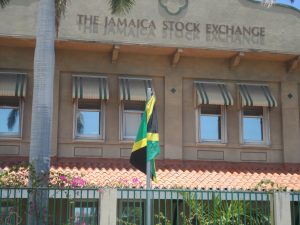
JSE frnt 2Jamaica Stock Exchange reported a 44 percent jump in the first quarter profit to $126 million, from $87 million in 2015 for the three months ending March. The growth in profit flowed from revenues of $327 million, a 29 percent increase over the $253 million in 2015. The increase this year comes against the background that the quarter in 2015 results came from a loss position of $2.3 million.
Earnings per share ended at 89 cents in 2016 versus 62 cents in 2015. Profit before tax, grew from $130 million in 2015 to $187 million, with tax taking $61 million in the 2016 first quarter from $43 million.
Revenues growth benefited from increased trading activities this year over 2015, new business from the handling of repo business and from a big trade in the shares of Desnoes and Geddes, in 2015 there was a large trade in the shares of Scotia Group.
Expenses climbed at a slower pace than income, with an increase of 16 percent to end at $150 million. Wages climbed from $46 million to $57 million due to salary increases and additional staffing. Advertising and amortization is up from $14 million to $20.7 million, while other operating cost rose by $10.6 million from $5 million.
At the end of the quarter, cash and equivalent stood at $589 million and equity capital climbed to $751 million up from $649 million at the end of March 2015.
JSE’s stock traded on the Jamaica Stock Exchange with the price closing at $21 on Thursday.