The year just past may have been a terrible one for many, for at Grace Kennedy, they have much to be thankful for and management wish must be for another repeat performance like 2020.
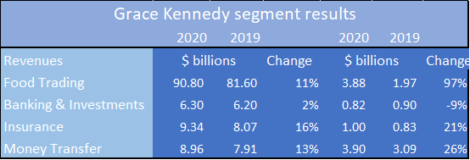
 Grace reports record profit of $6.2 billion attributable to shareholders for 2020, jumping 39 percent from $4.49 billion in 2019 after taxation more than doubled to hit $2.85 billion for an increase of 178 percent.
Profit before tax rose a strong 58 percent compared to 2019 to end at $9.7 billion. Importantly profit before other income jumped a stunning 82 percent to $6.8 billion while other income rose 20 percent to $3 billion. In what was a spectacular year for the 100 years old company, revenues grew 12 percent to $115 billion, surpassing the $99 billion generated in 2019. Direct and operating expenses rose 9 percent to $109 billion. Other comprehensive income brought total profits to $9.2 billion versus $9.26 billion in 2019.
The groups’ segments had a mixed performance, with Food trading profit almost doubling from 11 percent rise in sales while Insurance and Money transfer contributed 21 percent and 26 percent in profit but banking and Investments fell.
“GK’s Food Trading segment saw improved revenue and profitability primarily due to the outstanding performance of its international food businesses. GraceKennedy Foods (USA) LLC showed triple digit increase in gross profit and marked growth in revenue, with the Grace and La Fe brands recording growth and improved margins; and GK’s Jamaican food distribution business recorded strong growth in both revenue and pre-tax profit, coupled with improved operating margins,” a release from the company stated.
 The group earned 6.26 per share for the year versus $4.51 in 2019 and the stock price closed on Friday with a last traded price of $84.50 for a PE ratio of 13, well below the market average of 20. ICInsider.com projects 2021 earnings of $11 per share and see the stock heading close to $200 for the year and receives the coveted IC BUY RATED stamp of approval.
Total shareholders’ equity stood at $29 billion at the end of December, up from $27 billion in 2019. the group paid $1.59 billion in dividend during the year, up slightly from $1.54 billion in 2019.
2020 a great year for Grace Kennedy
Q4 profit jumps 76% for Honey Bun
The Easter bounce in earnings never happened for Honey Bun with sales in the March quarter up 13 percent and the June quarter down 7 percent, but fourth quarter sales compensated for the June fall out, increasing a strong 15.5 percent.

Rising profit at Honey Bun
Profit after tax in the fourth quarter rose a healthy 76 percent to $54 million from $31 million in 2019, bettering the 21 percent rise in the June quarter, to $20.4 million from $16.7 million. For the year to September, profit increased just 6.6 percent to $167 million from $156 million in 2019.
Sale revenues rose 15.5 percent for the quarter, to $432 million from $374 million but rose 8.5 percent for the year, to $1.675 billion from $1.544 billion in 2019. The company manufactures and distributes baked products in Jamaica and overseas, with overseas revenue less than 10 percent of gross sales revenue.
Historical profit performance has not been exhibited a predictable pattern, partly due to expansion related cost. Profit jumped sharply in 2016 from 2015 but dipped in 2017 and again in 2018 but rose in 2019 as a recent expansion allowed for increased sales, with the latest period continuing to reflect growth but muted by the COVID 19 dislocations.
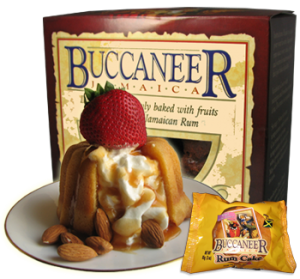
One Honey Bun’s Products.
Notwithstanding the profit performance that may present a chequered path, the company has one of the best management teams of Junior Market companies to build-out the capacity for continued growth in revenues and increased efficiency.
Gross profit margin moved up from 46 percent in 2017 and has been consistent at 48 percent since 2018 and resulted in gross profit rising nine percent to $799 million from $745 million.
Administrative and other expenses rose just one percent to $295 million, while depreciation charges relating to administrative expenses increased 28 percent to $48 million. Selling and distribution expenses rose 17 percent to $292 million from $250 million in 2019.
The company employed an average of two hundred and seven workers during the year, up from one hundred and eighty in the 2019 period costing $428 million compared to $406 million in 2019.
Finance cost was negligible at just over $1 million for the year.
Earnings per share came out at 35 cents for the fiscal year. The stock traded at $4.83 on the Junior Market of the Jamaica Stock Exchange at a PE ratio of 14 times earnings. ICInsider.com is forecasting 55 cents per share for 2021 at a PE of 9 times. Net asset value is $1.85, with the stock selling at 2.6 book value. The company paid a dividend of 8 cents d 20uring the year.
Gross cash flow brought in $260 million but increased working capital reduced the amount marginally to $253 million and payment of dividends amounting to $38 million acquisition of fixed assets amounting to $119 million and the payment of $27 million in taxation left $98.5 million to be added to funds on hand at the start of the year. Current assets ended at $444 million, including inventories of $71 million, receivables of $73 million, cash and bank balances of $297 million. Current liabilities stood at $148 million. At the end of the year, shareholders’ equity stood at $870 billion, with borrowings at just $26 million.