 Barita Investments profit after tax dropped 21 percent to $46 million for the quarter ending December 2014 compared to the similar period in 2013, from total revenues of $345 million and net operating revenues of $177 million. In 2013, the company that is involved in stockbroker and fund management reported net operating profit of $165 million but increase expenses helped to pull down profit for the quarter.
Interest Income contributed $230 million to revenues, 15 percent below the prior year, while related interest expense remained flat at $168 million.
Barita is suffering from a mixture of assets priced for shorter periods than the funds clients’ invest with them. According to Chairman Rita Humphreys, “in an environment where interest rates have decreased, our liability costs have been similarly reduced resulting in our interest expense decreasing to prior year levels. However, with our investment portfolio comprising of approximately fifty percent variable instruments, our interest income has decreased at a faster rate. This has resulted in a significant contraction in our margins resulting in a recorded net interest income of $62 million, approximately 36 percent down from prior year.”
Fees and Commission income rose 65 percent above prior year to $38 million, with improvement coming from the subsidiary Barita Unit Trusts. Additionally, trading gains were 600 percent above prior year at $48 million compared to only $8 million in 2013. Depreciation of the Jamaican resulted in translation gains of $21 million down from $29 million prior year.
“Staff and administrative expenses contributed to a 16 percent increase in operational costs when compared to the same period last year. Staff costs increased by 10 percent which was triggered primarily by additional human resources and remuneration adjustments. Administrative costs were 25 percent higher than last year, with the main contributors being financial support for our charity arm the Barita Education Foundation and client support expenses,” the report to shareholders stated.
Interest rate developments, with Treasury bill rates continuing to fall and the change in the method relating to the repo business could put further pressure on income for a while. At the end of the quarter fair value reserve amounted to $107 million which could be realised in subsequent quarters and thus boost earnings. Falling T-Bill rates should result in gains in longer term Jamaican fixed interest rates securities and pickup in interest now seen in the Jamaica stock exchange is likely to hand Barita increased fee income during the balance of 2014.
Lasco Manufacturing profit climbs 19%
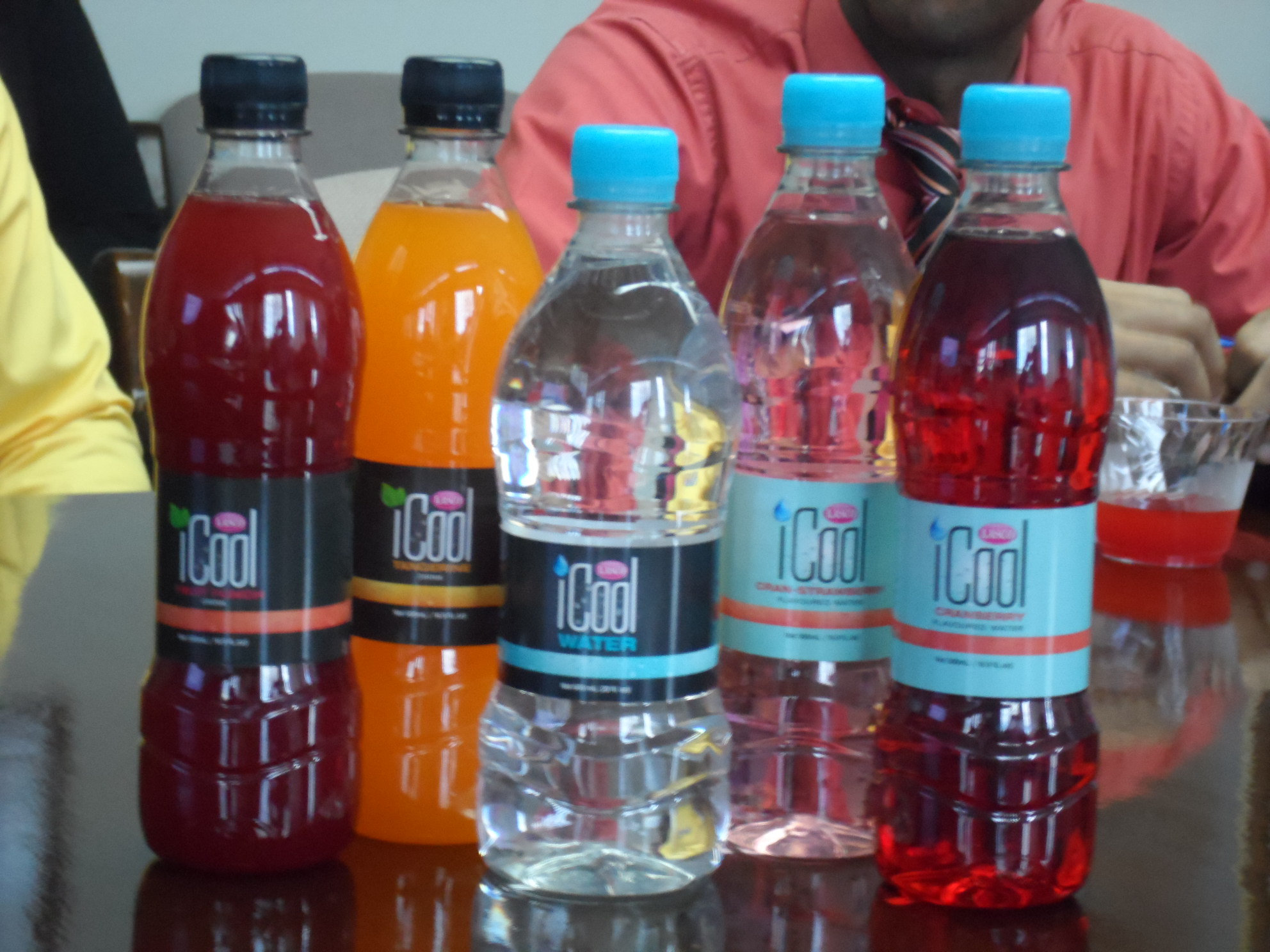
Lasco’s new I Cool drinks – demand exceeded supply in the December quarter
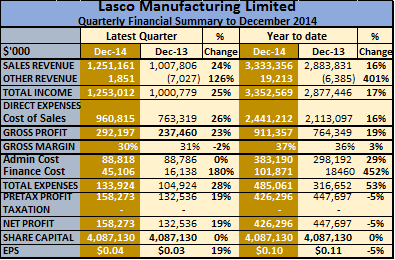
Revenue for the nine months to December increased by 16 percent to $3.3 billion. “This performance was mainly due to increased sales volume in the export markets as well as the introduction of the iCool line of products. The export division revenue year to date, shows a 53 percent growth over the same period in the 2013” Dr. Eileen Chin, Managing Director stated in her report accompanying the financials. Additionally, finance cost increased in the quarter, as well as year to date, with the quarterly figure rising 180 percent to $45 million and the nine months, to $102 million from just $18 million in the prior year’s nine months period, much faster than the increase in revenues. The increases above helped to pressure profit for the period, resulting in slight 5 percent reduction in net profit for the nine months, amounting to $426 million, from the prior year.
 “There was also an increase in operating expenses during the period due to a significant investment in marketing to support and promote the introduction of our new iCool line,” Chin also states in her report. “Operationally, we are meeting our growth milestones. Lasco Manufacturing is well positioned in the current environment to deliver increased growth. We have completed a significant transformation that provides us with a strong asset base. Importantly, we expect strong growth in the 2015-16 financial year driven by ongoing success in our local and export markets. The integration of our business process and product extension portfolio has contributed positively to this quarter’s results. This integration is also expected to have further positive impact on profitability during the 2015-2016 financial year. We are on target to deliver on the promise to improve efficiencies and productivity, reduce operational costs, and increase product portfolio, sales and profitability”, said Chin.
Lasco recorded gross profit margin of 30 percent, in the December quarter from 23 percent in the same period in 2013, the margin, year to December, is 37 percent. Administrative and marketing expenses were flat in the quarter and up 29 percent year to date, compared with the prior year.
Earnings for the full year to March should end up around 15 cents per share. With new products to be added to its portfolio when the dry products factory is activated, revenues going forward should grow strongly. Increased finance cost and depreciation charge will be a drag on earnings for a while. At a stock price of $1, the stock is a buy to benefit from strong future income and above average profit growth.
Shareholders’ equity stood at $3 billion at December, borrowed funds stands at $1.4 billion. Work in progress stood at $2.26 billion, this amount relates to the dry product factory and when completed will swell fixed assets to $3.3 billion but it will result in increased depreciation charge and the funding for it will result in finance cost hat was being capitalised being expended against revenues.
Lasco Financial profit up 50%
 Profit at Lasco Financial jumped a noticeable 50 percent, in the December 2014 quarter, on rising revenues of 11 percent. The company recorded profit of $68 million in the quarter versus $46 million in 2013 and recorded a 33 percent rise in its nine profit to $181 million from $136 million.
Lasco reported improvement in gross profit margin of 152 percent, in the December quarter, from 108 percent in the same period in 2013, the margin, year to December, is 155 percent from 137 percent in the nine months of 2013. Administrative expense rose by 8 percent for the quarter and 13 percent year to December while marketing expenses fell 8 percent in the quarter but was up 9 percent year to date, compared with the prior year, but still below the rise in revenues.
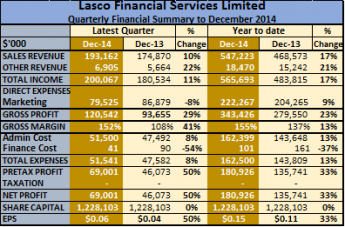 Earnings per share for the quarter amounted to 6 cents and for the nine months 15 cents. Earnings for the full year to March should end up around 20 cents per share. The stock now priced at $1, remains a buy, with prospects for increased profits for 2015/16.
The company is listed on the Jamaica Stock Exchange junior market and is primarily involved in cambio and money transfer and has with equity of $795 million no debt, and cash funds of $502 million.
Lasco Distributors profit climbs 69%

Peter Chin – CEO Lasco Distributors
 The company is listed on the Jamaica Stock Exchange junior market, has virtually no debt, is yet to book its successful legal claim against Pfizer and boast equity of $2.7 billion and cash funds of $608 million. The company is to build out a new warehouse for housing the increased need of space for new product lines they represent, the building has already been bought and booked in the accounts.
Boeing $24b sales just beat Apples’ $18b Profit

Fly Jamaica’s Boeing jet
Those are impressive numbers for a huge corporation and against a rising United States dollar that is likely to affect cost and sales, but the numbers pale in contrast to Apple’s $18 billion profit in one quarter, on sales of US$74.6 billion, based on rising iPhones sales, in the December quarter.
Boeing in its release of the full year results stated that “core earnings per share guidance for 2015 is set at between $8.20 and $8.40, while GAAP earnings per share guidance is established at between $8.10 and $8.30. Revenue guidance is between $94.5 and $96.5 billion, including commercial deliveries of between 750 and 755.”
Apple provided the following guidance for its fiscal 2015 second quarter, revenue between $52 billion and $55 billion, gross margin between 38.5 percent and 39.5 percent and operating expenses between $5.4 billion and $5.5 billion.
Cargo Handlers profit up 43%
Junior market Cargo Handlers, reported their first quarter results to December, last year, continuing the strong growth trend of the 2014 fiscal year, with another impressive increase in operating revenue which jumped 40 percent over 2013, to $62 million. Profit was up by 43 percent to $40 million, ending with earnings per share of 96 cents. Other income fell from $6.8 million to $341,000.
Trading on the Junior Market was very low but for lack of buying interest but more due to sellers holding out for higher prices and in a number of cases there is no selling interest for nearly a third of the listings.
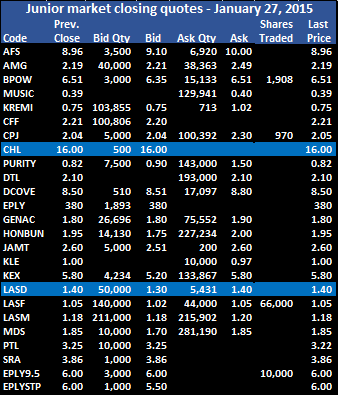 The market closed with only 4 securities traded and ended with 78,878 units valued at $142,210. The JSE Junior Market Index declined 0.35 points to close at 692.76, with the price of 1 advancing and none declining. At the close, there were 5 stocks with bids higher than their last selling prices and only 1 stocks with the offer that was lower. The junior market closed with only 3 securities closing with no bids to buy. There were 7 securities that had no stocks being offered for sale.
Stocks trading are, Caribbean Producers closing with 970 shares and gained 1 cent to $2.05, Blue Power ending with 1908 units changing hands at $6.51, Eppley 9.5% preference share traded 10,000 units at $6 and Lasco Financial ended trading with 66,000 shares at $1.05.
Sagicor Expensive Real Estate Fund
Sagicor Real Estate X Fund has been selling significantly above its IPO price of $5 and has since risen by 40 percent to $7, making it one of the better performing stocks on the local stock market since listing.

One of the properties in the fund
Of import is the seasonality of the hotel operations—high income and profits in the period between December and April, July and August, and lousy in the other months, which are usually loss making months. Sagicor Real Estate X Fund had assets of $9 billion at the end of September and net book value of $6.09. The stock price is $7, for a near 20 percent premium, which is well over the market.
The fund with 1,495,336,750 shares issued, boasts a very high PE ratio of 12, which is far greater than the other stocks in the market, and without the growth prospects of the vast majority of them. In a market that values stocks based on earnings generating cash flow, the valuation placed on the fund is even higher than the PE suggests and may be as high as a PE of 30. But that is the value that would be placed on a company
growing profits at 30 percent per annum. Earnings growth will not be there to drive the stock price compared to many of the quality listed stocks. The stock is now being valued on hype not reality.
The Sagicor Real Estate X Fund has a number of hotels, but many hotels have been notorious for not being highly profitable. There is also a great level of seasonality in performance in the sector. Income from other local properties will be steady as
most are rented on a long term basis.
The company has strategically invested in the Sigma Real Estate Portfolio, which holds a mix of hotels, commercial, industrial and warehousing properties. At this time, the only investment for the Fund is the units in the Sigma Real Estate Portfolio.
The Fund is 67.7 percent owned by the Sagicor Pooled Pension Investment Funds, which are administered by Sagicor Life Jamaica and is listed on the Jamaica Stock Exchange.
JSE stock moved to Buy Rated list
 The Jamaica Stock Exchange shares which were issued at $2.85 in the IPO in 2013, dropped last year to a low of $1.50 and the stock languished below $2 for months begging to be bought but with a few takers. This past week it hit $2.
At the close of last week, there was a bid in to buy 282,565 units at $2, but selling has dried up substantially. The prospects for the company is bright. Investors may be looking at 2014 performance to guide them, but it is 2015 onwards where the exciting times will be, this why IC Insider moved the stock from Market Watch to Buy Rated.
For the nine months to September last year, the JSE reported profit for the quarter of $11 million up from a small loss in the June quarter and for the first six months of the year. The big change in the September quarter resulted from a large block of shares traded that provided increased one-off income but also the recovery of $6 million in bad debts. For the year to September the JSE reported only $8 million in profit or a mere 6 cents per share, but bad debt recovered amounted to $10 million before tax. Revenues climbed to $89 million in the September quarter, an increase over the $73 million garnered in 2013. For the year to date revenues jumped $41 million to hit $242 million. Quarterly expenses climbed from $85 in 2013 to $91 million in 2014, and for the nine months, from $247 million to $273 million or just over 10 percent, a slower pace than the income growth of 20 percent.
 Based on these results alone, the stock would at best be a hold and more likely a sell. Investment is about the future more than the past, and the latter is where the attraction is. The local stock market is exhibiting all the signs of a bull market in 2014. The early trading for the year to date is mostly positive. Increased market activity will mean more income from trading transactions. Increased prices will result in much more income from annual listing fees in 2015. More securities were listed in 2014 and more are expected in 2015 which will result in increased listing fees and the possibility of increased trading opportunities going forward.
Some of the factors supporting the above can be found in strong technical indicators pointing to a strong market ahead, sharp decline in interest rates and projected low inflation. Additionally, the fall in the price of oil and other commodities on the world market will provide consumer with added disposal income to spend and this is likely to improve the profits of many listed companies and should result in increased gains in stock values and trading volumes. Political winds may be blowing over the market, with elections due by 2016, but that should not stop investors from picking the stock up cheaply, if they can, and await what will be a huge pay off in two to three years’ time as the market gets back to full life, in a low inflation, low interest rate environment. The JSE had cash and investments at the end of the period of $375 million equity of $571 million with no borrowed funds.
Caribbean Producers have been restored to the Buy Rated list based on strong revenue growth in the September quarter that suggest higher profits in the current year compared with the 2014 results.
AMG flat sales push profit down 15%
 Revenues rose a strong 36.56 percent for the year to August 2014 for junior market listed, AMG Packaging, hitting $607 million but it increased by a much slower pace of 28 percent in the final quarter of the financial year, to $165 million.
Those strong gains may have cannibalized sales in the November quarter with flat sales compared with 2013 quarter, with revenues of $151 million. But the performance comes against the back ground of volumes sold, climbing a very strong 19 percent for the year. The fall in volume started from the August quarter as units sold increased by 23.4 percent, management stated in a release accompanying the May results.
While sales increased impressively in 2014 fiscal year margins came under pressure with only 23.7 percent for the year to August down from 33 percent in 2013. For the latest quarter gross profit margin comes out at 25.9 percent but could end up at 31.5 percent for the current year if sales volumes increase by 10 percent for the rest of the fiscal year. Gross profit for the quarter amounted to $34.4 million up from $33.3 million in 2013 but increase mainly administrative cost that rose 28.4 percent eroded profit slightly by 15 percent to $15.4 million from $18 million in 2013. The company got a double whammy, with the Jamaican dollar losing value, resulting in a 28 percent more Jamaican dollars having to be found to purchase a US dollar since September 2012, and the price of paper on the world market moving 22 percent from US$720 per tonnes at September 2012 to US$830 in August 2013 and now US$875, which it has been since June last year.
Receivables are down by $12.7 million from the amount at the end of August last year and so too is amounts in payables by $26 million. Cash funds grew to $33 million from $22 million while inventories is down from to $118 million at August to $113 million, which is nearly 4 months supplies based on sales in the quarter and is up from just two and a half months back in 2013 and seems to be a hedge against devaluation of the Jamaican dollar. But that is only a part of the story. A check on world prices for pulp shows a pretty sharp increase since 2012.
AMG has to continue to grow its business by continued strong volume growth to become a more cost competitive producer with lower unit cost. The company needs to put strategies in place to return volume sales to growth and needs to continue cost containment measures to ensure profit improvement going forward. With increase through put, unit cost of production will fall allowing more growth in gross to flow into overall profits. A bright spot for the company is the fall in the cost of fuel and electricity will help in keeping cost down for the rest of the fiscal year.
IC Insider’s forecast for 2015 is 90 cents per share and $1.50 for 2016 on the assumption that volume sales return reasonable growth.
Jamaican Teas 2014 profit drops
 Jamaican Teas reported sharply lower profit, last year to September, of $52.7 million versus $93 million in 2013, with earnings per share of 31 cents. The figures were reported in the group’s audited financial statements release last week.
The results emanated from sale revenues of $1.14 billion down from $1.23 billion in 2013. There was approximately $50 million coffee sales included in the 2013 results with none in 2014. In 2013 the real estate segment contributed $185 million in revenues compared to only $26 million in 2014 with most coming in the September 2013 quarter.
Gross profit margin shrank slightly from 21.89 percent to 21 percent for the year, helping to cut gross profit by $17 million. Other operating income climbed to $24.7 million from $12.9 million in 2013, partially due to losses on sale of, and impairment of investments incurred in 2013, amounting to $13.5 million, but did not occur in 2014.

The Orchid property being developed that should add to Jamaican Teas’ profits in 2015 & 2016.
Changes in our distributorship in the Florida at the start of the fiscal year resulted in some short-term fall out in sales and increased marketing cost. A new distributor was appointed in the US market that will provide wider distribution in some key cities within that country. Revenues are expected to benefit from this development starting with the December quarter. The 2015 revenues, should also benefit from the completion of sales of 16 units in the first phase of the real estate development in St Thomas. The supermarket in Savanna-la-Mar was close to a break even by year-end and while the one in Kingston remained profitable. The Montego Bay supermarket reported losses in line with what was incurred in the prior year.
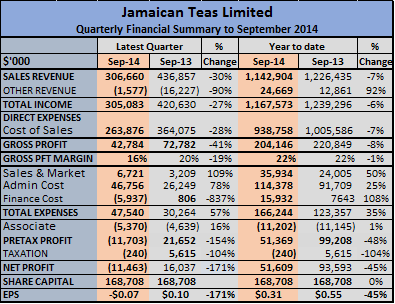 There was approximately $50 million increased borrowed funds at the end of the year, putting borrowings at $304 million. The profile of the debt changed markedly, with long-term loans accounting for two thirds of the debt at the end of the fiscal year compared with just 2 percent in 2013. The portfolio of investments including equities, stood at $123 million at the year-end and shareholders’ equity of $635 million.
The company imports of black and green tea in bulk for packaging and the distribution local and overseas. it also packages and distributes herbal teas and distributes other bottled water, coconut milk and other pre-packaged food items. the group operates supermarkets and is involved in the rental of residential properties and the development of real estate for resale.The stock is listed on the Jamaica Stock Exchange and last traded at $2.50.