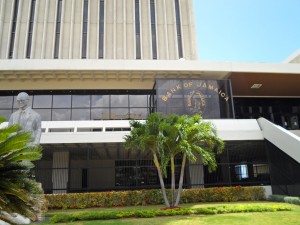
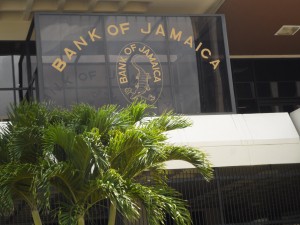
Jamaica’s Central Bank head quarters Downtown Kingston
The present arrangement where Bank of Jamaica requires foreign exchange dealers to surrender around 25 percent of their daily intake is to be phased out.
The central bank now considers the market deep and liquid enough for government entities to go directly into the market for their needs.
According to Bank of Jamaica, “the introduction of the buying side of B-FXITT will be synchronized with the gradual reduction of surrender and PSE requirements, and over time, these requirements will be terminated. This gradual transition will see more funds available in a more dynamic and transparent market.” Starting July 26, the central bank formally introduced an auction system for foreign exchange trading. The initial stage is the introduction of selling of funds to the market.
Bank of Jamaica (BOJ) currently purchases foreign exchange via three channels: regular surrender arrangements, the public sector entity (PSE) facility, and occasional direct purchases from individual financial institutions. The PSE facility in particular was considered a useful initiative to remove potentially distorting transactions from the foreign exchange market, but the central bank states that it is not flexible or synchronized enough to respond proportionately if a large entity experiences a sudden change in its foreign exchange needs. Also, while it began as a safeguard mechanism to protect a shallow and fragile market, the facility came with the price of a loss of transparency. Taking these and the surrender transactions out of the mainstream market means the market rate does not reflect the entire spectrum of foreign exchange transactions.
 BOJ says that “with economic fundamentals improving and the foreign exchange market growing deeper, Jamaica is evolving towards a stage where the market is robust enough to handle these transactions without BOJ’s protection, and so these government agencies can freely settle their transactions in the market without causing disruptions. The market will therefore become more accurate and transparent by reflecting all major transactions, and daily rates will be a more accurate and credible reference of overall market activity.”
These pending changes mean that BOJ’s standard method of buying foreign exchange will become the what the central bank states is the “same efficient, market-friendly and transparent tool which it now uses to sell”. “BOJ says it “will retain the right to buy or sell foreign exchange outside of the standard B-FXITT schedule at any time if extraordinary conditions warrant, but will likely utilize a B-FXITT-type operation at those times instead of bilateral transactions, which will ensure that these transactions reflect current market conditions and are settled transparently at market-determined rates. BOJ’s avoidance of bilateral transactions will also benefit the market by encouraging dealers to trade more among themselves.”
 The Jamaican dollar made modest gains In the foreign exchange trading on Friday to close 3 cents better to purchase one US dollar than on Thursday on a day that saw C$76,397,101 being sold (US$60,805,327 equivalent) at J$101.70 versus J$102.76 on Thursday.
 Inflows of all currencies into Jamaica’s forex market fell to US$44.14million, from US$58.03 million on Thursday while dealers sold US$101.2 million versus US$40.33 million, previously.
 Authorised dealers bought US$9,913,199 at an average rate of J$127.137 up to mid day on Thursday and sold US$5,243,960.45 at an average of J$127.769.
 The Jamaica dollar slipped below $128 to purchase one US dollar in foreign exchange trading on Tuesday for the first time since 2016.
 Jamaica’s foreign exchange dealers sold US$33 million more US dollars than they purchased this week, adding to the US$35.5 million net sales in the prior week.
 US currency purchases, accounted for US$33.81 million on Friday at an average rate of $127.23 compared to Thursday at US$36.57 million at $127.58. Dealers sold US$43.84 million at an average rate of J$128.22 versus J$128.41 for US$42.52 million, previously.
 The selloff of US dollars continued in forex market activities on Wednesday.
 The selloff of US dollars continued in forex market activities on Tuesday. While dealers raised the average buying price by $1.26 to $127.92 for the US dollar, up from $126.72 on Monday, the rate was still lower than the J$128.42 they paid on Friday.