Bank of Jamaica is advising that with immediate Effective, Financial Holding Companies and Other Deposit-Taking Institutions can choose to resume the distributions of dividends to shareholders owning more than one percent of issued shares that was declared for their 2019 and 2020 financial years.
 Dividends for 2021 can be declared and distributed to all shareholders. Jamaica’s central bank reported the change after reaching an agreement with the financial institutions to resume dividend declarations and distribution.
The central bank has, however, stated that there are still significant uncertainties associated with the COVID-19 pandemic, but BOJ continues to urge financial institutions to remain prudent in their decisions to declare and distribute dividends.
The central bank stated, “the agreement to resume dividend declaration and distribution reflects the fact that the quantum of loans that were afforded payment accommodations since the onset of the COVID-19 pandemic has fallen. In addition, BOJ believes that the worst of the impact of the pandemic on the economy is behind us, although the economic outlook remains uncertain. In this context, the Bank of Jamaica is of the view that the financial system has adequate capacity to absorb unexpected losses that could arise as the crisis unwinds. BOJ’s views about the evolution of system risks in 2020 are contained in more detail in the recently released report on Financial System Stability for 2020.”
BOJ frees up banks’ dividend payments
Jamaica Broilers profit jumps 64%
Nine months through the fiscal year, profit after tax at Jamaica Broilers Group jumped 64 percent to $1.9 billion, up from $1.1 billion for the similar period to January 2020. The group had a solid third quarter performance registering a 61 percent increase of $287 million over the corresponding period to land at $758 million.
 Revenue gains have been small, with a two percent rise to $41 billion for the nine months through January and a three percent rise to $14.7 billion for the third quarter. However, the second quarter enjoyed a seven percent increase in revenue that pushed profit before finance charge up a strong 42 percent at $1.3 billion for the quarter and 35 percent for the nine months at $2.97 billion.
Gross Profit climbed 11 percent to $3.84 billion from $3.45 billion and three percent to $10.28 billion from $9.94 billion in 2020. Gross Profit margin increased to 26 percent in the 2021 quarter from 24 percent in 2020 and remained at 25 percent for the nine months period.
Other Income rose from $81 million in the 2020 January quarter to $225 million and from $184 Million to $453 million for the nine months period.
Distribution Costs fell 14 percent in the third quarter to $601 million from $696 million in 2020 and by 6 percent to $1.7 billion for the nine months period from $1.8 billion in 2020.
Administrative Expenses rose 13 percent to $2.19 billion from $1.94 billion for the latest quarter and fell modestly for the nine months to $6.07 billion from 6.12 billion in 2020. Finance cost climbed 37 percent to $330 million from $240 million in the 2020 January quarter and dropped 33 percent for the nine months to $509 million, from $758 million in 2020.
Segment profits rose in the Jamaica operations by a convincing 29 percent, from a four percent fall in sales for the nine months largely driven by the first quarter performance with a 24 percent increase.

Jamaica Broilers announced a new acquisition last week
Sales in the USA market was up nine percent in Jamaican dollars with profit rising by 10 percent. Haiti continues to operate at a loss, but the group has managed to reduce the loss by 75 percent to just $23 million, with sales improving by 26 percent for the nine month period to $1.7 billion.
The group has been enjoying geometric growth as well as by using cheap debt in financing acquisitions of new businesses, helping to grow profits.
The business brought in gross cash inflows of $3.7 billion, up from $2.3 billion in 2020, $2.15 billion was spent on investing activities versus $2.46 billion in 2020, mainly due to acquisition of property, plant and equipment and ended with cash and equivalent of $3.4 billion up marginally from $3.37 billion in 2020. Borrowings of $20.7 billion as of the end of January 2021, while Shareholders equity stood at $17.9 billion, up from just under $16 billion at the corresponding point in 2020.
Listed among IC.Insider.com’s Top 15 for 2021 and remains on the TOP 10 list. Earnings per share closed out the quarter at 74 cents and $1.77 for the nine months. IC.Insider.com projects earnings per share of $3 for the year ending April and $4 for fiscal 2022. Jamaica Broilers last traded at $31 on Monday with a PE of 10 based on 2021 earnings and 7.4 times 2022 EPS.
.
Fosrich APO coming
FosRich, a distributor of lighting, electrical and solar energy products and a Junior Market listed company, seems set to go back to the capital market to raise funds for expansion and reduce loan funding.
 “We are currently examining a possible additional Public Offer (APO) in 2021,” managing director Cecil Foster stated in response to ICInsider.com enquiry as to why would they not take advantage of favourable market conditions currently to reduce the high debt load.
Fosrich borrowed debt totalling $1.6 billion is more than twice the Shareholders’ equity of $869 million at the end of December last year. The company has lent nearly $400 million to a related party that should be repaid this year, with the proceeds expected to reduce the debt load. Even after that, the company will still be overleveraged and will need approximately $500 million in new equity to bring its financing to accepted levels. Any new issue seems unlikely until the last quarter of 2021, with the company annual general meeting that will likely be held in August, as was the case in 2020 that would most likely approve such an issue. Additionally, with the stock now price over $5, a stock split would likely be considered to be approved at the 2021 AGM.
The company had a successful 2020 financial year with increased profits from rising sales and the stock price rising 31 percent so far in 2021.
More record profits for Limners & Bards
Limners and Bards reported strong first quarter results with rising revenues and profit for the first three months of the new fiscal year. Revenues for the quarter ending in January this year grew a strong 36 percent over the 2020 period to $356 million from $263 million,  with profit rising 36 percent to $67 million as cost of operations rose 38 percent over the 2020 period.
Profit for the quarter is more than 50 percent of the profit of $127 million made in the fiscal year ending October 2020.
The growth in revenues continues the increase of 31 percent enjoyed in 2019 over 2018 and 44 percent in 2020 over 2019. “The revenue growth is attributable to increases in the company’s core business, media placement (up $21.3 million or 16.6 percent) and production (up $72.8 million or 92.3 percent). These increases were to some extent offset by reduction in advertising agency (down $0.9 million or 1.7 percent) during the period,” Steven Gooden, Chairman and Kimala Bennett, Chief Executive Officer, stated in their report to shareholders in their comments on the results for the first quarter.
The principal activities of the company is that of an advertising and public relations agency and have several large Jamaican businesses as clients.

Kimala Bennett, Chief Executive Officer of The Lab.
Cash and cash equivalents climbed to $342 million from $249 million at the end of the first quarter in 2020 but is down from $380 million at the end of the fiscal year ended October last year after the company paid $70 million in dividends. Current assets ended at $560 million, with current liabilities at $157 million, leaving them in a healthy working capital position. Shareholders’ equity stood at $461 million at the end of the 2021 first quarter, slightly lower than the $464 million at the end of October last year.
The company seems set to nearly doubling profit for the full year, with a profit of approximately $200 million and earnings per share of 20 cents. The stocks traded at $2.80 on the Junior Market of the Jamaica Stock Exchange on Friday last, with a PE of 14 based on projected earnings.
The stock seems to be meeting resistance at $3, after trading at a record high shortly after listing in 2019 when it hit $4. This past week following the results, it traded at $2.95 when 1.1 million units traded, followed by 3.1 million on Friday, the highest daily volume for some time. Prior to December 2019, it hit $3 and again in December 2020, $3.10 and then retreated, but could move up to $3.30 with a PE of 16.5 times this year’s earnings.
Proven buying Fidelity Bank Cayman
Proven Investments entered into an agreement with Fidelity Bank and Trust International to acquire all the shares of Fidelity Bank Cayman (FBCL), subject to receiving approval by the Cayman Islands Monetary Authority.
 The purchase price for the Shares will be determined in accordance with the terms of the Share Purchase Agreement.
“FBCL is a financial services company incorporated in the Cayman Islands and is licensed with the Cayman Islands Monetary Authority under the Bank and Trust Companies Act as a Category A Bank to carry on banking business in the Cayman Islands.
“The proposed acquisition of the Shares is aligned with Proven’s strategy of regional growth through acquisitions in the regulated sector throughout the Caribbean and Latin American regions, with a view to increasing value to its shareholders,” advised Proven.
The acquisition, if completed will result in the second financial institution to be owned by the group in the Cayman Islands and the second bank within the Caribbean as the company continues to grow by acquisitions.
Proven acquired all the shares in International Financial Planning (Cayman) Limited, a licensed security dealer, in August 2018. In 2017, the majority shares in Bank of Saint Lucia International Limited were acquired. Proven could realise cost savings, with two entities owned within the same territory.
In January this year, Proven acquired 50.5 percent interest in Roberts Manufacturing Company, a Barbados based company.
Flat profits for Scotia Group
Scotia Group reported a marginally lower profit net of taxation of $1.75 billion for the quarter ending January, compared to $1.78 billion in 2019, despite the impact of the COVID-19 pandemic on its operations directly and that of their clients.
Scotia Group hiked dividend.
Profit for the quarter flowed from total revenues of $11.74 billion, similar to the amount earned in the comparative period last year. Net interest income fell to $5.8 billion from $6.2 billion in 2019, while provision for credit losses dropped from $895 million in 2019 to $430 million this year. Prior period results included additional provisions of $408 million (one time impact), based on adopting a more prudent approach in determining credit loss provisions.
According to the group’s directors,“ total revenues continue to be heavily impacted by the COVID-19 pandemic as evidenced by the ongoing reduction in interest rates offered in the market, leading to a reduction in the Group’s net interest income coupled with the decline in transaction volumes resulting in lower net fee and commissions as well as insurance revenues.”
Other income grew 10.9 percent or $535 million over 2020. Net fee and commission income amounted to $1.7 billion, a reduction of $339 million or 16.8 percent compared to the 2020 inflows, due partially to lower transaction volumes stemming from the COVID-19 pandemic in conjunction with the continued execution of the Group’s digital adoption strategy.
Insurance revenues fell $423 million or 40 percent to $634 million due to the reduction in premium income stemming from the pandemic as well as lower actuarial reserve releases. Net gains on foreign currency activities and financial assets amounted to $2.2 billion, an increase of $333 million or 18.3 percent above the prior year. Other revenues climbed by $963 million from just $9.5 million in 2020 is attributable to gains realized on the extinguishment of debt facilities.
Operating expenses amounts to $7.8 billion for the period and reflected an increase of $656 million or 9.2 percent. “This was primarily attributable to an increase in other operating expenses of $804 million, which was partially offset by the reduction in salaries and staff benefits of $196 million. The increase noted in other operating expenses was due to provisions for non-salary related restructuring and other technology expenses. Excluding restructuring and other one-off expenses, operating expenses would be flat compared to Q1/2020,” the Group reported. Asset tax expenses grew year over year by $23 million or 1.9 percent to $1.3 billion, given the increase in the Group’s assets.
Scotiabank gained $1 on Friday.
Total assets increased year over year by $10 billion to $553 billion at the end of January. This was predominantly a result of the growth in cash resources of $17 billion or 15 percent and loan portfolio of $4.5 billion or 2.1 percent, which was partially offset by a reduction in investments of $3.1 billion or 2 percent, and other assets of $8.1 billion or 13.4 percent.
The loan portfolio grew by $4.5 billion or 2.1 percent year over year, with loans after allowances for credit losses increasing to $217 billion, down from $221 billion at the end of October last year.
Deposits by the public increased to $342 billion, up from $315 billion in the previous year and up from $337 billion at the end of October.
On a positive note, the holding of profit in line with that of 2020 is a strong positive, even more so as there are large one off costs incurred during the period. The decline in loans since the October year end is negative, but loans grew 3.3 percent between October 2019 and January 2020 and a stronger 4.7 percent from February to April. Growth in the July and October quarters was flat. If the group can return to the growth rate of the first half of the last fiscal year, then profits should start to see an appreciable rise, without it, profit increase will be muted.
Berger Paints holds some promise
Berger Paints held the number one spot in ICInsider.com’s TOP15 list for 2021 based on its performance for the nine months ended September 2020, which has changed with the failure for sales growth to continue into the final quarter.
 Revenues climbed eight percent in the September quarter to $574 million, with a gross profit of $304 million. Profit suffered a sharp fall in the June quarter, with sales negatively impacted by the partial closure of some businesses resulting from the spread of the covid-19 pandemic in the country. Revenues for the nine months were down, with profit after tax coming in with a loss of $60 million. Revenues for the fourth quarter to December failed to enjoy the level of growth in the September quarter and dipped against the similar quarter in 2019.
Audited financials for the full year show revenue for 2020 of $2.37 billion, six percent below 2019 figures, with the fourth quarter dipping just two percent at $877 million versus $892 million in 2019. Losses suffered in the earlier part of the year were simply too much for the company to overcome and recoup. Profit before tax for the year was down a noticeable 72 percent to $12 million, but profit before tax for the December quarter of $38 million was vastly better than the loss of $9 realised in the 2019 period. The December quarter profit after tax of $32 million was vastly better than the $11 million in 2019.
Direct operating cost declined by 4 percent or just $38 million to $1.22 billion for 2021. Staff cost also declined from $558 million to $512 million.
At $211 million, cash and bank balances fell 64 percent in 2020, down from the $585 billion recorded at the end of 2019 as the company paid down the $655 million owed to fellow subsidiaries by $552 million. Current assets of $1.3 billion include trade and other receivables of $575 million and inventories of $446 million, down from $639 million in 2019.

Berger Paints is one of IC Insider’s TOP 10 stocks.
Current liabilities ended at $484 million for the financial year, down from $1 billion in 2019, with amounts owing at the end of 2020 include $148 million due to the parent company and $102 million due to fellow subsidiaries. Shareholders’ equity closed out the year at $1.15 billion. The only interest bearing debt was for leasing, amounting to $65 million.
Earnings per share for 2020 was just 5 cents compared to 14 cents in 2019. IC.com projects 2021 earnings of $1.50 as the company benefits from recovery of sales that fell out in 2020 due to the effects of Covid and increased sales from a buoyant construction sector, relatively new automotive paints and better data usage from the new IT system.
The stock last traded at $13 on the Main Market of the Jamaica Stock Exchange and is now at the lower end of the ICTOP10 stocks for 2021 at a PE of 9 times 2021 earnings, but it could surprise with better than expected results.
Guardian Holdings shares set to relist on JSE
Shares of the Trinidad based and the NCB Financial Group majority owned Guardian Holdings are set to be relisted on Jamaica Stock Exchange (JSE) after an eight year absence from the exchange.
 The shares of Guardian were list on the JSE in 2002 initially and remained listed until 2013, when the company decided to voluntarily delist the shares.
NCB Financial Group advises of a decision made on March 4, 2021, by the Board of the Directors of its subsidiary, Guardian Holdings (“GHL”), to pursue the cross-listing of the shares on the Jamaica Stock Exchange, having considered that trading on the exchange has become increasingly dynamic over the years.
The move is in keeping with an ICInsider.com report in 2015 when NCB and Proven Investments were jointly pursuing the acquisition of approximately 36 percent more of GHL shares of the company. Proven eventually backed out and NCB made a bid to acquire an additional 30 percent.
Guardian Holdings reported increased profit for the year ended December 2020 with profit attributable to equity holders rising 12 percent to $774 million from $692 million in 2019 and ended with Earnings per share of $3.34 versus $2.98 in the prior year.
Net income from insurance underwriting activities increased to $1.413 billion, a 47 percent increase over the $959 million reported in 2019 the company reported. Net income from Investing Activities declined from $1,370 million to $989 million, or 28 percent. The Group result in 2020 was not adversely affected by catastrophes as was the case in 2019. Gross Written Premiums increased from $6.367 billion to $6.557 billion or 3 percent.
Guardian last traded on the Trinidad and Tobago Stock Exchange on Wednesday at a 52 weeks’ high of $23.39 with a PE of 7 and with more growth in profit this year the PE is likely much lower.
Another Grace acquisition this week
Fresh on the heels of announcing an agreement to acquire all the shares on Scotia Insurance Eastern Caribbean shares, Grace Kennedy announces another agreement to acquire, this time the brand of 876 spring water from Bliss Limited and UniBev Limited (UniBev).
 Under the acquisition agreement, Grace Kennedy will assume ownership of the 876 brand, while UniBev will continue to manufacture the product.
“ 876 spring water has been distributed by World Brands, a Grace Kennedy subsidiary since it entered the market in 2017” a Grace release states. The release further states, “this is the second announcement of an acquisition by Grace Kennedy this week. The acquisition of 876, which remains subject to customary closing conditions, places GK in a stronger strategic position in the Jamaican spring water market”.
Commenting on the latest move from Grace Kennedy, Group CEO, Don Wehby stated, “Brand acquisition is a key component of the growth strategy for our Foods Division. Since GK began partnering with UniBev to distribute 876, the brand has shown strong growth and we see opportunities to expand this even further through possible line extensions and the export market. We’re excited to be taking steps to grow our portfolio of products to provide a wider selection to our consumers.”
More growth for Grace
Fresh from a record-breaking profit performance in 2020, Grace Kennedy announced the signing of an agreement to acquire all the shares of Scotia Insurance Eastern Caribbean Limited subject to regulatory approval.
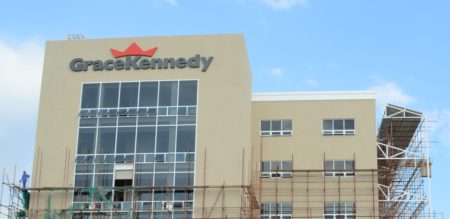
Grace Kennedy HQ in Kingston
Scotia Insurance operates in seven countries in the Eastern Caribbean: Anguilla, Antigua and Barbuda, Dominica, Grenada, St. Kitts and Nevis, St. Lucia and St. Vincent and the Grenadines. Scotia Insurance offers credit protection regionally to customers of Scotiabank on personal loans, residential mortgages, personal lines of credit, personal and small business credit cards.
According to Don Wehby, CEO of Grace Kennedy, “the operation is profitable but not highly profitable”. Grace’s ownership is likely to result in lower operating cost and a vehicle to do business in other countries and for other financial institutions.
In an investors briefing on Monday, Wehby stated that the proposed acquisition is one of ten that the group is looking at currently, at various stages of assessment or negotiation, including some being stress tested and others at the legal stages.
Wehby in answer to a question on the growth rate of 2020 continuing into 2021 confirmed, that it will as the 2020 growth was achieved after years of work to lay the foundation for it to happen.
tTech limited is a Junior Market that seems set to benefit when the acquisition is concluded, the extent of its involvement will depend on the technology in use and whether the acquisition will continue to utilize the current infrastructure or not. tTech is a major Information Technology supplier to Grace.
Grace is listed on the Jamaica Stock Exchange and currently trades at $90.99, the shares are trading on the Trinidad and Tobago Stock Exchange at TT$4.50, in line with the JSE price.