FCIB gets punched

For the fiscal year ending October 2013, First Caribbean International Bank generated $530 million in revenue, down from $543 million in 2012 but reported lousy net results of a loss for the year of $27.5 million compared with a profit of $72 million in the prior year.

The Bank would have generated $29.6 million of net income for the year but results were affected by a number of factors. Of note they incurred $37.6 million ($35.5 million after-tax) of restructuring expenses and an increase in the collective allowance for loan losses of $25 million ($21.6 million after-tax). The bank took a $151 million loan loss hit, an increase from $120 million in 2012. The 2013 write off is 2.4 percent of the net loan of $6.3 billion with loans falling from $6.8 billion in 2012.

FCIB saw operating expenses going in the opposite direction to income as expenses grew from $348 million in 2012 to $403 million but the 2013 amount would include the restructuring cost mentioned above.

Total assets also declined to $11.4 billion from $11.5 billion in 2012. Customers’ deposits remained at $9.6 billion, roughly the same as the year before. (All figures are in US dollars).

FirstCaribbeanLogo150x150The bank, in its report to shareholders, states that “Many of the economies in which we operate rely heavily on tourism and foreign direct investments. The overhang from the economic crisis continues to impede growth and by extension has negatively affected our results. Loan loss provisions this quarter were higher than normal and include an increase in the collective allowance. The Bank is focused on pursuing risk-controlled growth and has taken considerable steps during the year toward the goal of becoming a lower risk bank. While never easy in these difficult times, we have also taken the decision to right size the organization, to redefine how we operate and to address our cost structure. The restructuring we are undertaking will position us for future cost savings and give us the ability to serve our customers better. As we continue to pursue our strategic priorities, our Bank has recorded some significant successes this year. We have introduced new and relevant products to better serve our clients and continue to leverage the capabilities of our parent and majority shareholder, CIBC.

Our focus on addressing operational and administrative concerns has also led to improvements in the client experience”.

“Our Wholesale Banking segment has recorded significant strides in client service delivery. During 2013, we have significantly removed operational and administrative activities away from the front-line personnel to ensure Corporate Managers and Client Service Officers allocate more time to work and interact with, and provide solutions to clients. We have also streamlined and strengthened our credit adjudication processes to further enhance efficiency. In our Retail and Business Banking segment we have invested heavily in developing a series of products and services to enhance our customer experience”.

The bank states that, “We have also continued our investment in upgrading our branches and network of Instant Teller machines. Focusing on customer experience, we have expedited our account opening times through an innovative continuous improvement process. In the Wealth Management segment we have leveraged the strong Axiom Mutual Funds capability in our parent and majority shareholder, CIBC, to manufacture a Caribbean based version of these funds suitable for international investors who have funds and wealth managed through the Caribbean. We have also strengthened our capability to service our Wealth Management clients with the integration into our bank of the CIBC Bank & Trust business, located in the Cayman Islands and the Bahamas, further widening the scope of clients we can assist and the range of services we can provide”.

A final dividend for the year of $0.015 per share was declared. With some of the cost not likely to recur and reduction in others flowing from the restructuring, profits should pick up in 2014 if the asset base can be held and no more major loan write down.

Barita – look beyond 2013 profit

Investors can lose out on some incredible investment opportunities if they focus too much on headline reports. This is true of the latest annual results for Barita Investments.

With a drop in the 2013 profits to September of $70.3 million, one would be tempted to dump the stock. However, a deeper look into the numbers says it’s a big buy. On the surface it looks disastrous, but when the one-off investment loss of $240 million is taken into consideration, a far different picture emerges. Barita reported a $196 million in loss on sale of Investments in its latest results versus $255 million in 2012. The investment loss, which is before corporate taxation, arose from the swapping of government bonds for new lower yielding ones. When this is factored in, earnings would have been around $230 million for the year or just slightly lower than the 2012 out turn.

The company incurred a small loss in the last quarter having reported a profit of $78.6 million up to June. The figures also indicate a loss of $79 million on disposal of investments in the last quarter on top of the $117 million reported to June this year. Going forward, Barita should not encounter another debt exchange charge and should recover from the reduction in interest rates on the government paper.

ExpoBusinessmanSitingNet interest income jumped to $111 million in the final quarter compared to $76 million in the June quarter and $76 million in the final quarter of 2012 fiscal year, a positive development that means that the company has gotten back the interest rate spread to where it should be.

This is a classic case of “buy when blood is in the streets”. The only major thing that has changed in the company over the last year relates primarily to the losses picked up from the debt exchange. This is a not a recurring item and the results should be adjusted to get a proper perspective of the stock’s value. Accordingly, normalised earnings should be around 60 cents per share for the year just ended, rather than 16 cents reported.

Expenses | Expenses were kept under control during the year but much of this may have been due to the impact of the debt write off on profits forcing the company to keep costs down, like reduced bonus compensation based on lower profits. Staff cost fell from $251 million in 2012 to $217 million in 2013, while administrative cost rose by $12 million to $218 million. Taxation fell sharply from $93 million in 2012 to only $222,000.

IC Insider projects earnings of 90 cents per share for the 2014 year.

Finances | The value of shareholder’s equity fell sharply from $1.7 billion in 2012 to $1.4 billion in 2013. Total assets amounted to $13.17 billon just slightly less than the $13.56 billion held at the end of September 2012. Securities of just over $12 billion is included in the assets. On the liability side, repurchase agreements make up $11.6 billion. Not included in assets are the unit trust funds managed by Barita Units Trust Management Company. 

Barita Investments is an IC Insider Buy Rated stock.

Related posts | Profits up at Barita | NDX hits out Barita’s profit

Neal & Massy profits up

Neal & Massy one of IC Insider’s Buy Rated companies, delivered slightly better results at the end of the fiscal year to September 2013 than our forecast, due primarily to reduction in corporate taxes in the final quarter.

The Trinidad based group reported profit after tax of $142 million in the 2012 September quarter and recorded an increase of 19 percent $168 million profit in the September quarter of 2013. However, taxation in the quarter fell from $98 million in 2012 to only $58 million in 2013 and was the only reason for the improved bottom-line in the quarter as profit before tax of $243 million in 2013 was virtually flat with $241 million earned in 2012.

Full year Profit | For the twelve months to September, profit before tax moved from $544 million to $611 million, an increase of 12 percent from continuing operations. Profit after tax for the same period moved from $496 million to $556 million from all operations and excluding losses in a discontinued business which was sold. Earnings per share is $5.73, making the stock more attractive than IC Insider’s forecast of $5.40. Profits were generated on sales of $2.34 billion versus $2.17 billion in the last quarter of 2012 and $9.4 billion for the year compared with $9.15 billion in 2012. This is not much change at all, leading to nearly flat pretax profit and suggests challenges in moving profit forward in 2014.

Image courtesy of StuartMiles/FreeDigitalPhotos.net

Image courtesy of StuartMiles/FreeDigitalPhotos.net

Tough environment | The reality is that the group operates in economies that are undergoing no growth or slow growth except for Guyana where GDP growth was 4 percent during the period. Neal & Massy was able to eke out a 7 percent growth in revenues in Trinidad but suffered declines of 4 percent in Barbados and Jamaica while Guyana rose by 4 percent. Profit from the region shows mixed performances with Barbados showing increase of 6.5 percent in spite of a fall in revenue, Trinidad recorded an increase of 4 percent but less than that of revenues while Jamaica’s profit fell worse than the decline in revenues at 24 percent, due partially to devaluation of the local currency. Guyana grew by 13 percent.

Plans | “Throughout 2013, the group made major strides in implementing its strategy. Its business unit successfully executed acquisitions, such as Caribbean Insulation Services, implemented innovative retail concepts, initiated projects to expand into new sectors such as petrochemicals, and launched new products and services, Furthermore the group made good progress in diversifying into new territories in Central and Latin America with specific acquisition currently underway,” management stated in their report to investors.

Neal & Massy declared a dividend based on the results, bringing the total dividend for the year to $1.75 up from $1.50 paid in 2012.

Outlook | “In light of the improved results and the strong outlook for the group” is how management described the group’s performance when declaring the dividend. Regardless, based on its dominance in their main market of Trinidad and with Barbados being put through greater austerity in 2014 than in 2013, growth is likely to be slow even as the Jamaican market is expected to emerge from recession with no new major taxes expected during the coming year. Earnings could grow 30 percent for the 2014 year thus putting profit at around $710 million or $7.33 per share. The forecast is in line with growth in profit after tax in 2012 and 2010. In 2011, profits got hit with a $300 million one-off charge, which resulted in a fall in after tax profit. The forecast is also consistent with growth level between 2004 and 2008, the year when the world-wide economic crisis commenced.

Finances | The group is financially strong with shareholders’ equity at $3.85 billion at the end of the financial year against borrowed funds of $1.3 billion and cash and equivalents of $1.1 billion. Current assets of $4.4 billion was adequate to fund current liabilities of $3.1 billion.

TheGroup’s stock, which last sold on the Trinidad market at $60, is undervalued based on its peers, the overall market valuation and its prospects for increased profit in 2014. One caution for investors is the tendency for conglomerates to be hit with surprises that can affect the profit markedly. The group got rid of the loss-making hotel operation in 2012 and so far, there is no mention of any major areas of concern.

Neal & Massy is an IC Insider’s Buy Rated stock.

Related posts | Buy Rated stocks coming in | TTSE PE: Neal & Massy makes strides

JMMB Q2 profits jumps 56%

Jamaica Money Market Brokers (JMMB) reported continued strong growth in profits attributable to shareholders in the September quarter of $697 million or a 24 percent increase over the September quarter last year.

The performance is even better than first appearance as there was a gain relating to the acquisition of Capital & Credit Group of $117 million in the September 2012 quarter. Without this gain, profits for this year’s quarter would have been up by 56 percent. This comes against the background of a big jump in profits from ongoing operations for the first quarter to June this year with profit after tax and due to shareholders of $753 million. Earnings for the six months hit $1.45 billion compared to $2.5 billion. The latter includes the booking of the difference between the purchase price and net asset of Capital & Credit Group, which was acquired in the June quarter 2012 amounting to $1.6 billion; excluding this item, profits would be up an impressive 59 percent.

Earnings per share of 43 cents for the latest quarter is up to 89 cents for the six months. The investment bank continues on track to rake in profits of around $2 per share for the year to March 2014, which makes the stock cheap at the last selling price of $8. However, this depends on a number of factors, the most of which is the level of investments and foreign exchange gains they are likely to book in the next two quarters.

JMMB_Building600x250Net Interest | For the September quarter, net interest income grew slightly to $1.23 billion from $1.196 billion in 2012 and from $1.178 billion in the 2013 June quarter. For the year to September, net interest income is up to $2.4 billion from $2.18 billion in 2012. Gains on securities trading almost doubled to $646 million from $333 million for the quarter compared with 2012 and from $633 million in 2012 to $1.3 billion in 2013. Net operating income was up strongly to $2.09 billion in the quarter from $1.7 billion in 2012 and for the six months $4.16 billion versus $3.1 billion in 2012. Operating expenses remained fairly stable at $1.2 billion in the latest quarter compared with to $1.13 billion in the first quarter and $1.1 in the 2012 September quarter. Year to date expenses climbed to $2.34 billion from $1.88 billion in 2012.

Regionally, Dominican Republic contributed J$754.6 million to the Group, driven mainly by growth in Net Interest Income and gains on securities trading compared to J$390.9 million in the first quarter. The Trinidad & Tobago based IBL Group, an associated company, contributed a loss of $$24.3 million due mainly to additional provisioning for loans. The Group has already stated that they have agreed to acquire the shares held by the other shareholder in the bank.

Financial Strength | Shareholders’ equity declined from $18.7 billion at the end of June to $16.5 billion at the end of September as a result of a fall in the value of investments. The group’s total assets under management fell to $172.4 billion at the end of September versus $175 billion at the end of June. Loans having increased by 17 percent to $12 billion to June, contracted slightly in September to $11.7 billion. Loans are a relatively small part of the asset base but could be one of the more profitable and fastest growing areas of its operations if lending is done smartly to minimize losses. Importantly, the full ownership of IBL will increase loans sharply when the group reports results for the December quarter.

JMMB is a financial conglomerate with the principal activities being securities brokering, securities trading, commercial and merchant banking, dealing in money market instruments, operating foreign exchange cambio and managing funds on behalf of clients.

JMMB is an IC Insider Buy Rated stock.

Related posts | JMMB grows assets $125B to $200B | JMMB big bump in profits |

Profit up 22% at Jamaica Broilers

Profit after tax due to the Jamaica Broiler’s shareholders, which was up 10 percent in the first quarter to August, is up 22 percent in the October quarter.

Profit was flat in the first quarter, before taking out losses due to outside shareholders of a subsidiary, and was 15 percent ahead of the 2012 second quarter period. The improved results flowed from increased revenues of 20 and 21 percent respectively in each quarter. For the half year, profit hit $324 million or 27 cents per share and in the October quarter, the company reported $184 million versus $151 million in 2012 or 15 cents per share in profits. With the Christmas period ahead, they are now into the best period for revenues and profit. IC Insider’s forecast is now at $1.50 earnings per share for the year, down from an earlier forecast, but cost savings are expecting from the acquisitions, particularly the US based one. Earnings should exceed $2 by 2015 fisscal year. The stock still remains Buy Rated.

The group enjoyed improved gross margins in the second quarter to 29 percent versus 23.4 percent in the first quarter and 26 percent for 2013 fiscal year that ended in April.

Jamaica-Broilers-Group_logo150x150The group completed the acquisition of Hamilton Smokehouse and England Farms Inc. during the latest quarter, which resulted in increased income as well as increased cost. Administrative cost rose by 33.5 percent in the October quarter to $923 million and 23 percent for the year to October to $1.43 billion; distribution cost jumped in the last quarter by 39 percent to $335.7 million and 33 percent for the two quarters to $615.6 million. Those were not the only costs to rise, finance cost jumped by 20 percent in the last quarter to $88 million and by 35 percent in the year to date to hit $167 million.

Segments | Poultry sales rose 15 percent to $7.2 billion over 2012; Hi Pro sales which includes feeds was down 1 percent for the half year but ethanol fell 39 percent to $445 million; other operation category is up 75 percent while US operations show a 221 percent jump to $2.15 billion, partially reflecting the new acquisition in the quarter. Other income rose from $68 million to $86 million. Segment results came out at $436 million for poultry, up from $350 million in 2012; Hi Pro recorded $310 million down from $501 million in 2012; ethanol recorded $27 million, in 2012 a loss of $7.5 million was recorded; and the US operations recorded an impressive $202 million compared to only $19 million in 2012.

Balance Sheet | Fixed assets increased by $700 million net of depreciation charge over April due mainly to the acquisitions noted above; intangible assets increased by $455 million and goodwill by $133 million all due to the US and the Hamilton Smokehouse acquisitions. Inventories rose $300 million over the position as of April this year; biological assets moved up by $640 million and receivables and prepayments by $560 million. Cash funds are down $1.1 million at the end of October to $1.1 billion; loans however climbed by $400 million to $5.8 billion, this compares with equity of $10.3 billion. Current assets amounted to $9.2 billion and is well ahead of current liabilities of $5.3 billion, which is a slight deterioration from the level of $8.8 billion in April to $4.2 billion in current liabilities.

Jamaica Broilers Group is an IC Insider Buy Rated Stock.

Related posts | JBG profit held back | New additions to Buy Rated stocks | Jamaica Broilers dividend

Image courtesy of Amenic181/FreeDigitalPhotos.net

Republic growth struggle

Trinidad’s Republic Bank recorded profit attributable to shareholders of TT$1.17 billion for the year ended September 2013, an increase of only $11 million over 2012.

The performance reflects an operation that is highly influenced by the poor state of some of the economies the group operates in. While profit inched up in 2013, it is still below the $1.2 billion generated in 2008 and $1.34 in 2007 but well above $948 earned in 2009. Recovery has been slow as the main income generator, loans have been growing slowly. Things could pick up somewhat as its main market, Trinidad, has returned to positive growth but Barbados should continue to be tight with high fiscal constraints in place.

“Profit declined by $23.3 million or 29.6 percent in Barbados and a loss of $18.2 million was recorded in Grenada, mainly due to higher level of provisions for loans and investments and a general decline in business activities in both islands. In addition, a loss of $75.7 million was recorded on our investment in Eastern Caribbean Financial Holdings Limited. Improved performance in the commodity-exporting economies of Trinidad and Guyana off-set these declines.”

Republic saw losses for non-performing loan drop from $103 million to $57 million in the 2013. Net interest income barely moved ending at $2.18 billion up from $2.14 billion in 2012. Other income performed more robustly, moving from $1.1 billion to $1.26 billion in 2013. Operating expenses climbed 7.5 percent to $1.74 billion, a faster rate than revenues. The tax charge went up by 25 percent or $76 million to $383 million, well ahead of the pretax profit that increased by $46 million.

Based on the results, a final dividend of $3 per share and $1.25 interim dividend was paid for the year.

HFCBank_ghana150x150Investments | During the year, the remaining 34.86 percent minority shareholding in Republic Bank (Barbados) was acquired and a 40 percent shareholding was acquired in HFC Bank (Ghana). “Republic will continue to look at opportunities in the African continent that meet our risk profile as we seek to expand from this initial investment,” the company stated.

Financial Position | The Group’s total asset base stood at $57.6 billion with equity at $8.3 billion. Total liquid assets, which was fuelled by increase in deposits of $5.0 billion or 13.5 percent, stood at $19.8 billion at year end, an increase of $3.3 billion or 20.2 percent from 2012. Loans and advances grew by $1.9 billion or 8.2 percent to reach $25.2 billion following a growth of 6.6 percent in 2012. All territories achieves growth, led by Trinidad and Tobago with an increase of $1.6 billion or 10.2 percent, which accounted for 84.5 percent of the increase compared to the prior three years of flat growth.

Non-Performing Loans (NPLs) is at 1.4 percent for Trinidad and Tobago, the best in the Group and below the industry average in Trinidad and Tobago of 4.7 percent. However, Trinidad and Tobago which accounts for 68.9 percent of the Group’s net interest income, increased this category by 3.1 percent in 2013, after declining by 8.7 percent in 2012, primarily because of increase in loans and investments balances.

NPLs in Barbados at 11.7 percent and Grenada at 8.2 percent respectively are high and reflective of the poor economic conditions, leading to a higher overall Group NPLs of 3.7 percent.

RepublicBanklogo150x150Non-Performing Loans (NPLs) to gross loans stood at 3.7 percent. The NPL ratio rose by 4 basis points, mainly as a result of increased NPLs in Barbados and Grenada, but down from the 4.6 percent in 2009. Total specific provision as a percent of total NPLs is 37.2 percent, down from the 50 percent in 2012, mainly because of the higher level of collateral held for loans downgraded resulting in lower provisioning requirement.

Outlook | “We expect that economic conditions will be tough going forward. Nonetheless, barring any unforeseen event, we are confident that the current level of profitability will remain robust. The commodity exporting economies of Guyana and Trinidad are expected to drive our performance while tourism dependent economies of Barbados and the Eastern Caribbean are expected to face ongoing challenges with little or no growth. We remain cautiously optimistic that these economies will achieve growth in the near term as global economic conditions improve.” management concluded.

The group has much capacity for increased lending with only 60 percent of deposited funds lent out and is at the lowest level since 2003 when only 61 percent was lent and is well down from 72 percent lent out in 2008. Loan growth in the September quarter suggest that lending could increase around $3 billion for the current year. A faster pace than in 2013 and would help grow income at a level to beat the rise in costs. On the basis of the likely growth in loans, IC Insider is forecasting earnings of $9.50 cents per share for the 2013/14 fiscal year.

Republic Bank is an IC Insider Buy Rated stock

Related posts | PE Ratios: Trinidad still has good buys | Republic ups stake in Ghanaian Bank | Republic onto something good in Africa

NCB ill-fated IPO cost $680m

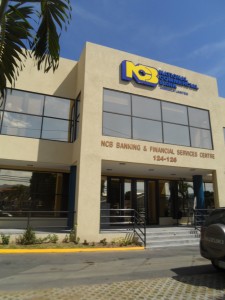
National Commercial Bank‘s profit took a $680 million hit from the costs relating to ill-fated Initial Public Offering (IPO) early in the just concluded fiscal year to September, according to the company’s audited financial statements.

The banking group was attempting to raise added capital in the international market during the turbulent period ahead of the country reaching an agreement with the International Monetary Fund (IMF). The amount involved was written off against income thus helping to depress profits for the year and that was not the only big hit shareholders got for their investment during the year.

Net profit for the year amounted to $8.55 billion, a decline from $10.05 billion in 2012 which translates to earnings per share of $3.47 versus $4.08. The 2013 profit was also hit with a huge $1.5 billion charge, the result of losses picked up when they exchanged high yielding government bonds for lower yielding ones. Had these costs not been incurred, earnings would have been around $4.10 per share instead of the reported $3.47 amount.

Profit also got a $281 million hit from receivership expenses, an increase over the amount spent in 2012 of $172 million. Technical, consultancy and professional fees reached $1.093 billion and is up from $846 million in 2012. Some of these fees would probably relate to the IPO issue as well. The impact of those exceptional charges helped in the directors cutting the dividend payment.

The group recorded a more than doubling in the item “Other expenses” that rose to $917 million from $449 million in 2012.

Wage related costs rose 17.25 percent in the year to $9.8 billion due primarily to a larger workforce related to the acquisition of AGIC and costs associated with the restructuring exercise carried out during the financial year, the company stated in its report to shareholders.  The group’s statutory contribution remained effective flat suggesting that the bulk of the increase probably relates to redundancy payments.

Advantage General suffered a fall in profit for the NCB Group.

Revenues | Net interest income rose to $23.56 billion from $21.78, in spite of the negative impact of the NDX on interest income from the government bonds. Fees and commission income moved up to $8 billion net compared to $7.1 billion in 2012. Premium income grew to $5 billion from $1.69 billion in 2012 due partially to the acquisition of Advantage General Insurance Company in the year. Gains on sale of debt securities fell to $1.15 billion from $2.65 billion in 2012.

Loan & Provision | The group wrote off $3.6 billion during the year while making fresh provisions of $2.3 billion down from $2.7 billion in 2012 and so ended with net provision of $3.2 billion at the end of the year against loans of $143.6 billion. The impact of the above adjustments show up in the aggregate amount of non-performing loans as at September 2013 for the Group on which interest was not being accrued amounted to $6,961,388,000 (2012  $8,271,530,000).

Personal loans of $72 billion account for more than half of loans on the books and was the largest growing segment of the portfolio accounting for $14 billion of the $28 billion increase in the year.

Related posts | NCB cuts dividend 75% | NCB recovers from NDX hit | NDX slaps NCB profits

Profit drops on falling sales at Salada

Profits did not percolate at Salada as the company reported a loss in its 4th quarter with revenues from all sources falling sharply to $152 million from $183 million and from $716 million to $634 million for the year to September.

The decline comes after the company reported robust sales and profits in the first quarter of its fiscal year to December 2012. Sales were up 27.5 percent in the December 2012 quarter and may have been a major reason why Salada suffered declines in sales thereafter, as the trade seemed to have stocked up on supplies, thus cannibalising sales in subsequent periods.

Profit after tax fell to a loss of $7 million for the quarter versus a profit of $41.8 million in the last quarter of the 2012 fiscal year. For the full year, profit fell from $153.4 million to $108 million in 2013. Early in the 2013 calendar year, the company adjusted prices downwards to try and combat declining volumes.

Salada_logo150x150The reduced performance was evident from early in the year as revenues fell and profits followed. In the March quarter, sales revenues were down by 15.6 percent and 19.6 percent in the June quarter but accelerated further to 24 percent in the September quarter for the main business, excluding sales for its new subsidiary, Mountain Peak, which started sales in the fourth quarter.

Interestingly, 2013 is the first year that revenues have been down since 2010, when revenues fell just over a percent, and the second year since 1997 when revenues fell 13 percent. Gross profit, which fell a sharp 31 percent in 2013 have hardly fallen year over year since 2003 except for a 16 percent decline in 2010 and a marginal decline in 2005. In the past year, gross profit margin fell to 56 percent from a high 86 percent in 2012. The gross profit levels have fluctuated over the years and 70 percent seems to be the range that the company has aimed for in recent years.

Cost rise | Compounding the issue is the start-up of the Roberts business lines, which contributed to the reduced profit. While revenues fell, spend on selling and promotion climbed by a third to $43.7 million and administrative cost edged up 6.4 percent. On the other hand, finance income nearly doubled from $17.28 to $34 million as gains from foreign currency contributed $20 million. Operating profit fell sharply to $91.4 million from $208 million in 2012. Expenses for 2013 includes cost for Mountain Peak without the full benefit of sales from that operation to fully cover cost. The new subsidiary contributed approximately $4 million in sales and contributed $17.5 million of losses to the year’s performance.

SaladaMountainPeak150x150The cost of inventories utilised in production amounted to $391 million versus $386 million in 2012.

Finances | The company recently declared a dividend of 40 cents per share payable in December which will amount to $41.6 million payment and is likely to reduce the cash on hand at the end of the year of $196 million. Amount due from customers is down from $150 million in 2012 to $90 million at year end but inventories rose to $251 million from $217 million in 2012. The company has current liabilities of just $75 million compared to current assets of $539 million at the end of September and shareholders’ equity stands at $700 million.

Related posts | Salada June profits down | Salada’s stock price may be stuck

Images courtesy of www.saladafoodsja.com

Sexiness no, performance yes

Cargo Handlers is by no means a sexy company but what it lacks in sexiness is made up from performance.

For the year just ended to September, the company out of Montego Bay reported revenue increase of 31 percent over 2012 and a 32 percent increase in profit to reach $95 million, an increase on the $64.6 million in 2012 which was up 24 percent on 2011. In the year just concluded, profit was negatively affected by a million dollar charge for damaged cargo compared to $356,000 in the prior year, administrative cost rose just over 20 percent to $13.8 million and other operating cost was up at a much faster pace at 28 percent to reach $74.75 million.

Return on equity rose from 64 percent in 2012 to 75 percent in 2013 with equity being $137 million at year end and $72 million at the end of 2012. Dividend paid during the year amounted to $63.3 million almost twice the $36 million paid in 2012.  The 2013 payment is 74.5 percent of profits or a return on the stock price of $12 at the start of the fiscal year of 14 percent. The high level of payout may have been tied to the higher tax that was applied to dividends starting in April this year rather than a decision to effect a permanent increase. In 2012, the payout ratio was just under 56 percent or 96 cents per share.

CargoHandlers280X150The audited financial statements indicated by way of a note that by resolutions dated 19 December 2012 and 17 February 2013, the Board of Directors approved the payment of interim dividends in the amounts of $0.68 and $1.00 per share respectively. In the prior year, resolutions dated 15 December 2011 and 2 July 2012 approved interim dividend payments of $0.64 and $0.32 per share respectively. Based on the simplicity of the operation, there is hardly any need to stock pile cash. As such investors can expect a healthy payout each year, thus providing a good source for income.

The company ended up with cash of $131 million at the end of the year and total current assets of $150.7 million and current liabilities stood at only $20 million. The company owes related parties $30 million and related parties owe them $25 million at the end of September.

Stock outlook | Profits may have grown well in the year just ended with some of the increase flowing from the change in value of the local currency. How much gains can be expected going forward is unsure. Suffice to say, the stock looks like a reasonable income provider.

Related posts | Profits up at Cargo Handlers | Cargo Handlers profits up 38%

Image courtesy of Sailom/FreeDigitalPhotos.net

Profit jumps 39% for Scotia Invest

Profit for Scotia Group’s subsidiary Scotia Investments jumped 39 percent in the October quarter to hit $572 million from $411 million earned in 2012 driven by strong growth in non-interest income, which contributed $490 million for the quarter, up $175 million or 56% above the corresponding quarter last year. Non-interest income, which includes fee income, securities trading gains and net foreign exchange trading income, was $1.64 billion for the year, an increase of $351 million or 27% compared to 2012.

In spite of the $230 million direct loss incurred from the National Debt Exchange (NDX) earlier in the year, the investment house was able to report profits of $1.99 billion for the full year, up $71 million from $1.92 billion earned in the previous year. Earnings per share (EPS) for the year was $4.71 compared to $4.54 for last year, putting the stock value at only 5.5 times 2013 earnings including the one off NDX loss and with prospects for higher profit in 2014, it looks even cheaper.

The Return on Average Equity (ROE) stood at 17.28 percent, down from 18.8 percent last year.

scotiabanklogo150x150Revenues | Total Operating Income, comprising net interest revenue and other income, was $4.46 billion for the year, up 8% above the $4.13 billion recorded last year and for the quarter $1.22 billion, up 18% from the $1.03 billion recorded for the corresponding quarter last year.

Net Interest | Net interest income, after impairment losses for the year, was $2.81 billion, marginally down by $23 million compared to last year and was $729 million for the quarter, $10 million above the similar period last year.

Operating expenses | Total operating expenses for the year were $1.66 billion, representing an increase of 21% or $291 million over last year. The increase was mainly due to staff related costs and other operating expenses as a result of the inflationary increases. Total operating expenses for the quarter were $447 million, 16% above the same period last year.

Balance sheet | Balance sheet assets remained static year over year at $73.7 billion at the end of October, compared to $73.87 billion in 2012 but off-balance sheet assets under management climbed 16 percent to $119.39 billion over last year. The stability in the assets seems in keeping with the concept of shifting out of the repo business thus reducing the risk to the company and putting investors into funds managed by the company. In keeping with this “the Scotia Premium Money Market Fund grew over 260% during the year to $5.15 billion,” management concluded while there was a reduction in Repurchase agreement liabilities from $45.68 billion in 2012 to $44.87 billion at the end of 2013. Shareholders’ equity stood at $12.49 billion as at October 31, 2013, an increase of $1.12 billion compared to last year.

Outlook | Had the company not suffered losses as a result of the NDX debt exchange, earnings for the year would have exceeded $5 per share, with the last quarter earnings hitting $1.35 and further growth very likely this coming year. IC Insider projects earnings to be in the $6 range.

Scotia Investments is an IC Insider Buy Rated stock

Related posts | Q3 profits up at Scotia Investments | Scotia Investments one time dent