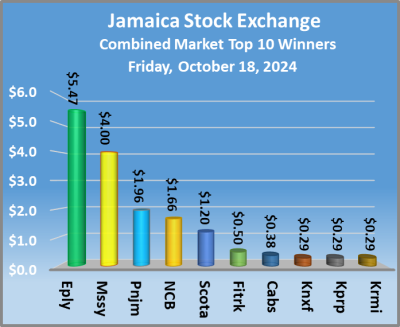
Trading ended on Friday on the Jamaica Stock Exchange with a sharp drop in the volume and the value of stocks being exchanges compared to Thursday, resulting in gains in the Main Market and the JSE USD Market indices, with the Junior Market’s closing lower. At the close of market activities prices of 45 shares rose including Lasco Manufacturing that traded at an intraday 52 weeks’ high of $9, prices of 34 declined and 24 remained firm.
 At the close of the market, the JSE Combined Market Index advanced 2,348.48 points to 330,905.57, the All Jamaican Composite Index rallied 1,703.81 points to end at 365,438.63, the JSE Main Index climbed 2,601.00 points to close at 317,594.25, the Junior Market Index slipped 19.29 points to 3,792.59, and the JSE USD Market Index popped 0.06 points to settle at 236.24.
At the close of trading, 16,768,098 shares were exchanged in all three markets, down from 48,553,846 units on Thursday, with the value of stocks traded on the Junior and Main markets amounting to $83.79 million, well off from the $202.88 million on the previous trading day and the JSE USD market closed with an exchange of 44,023 shares for US$2,193 down sharply from 555,546 units at US$14,136 on Thursday.
In Main Market activity, QWI Investments led trading with 2.93 million stocks followed by Transjamaican Highway with 1.63 million shares and Radio Jamaica with 1.37 million units.
In Junior Market trading, ONE on ONE Educational led trading with 1.50 million stocks followed by JFP Ltd with 1.32 million shares and Fosrich with 543,515 units.
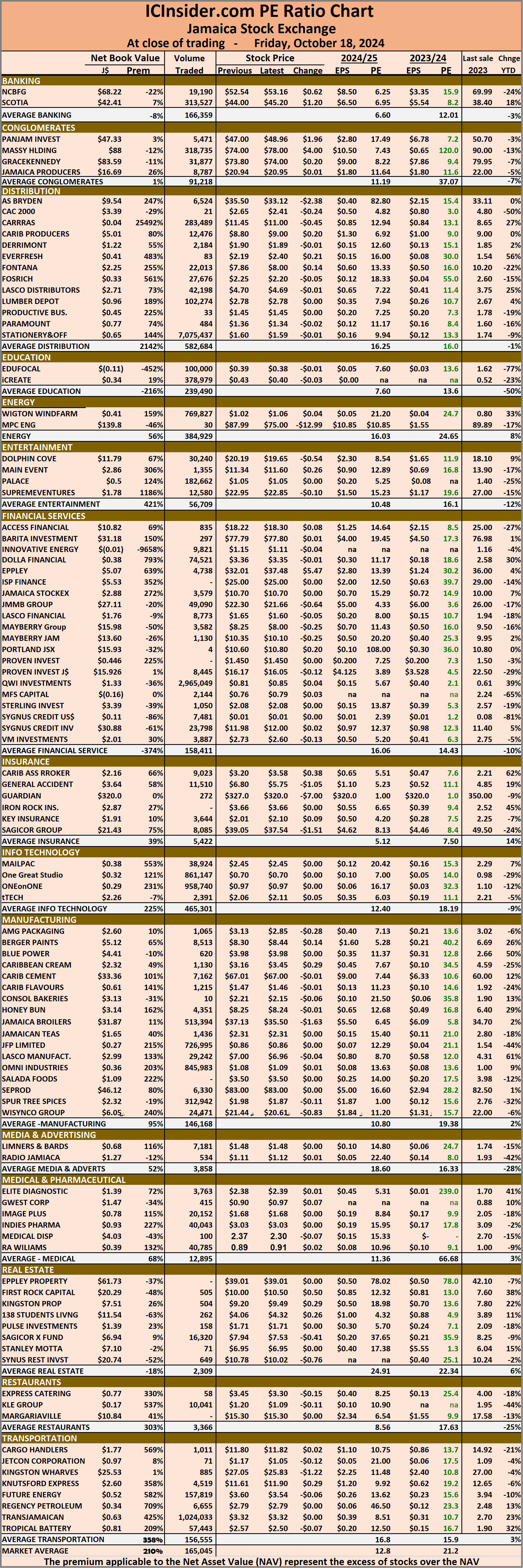
In the preference segment, Eppley 7.25% preference share declined $3.09 in closing at $16.51 with investors swapping 1,000 units, Jamaica Public Service 9.5% gained $209.99 to close at $2,899.99. The market’s PE ratio, the most popular measure used to value stocks, ended at 13 based on 2024-25 earnings and 21.3 based on 2023-24 historical earnings. The ICInsider.com PE ratio chart and other more detailed daily charts provide investors with regularly updated data to help decision-making. The PE chart covers all ordinary shares on the Jamaica Stock Exchange, grouped by industry, allowing for easy comparisons within a sector and the overall market. The earnings per share (EPS) and PE ratios are based on 2023 and 2024 actual or projected earnings, excluding any major time income or expenses.
The chart should be used in making rational decisions when investing in stocks close to the average for the sector, not going too far from it unless there are compelling reasons to do so. This approach helps to remove emotions from investment decisions and place them on fundamentals while at the same time not being too far from the majority of investors. Investors who buy when the price of a stock is close to the average will find that they are not inclined to overpay for a stock. The net asset value of each company is incorporated into the chart. Investors can use this measure in assessing stock values. The chart also shows daily changes in stock prices and the percentage year to date price movement based on the last traded prices. Dividends that are paid or are due to be paid and yields for each company are shown in the Main and Junior Markets’ daily report charts, along with the closing volume of the highest bid and the lowest offer
 At the close of trading the JSE Combined Market Index rose 2,404.81 points to 328,557.09, the All Jamaican Composite Index gained 3,211.53 points to conclude trading at 363,734.82, the JSE Main Index climbed 2,216.56 points to 314,993.25, the Junior Market Index is up 39.75 points to end the day at 3,811.88 and the JSE USD Market Index popped 11.11 points to close at 236.18.
 In the preference segment, 138 Student Living preference share popped $38 to $250 with traders dealing in 242 units.
 The chart should be used in making rational decisions when investing in stocks close to the average for the sector, not going too far from it unless there are compelling reasons to do so. This approach helps to remove emotions from investment decisions and place them on fundamentals while at the same time not being too far from the majority of investors. Investors who buy when the price of a stock is close to the average will find that they are not inclined to overpay for a stock. The net asset value of each company is incorporated into the chart. Investors can use this measure in assessing stock values. The chart also shows daily changes in stock prices and the percentage year to date price movement based on the last traded prices. Dividends that are paid or are due to be paid and yields for each company are shown in the Main and Junior Markets’ daily report charts, along with the closing volume of the highest bid and the lowest offer for each company.
 At the close of trading the JSE Combined Market Index dropped 1,451.15 points to 326,152.28, the All Jamaican Composite Index sank 1,773.41 points to 360,523.29, the JSE Main Index dived 1,652.50 points to settle at 312,776.69, the Junior Market Index popped 17.95 points to settle at 3,772.13, and the JSE USD Market Index shed 2.42 points to close at 225.07.
 The market’s PE ratio, the most popular measure used in valuing stocks, ended at 13.1 for 2024-25 and 21.1 for 2023-24 earnings. The ICInsider.com PE ratio chart and the other more detailed daily charts provide investors with regularly updated information to help decision-making. The PE ratio chart covers all ordinary shares on the Jamaica Stock Exchange, grouped on an industry basis, allowing for easy comparisons within a sector and the overall market. The earnings per share (EPS) and PE ratios are based on 2023 and 2024 actual or projected earnings, excluding any major time income or expenses.

 At the close of trading the JSE Combined Market Index jumped 3,661.36 points to 327,603.43, the All Jamaican Composite Index rallied 3,524.53 points to wrap up trading at 362,296.70, as the JSE Main Index jumped 3,581.63 points to 314,429.19, the Junior Market Index gained 32.97 points to 3,754.18, and the JSE USD Market Index rallied 3.80 points to wrap-up trading at 227.49.
 In the preference segment, Jamaica Public Service 7% skidded 98 cents to finish at $45.
 This approach helps to remove emotions from investment decisions and place them on fundamentals while at the same time not being too far from the majority of investors. Investors who buy when the price of a stock is close to the average will find that they are not inclined to overpay for a stock. The net asset value of each company is incorporated into the chart. Investors can use this measure in assessing stock values. The chart also shows daily changes in stock prices and the percentage year to date price movement based on the last traded prices. Dividends that are paid or are due to be paid and yields for each company are shown in the Main and Junior Markets’ daily report charts, along with the closing volume of the highest bid and the lowest offer for each company.
 At the close of trading the JSE Combined Market Index rose 3,011.68 points to 323,942.07, the All Jamaican Composite Index rallied 3,750.99 points to 358,772.17, as the JSE Main Index popped 2,888.42 points to close at 310,847.56, the Junior Market Index popped 34.80 points to 3,721.21 and the JSE USD Market Index fell 2.76 points to 223.69.
 In Junior Market trading, JFP Ltd led trading with 8.02 million stocks followed by Derrimon Trading with 2.18 million shares and Jamaican Teas with 1.01 million units.
 Investors who buy when the price of a stock is close to the average will find that they are not inclined to overpay for a stock. The net asset value of each company is incorporated into the chart. Investors can use this measure in assessing stock values. The chart also shows daily changes in stock prices and the percentage year to date price movement based on the last traded prices. Dividends that are paid or are due to be paid and yields for each company are shown in the Main and Junior Markets’ daily report charts, along with the closing volume of the highest bid and the lowest offer for each company.
 At the close of trading, the JSE Combined Market Index rose 2,032.13 points to 324,259.36, the All Jamaican Composite Index jumped 4,324.48 points to end at 356,293.12, the JSE Main Index rallied 2,035.29 points to end at 311,523.65, the Junior Market Index rose 11.99 points to 3,675.39, and the JSE USD Market Index slipped 0.81 points to close trading at 222.88.
 The market’s PE ratio, the most popular measure used to value stocks, ended at 12.8 on 2024-25 earnings and 20.9 based on 2023-24 earnings. The ICInsider.com PE ratio chart and more detailed daily charts provide investors with regularly updated information to help decision-making. The PE ratio chart covers all ordinary shares on the Jamaica Stock Exchange, grouped by industry, allowing for easy comparisons within a sector and the overall market. The EPS & PE ratios are based on 2023 and 2024 actual or projected earnings, excluding major one off items.
 This approach helps to remove emotions from investment decisions and place them on fundamentals while at the same time not being too far from the majority of investors. Investors who buy when the price of a stock is close to the average will find that they are not inclined to overpay for a stock. The net asset value of each company is incorporated into the chart. Investors can use this measure in assessing stock values. The chart also shows daily changes in stock prices and the percentage year to date price movement based on the last traded prices. Dividends that are paid or are due to be paid and yields for each company are shown in the Main and Junior Markets’ daily report charts, along with the closing volume of the highest bid and the lowest offer for each company.
 At the close of trading the JSE Combined Market Index fell 1,209.12 points to close trading at 324,707.11, the All Jamaican Composite Index skidded 618.05 points to finish at 357,496.90, the JSE Main Index dipped 1,151.31 points to finish at 311,890.12, the Junior Market Index declined 15.08 points to 3,688.94 and the JSE USD Market Index popped 1.41 points to end at 225.68.
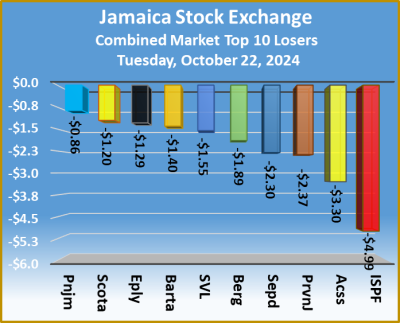 In the Junior Market trading, Stationery & Office Supplies led with 7.08 million stocks, ONE on ONE Educational followed with 958,740 shares and One Great Studio with 861,147 units.
 At the close of trading, 64,714,237 shares were exchanged in all three markets, up from 11,145,537 units on Wednesday. The value of stocks traded on the Junior and Main markets jumped to $267.31 million, well above the $39.69 million on the previous trading day and the JSE USD market closed with 51,055,916 shares traded for US$1,092,742 up from 231,331 units at US$18,240 on Wednesday.
 The PE ratio chart covers all ordinary shares on the Jamaica Stock Exchange, grouped by industry, allowing for easy comparisons within a sector and the overall market. The EPS & PE ratios are based on 2023 and 2024 actual or projected earnings, excluding major income or expenses that do not recur regularly.

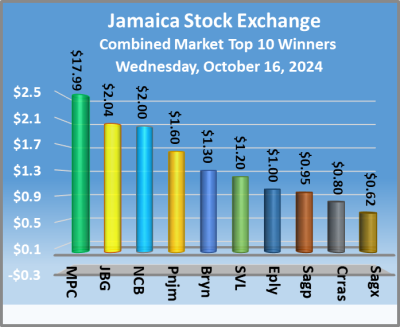 At the close of trading the JSE Combined Market Index rose 1,760.76 points to 326,230.15, the All Jamaican Composite Index jumped 3,577.52 points to end trading at 358,937.25, the JSE Main Index popped 2,012.28 points to 313,186.67, the Junior Market Index shed 22.73 points to 3,728.39, and the JSE USD Market Index skidded 0.95 points to close at 221.29.
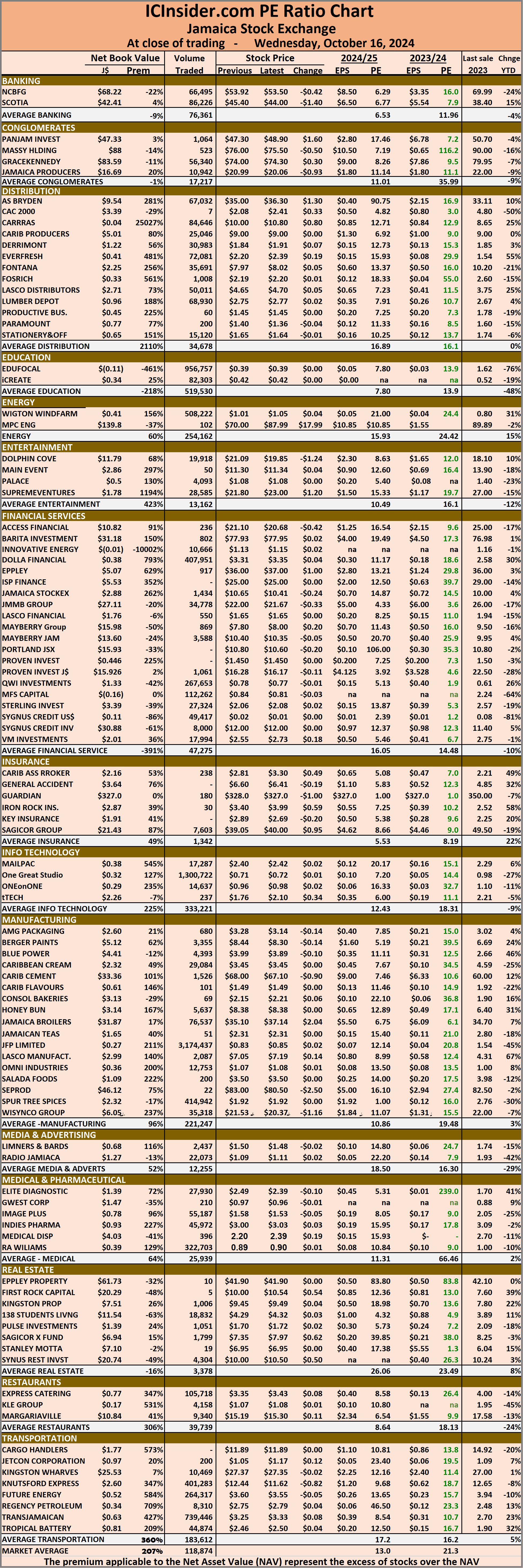
 The market’s PE ratio, the most popular measure used to value stocks, ended at 21.3 based on 2023-24 earnings and 13 based on 2024-25 projected earnings. The ICInsider.com PE ratio chart and the more detailed daily charts provide investors with regularly updated data to help decision-making. The PE ratio chart covers all ordinary shares on the Jamaica Stock Exchange, grouped by industry, allowing for easy comparisons within a sector and the overall market. The EPS & PE ratios are based on 2023 and 2024 actual or projected earnings, excluding major one off items.
 This approach helps to remove emotions from investment decisions and place them on fundamentals while at the same time not being too far from the majority of investors. Investors who buy when the price of a stock is close to the average will find that they are not inclined to overpay for a stock. The net asset value of each company is incorporated into the chart. Investors can use this measure in assessing stock values. The chart also shows daily changes in stock prices and the percentage year to date price movement based on the last traded prices. Dividends that are paid or are due to be paid and yields for each company are shown in the Main and Junior Markets’ daily report charts, along with the closing volume of the highest bid and the lowest offer for each company.
 At the close of trading, the JSE Combined Market Index shed 2,096.14 points to 323,574.82, the All Jamaican Composite Index skidded 1,331.62 points to close trading at 356,654.64 and the JSE Main Index sank 2,353.97 points to 310,266.31. The Junior Market Index rose 21.52 points to end at 3,747.45 and the JSE USD Market Index rallied 1.68 points to end the day at 222.28.
 In the preferred segment, Eppley 7.50% preference share slipped 99 cents to $5.61 and Sygnus Credit Investments C10.5% sank $2 to end at $103.
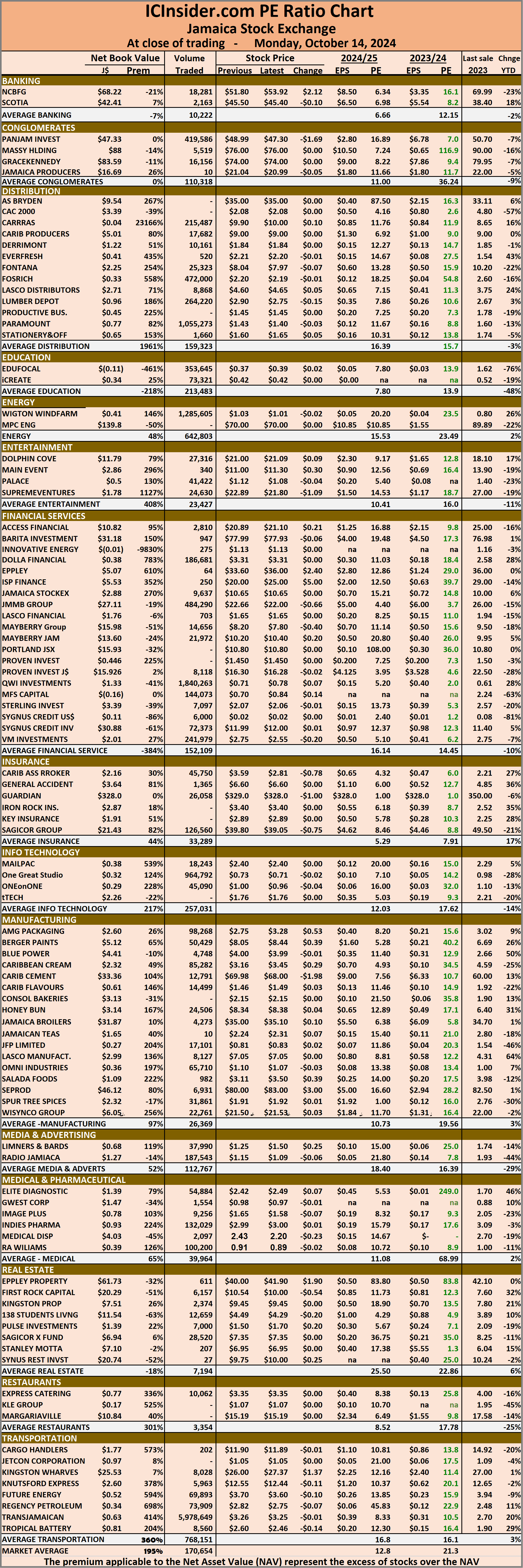 The chart should be used in making rational decisions when investing in stocks close to the average for the sector, not going too far from it unless there are compelling reasons to do so. This approach helps to remove emotions from investment decisions and place them on fundamentals while at the same time not being too far from the majority of investors. Investors who buy when the price of a stock is close to the average will find that they are not inclined to overpay for a stock.