Trading surged on the Jamaica Stock Exchange on Tuesday following the listing of Woodcats International with the company accounting for more than 32.5 million shares and NCB Financial with 22.3 million shares with a value of $969 million, resulting in the volume of stocks that were exchanged, jumping well above trading on Monday, Trading close with all three markets ending with the major indices declining. At the end of trading, prices of 35 shares rose, 43 declined and 27 remained firm.
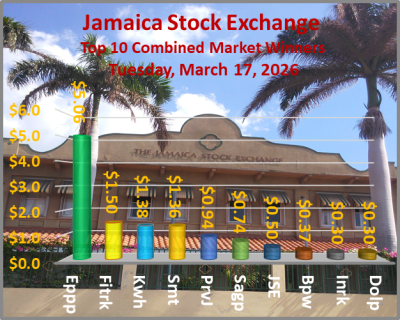 At the close of the market, the JSE Combined Market Index skidded 2,178.83 points to 353,358.94, the All Jamaican Composite Index dropped 2,623.06 points to end at 402,828.29, the JSE Main Index shed 2,170.93 points to finish at 343,903.06, the Junior Market Index fell 14.38 points to conclude trading at 3,417.38 and the JSE USD Market Index skidded 8.49 points to 279.93.
At the close of trading, 77,758,205 shares were exchanged in all three markets, up from just 18,672,192 units on Monday, with the value of stocks traded on the Junior and Main markets amounted to $1.08 billion, up from a mere $94.9 million on the previous day. The JSE USD market closed with an exchange of 124,111 shares for US$19,989, down sharply from 1,213,201 units at US$898,871 on Monday.
In Main Market activity, NCB Financial led trading with 22.28 million shares followed by Transjamaican Highway with 2.51 million stocks and Wigton Energy was next with 1.11 million units.
In Junior Market trading, newly listed, Woodcats International led with 32.52 million shares followed by Kintyre Holdings with 9.78 million stocks and Future Energy with 1.64 million units.
In the preference segment, Jamaica Public Service 7% popped $4.94 to $43, 138 Student Living preference share advanced $5 to $197 and Sygnus Credit Investments 10% rose $2 in closing at $107.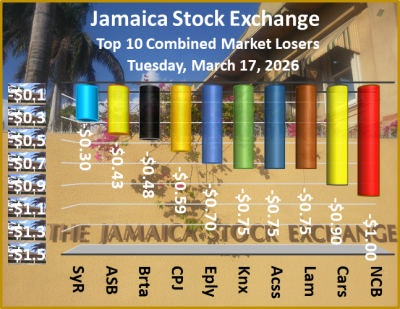 At the close of the market, the market’s PE ratio averaged 14.9, is computed using projected 2026-27 earnings and 15.9 based on 2025 historical earnings, excluding any major one-time income or expense. The PE ratio is one of the most popular measures for valuing shares and is calculated by dividing the stock price by the company’s earnings per share. The ICInsider.com PE ratio chart and the more detailed daily charts provide investors with regularly updated information to assist decision-making. The PE ratio chart includes all ordinary shares listed on the Jamaica Stock Exchange, grouped by industry, with easy comparisons within sectors and the overall market.
Pertinent information is needed to navigate the numerous options in the stock market. The chart should be used in decision-making, especially when investing around the sector average, and not going too far from it unless compelling reasons exist. This approach reduces emotion from investment decisions and places them on fundamentals, without straying far from the majority of investors. Investors who buy stocks near the average will not be inclined to overpay. The net asset value of each company is incorporated into the chart.  Investors can use this measure in assessing stock values. The chart also shows daily changes in stock prices and percentage year to date price movements based on the last traded price. Dividends that are paid or due to be paid and yields for each company are shown in the Main and Junior Markets’ daily report charts, along with the closing volume of the highest bid and the lowest offer for each company.
 The Montego Bay airport processed 274,500 incoming and outgoing passengers, down by 31.4 percent from 400,100 in 2025, representing a 17 percent improvement over the 37.7 percent decline for January. For the year to date, traffic dropped 34.7 percent to 559,000 from 856,300 in the prior year.
 Bank of Jamaica announced that, effective 24 February 2026, the rate offered on overnight balances on the current accounts of deposit-taking institutions, the policy rate, will be reduced by 25 basis points from 5.75 percent per annum to 5.50 per cent per annum.
 This earlier-than-previously-anticipated return to target reflects a moderation of the Bank’s forecast for later (or second-round) price increases. In addition, private sector expectations of future inflation (inflation expectations), a key driver of headline inflation, are forecast to fall to normal levels over the near term. The current account of Jamaica’s balance of payments is, however, projected to record higher deficits over the near term as the economy rebuilds from the Hurricane Melissa fallout, but the international reserves remain healthy and are projected to improve further. The forecast also considers the direct impact of the recently announced tax package.

 November’s 2.4 percent monthly rise was the highest since September 2013, with 2.8 percent and matched the August 2024 increase following Hurricane Beryl. Hurricane Melissa, which struck on October 28, severely disrupted agricultural production and infrastructure. Food prices surged 6.0 percent in November, with vegetables, tubers, and plantains jumping 19.1 percent, while fruits and nuts increased 8.8 percent. Inflation in this category, in December climbed at a much slower pace of 2.1 percent, with vegetables, tubers, and plantains jumping 4.5 percent, while fruits and nuts increased 5.6 percent.
 Trading in the stock was halted, with 225,000 shares on offer at $10. There are minor bids in the nine-dollar region, the highest at $9.60. At $10, the stock is highly overvalued at a PE of 200. This is not going to end well for several investors.
 The country recorded 12 murders through January 10 versus 34 in the corresponding 2025 period, a dramatic continuation of the 2025 decline that produced 673 murders, the lowest in nearly three decades.
 The 2025 increase is just above the average of US$631 million from 2021 to 2025, but less than the 2024 increase of $836 million, and 2023, with net inflows of US$770 million.
 There is something completely wrong with this listing. The stock is currently trading at a PE of 51 based on 2024 earnings adjusted for a one off expense, with very little supply coming on the market. Since listing, only 16,003 shares have traded to date, with the stock in heavy buying demand.